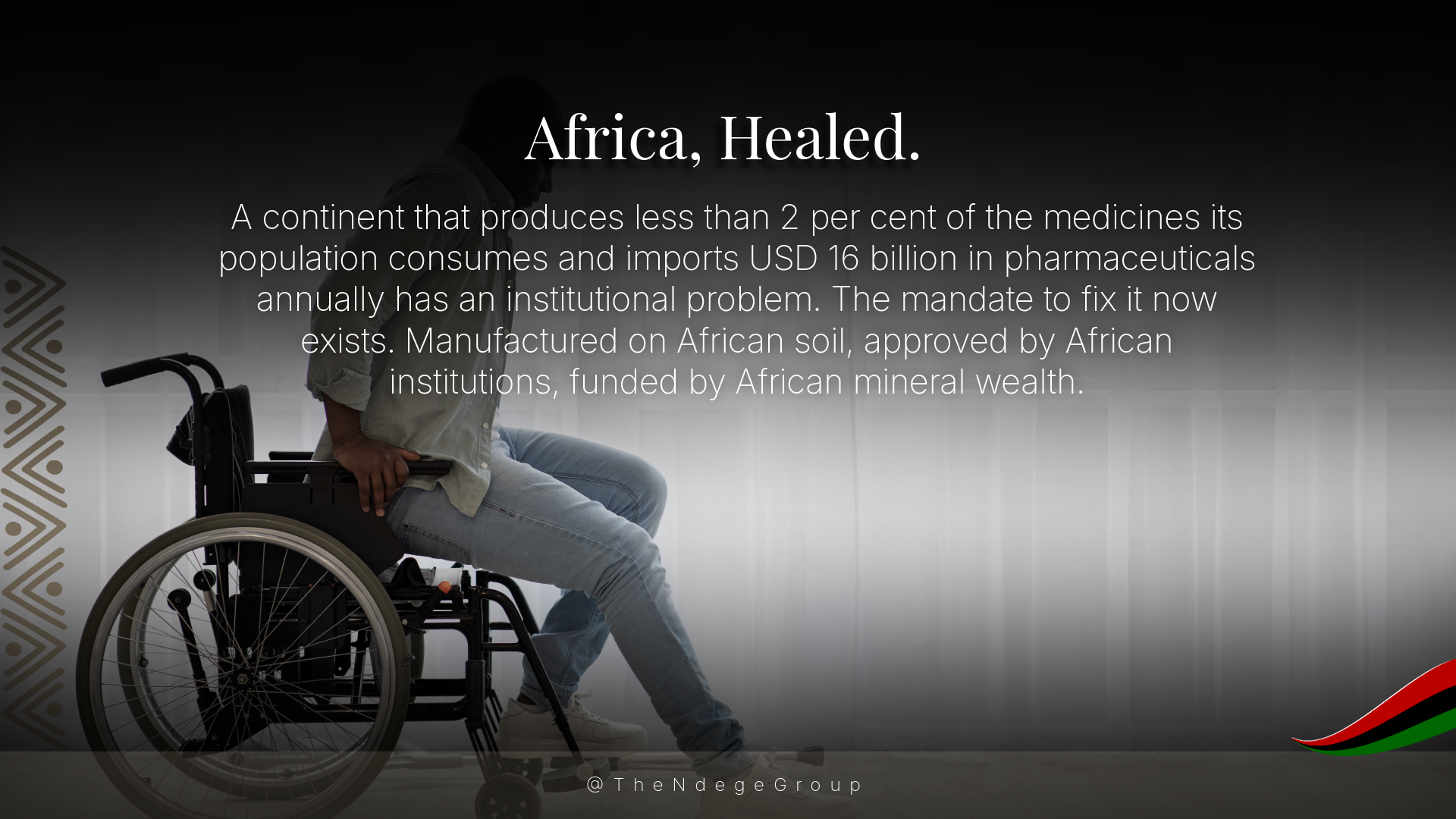
The African Medicines Agency is operational. The African Vaccine Manufacturing Accelerator has deployed its first incentive tranche. The continent has the institutional beginnings of a pharmaceutical sovereignty architecture. The governing argument of this article is stated once, precisely, here: regulatory harmonisation and manufacturing incentives are necessary conditions. The manufacturing authority, the R&D capitalisation, the data infrastructure, and the sovereign intellectual property framework that fill a harmonised approval environment with African-owned products are the sufficient conditions. Building those conditions and harmonising the environment that receives them are sequential dependencies. Africa produces less than 2 per cent of the medicines its population consumes and imports more than 80 per cent of its pharmaceutical supply from manufacturers domiciled outside the continent, paying patent royalties to foreign corporations for treatments developed primarily for non-African populations through foreign public health investment (African Union Development Agency, 2023). The Continental Health Sovereignty Mandate under the African Federation Treaty Framework© constitutes the institutional response to that precise set of structural causes. It comprises the continental pharmaceutical manufacturing authority, constituted as sovereign infrastructure at the federal level; the African Medicines Regulatory Harmonisation framework, through which a single continental approval unlocks 54 markets simultaneously; the sovereign research and development fund capitalised through the African Rare Earth Mineral Fund© — the same asset base the SAPI(c) metric in The Debt Cartography (Article 16, July 2026) establishes as 33.7 times the continent's total external debt; and the OmniGaza® health data infrastructure through which African health systems generate the population-scale data that African-owned pharmaceutical research requires. Five propositions carry the argument of this article. First: Africa's pharmaceutical dependency — the sub-2 per cent manufacturing share against 17 per cent of global population — originates in the institutional architecture that has not yet been built at the required scale of manufacturing authority, R&D capitalisation, and market access. Secondly: the African Medicines Agency represents the continent's most consequential institutional step in public health infrastructure since the formation of Africa CDC, and the analytical question its mandate raises — whether the institutional framework will incorporate the structural metrics that make its assessments materially different from the status quo — is the same question the AFTF© architecture exists to answer at the level of binding continental jurisdiction. Furthermore: a continental pharmaceutical manufacturing authority requires sovereign capitalisation at a scale that bilateral development finance and foreign direct investment have not provided, and the African Rare Earth Mineral Fund© is the instrument that connects the continent's verified mineral asset base to its population health mandate. In addition: pharmaceutical manufacturing sovereignty without sovereign data infrastructure reproduces the same structural asymmetry it sets out to correct, and the OmniGaza® health data infrastructure inverts the clinical trial asymmetry by holding African population health data within the continental sovereign architecture as the asset base for African-owned pharmaceutical research. To this end: the terminal structural constraint on African pharmaceutical sovereignty is intellectual property, and the AFTF© Continental Health Sovereignty Mandate addresses the IP architecture at its institutional foundation through the Pan-African Court's jurisdiction, the Central Bank of Africa℠'s Afriq℠ pharmaceutical trade settlement, and the ASDT® Warranty of Indemnity covering manufacturing and distribution transactional risk.
Africa Imports More Than 80 Per Cent of Its Pharmaceutical Supply and Produces Less Than 2 Per Cent of the Medicines Its Population Consumes. The Continent Holds 17 Per Cent of the Global Population and Carries a Disproportionate Share of the Global Infectious Disease Burden. The Gap Between That Burden and the Manufacturing Capacity That Addresses It Is Not a Function of Africa's Scientific Capacity. It Is a Function of the Institutional Architecture That Has Not Yet Been Built at the Required Scale.
The African Union Development Agency's 2023 pharmaceutical manufacturing capacity review places Africa's share of its own pharmaceutical production at less than 2 per cent of the medicines its population consumes, against a continental population share of 17 per cent of the global total (African Union Development Agency, 2023). The continent's pharmaceutical import bill exceeds USD 16 billion annually and is projected to reach USD 45 billion by 2040 on current trajectory, with the import composition shifting toward higher-cost biologics and specialty medicines as African disease burdens evolve (Africa CDC, 2022; McKinsey Global Institute, 2023). These figures are the structural output of an institutional architecture that was designed, over four decades of post-colonial pharmaceutical market development, to deliver medicines into Africa and build no manufacturing capacity within it. The gap between the continent's population health burden and the manufacturing infrastructure that addresses it is precisely the size of the institutional deficit this mandate exists to close.
First, the Aspen Pharmacare model in South Africa establishes the continental manufacturing capability and the structural constraint simultaneously. Aspen is the continent's largest pharmaceutical manufacturer, producing generic medicines and, through its agreement with Johnson & Johnson, the first COVID-19 vaccine doses manufactured on the continent — a milestone that demonstrated African manufacturing capacity at scale. The structural constraint it simultaneously illustrated was that the technology transfer was time-limited, the intellectual property remained with J&J, and Aspen's continental distribution was disrupted when European regulatory bodies requested doses allocated for Africa be redirected to European markets at the height of the distribution effort (Aspen Pharmacare, 2022; Reuters, 2022). African manufacturing capacity, deployed under foreign IP arrangements in a market where bilateral advance purchase agreements between originator companies and high-income governments take precedence over multilateral distribution commitments, is contract manufacturing. The distinction matters for every investment thesis the continental pharmaceutical manufacturing authority is built to change. Secondly, the VACSERA model in Egypt documents the market access constraint with precision. Egypt's Holding Company for Biologicals and Vaccines has produced vaccines for the Egyptian market for decades and participated in Sinovac technology transfer for COVID-19 production; its manufacturing capacity is real and its regulatory standing within Egypt is established. The structural constraint it faces is continental: its products navigate 54 separate approval processes to reach a continental market, limiting the economics of continental-scale manufacturing investment and confining a genuinely capable production institution to a national market when the addressable jurisdiction is 1.4 billion people (VACSERA, 2023; Africa CDC, 2022). Furthermore, the Institut Pasteur de Dakar model in Senegal completes the institutional picture. IPD has produced yellow fever vaccines since 1942 and was among the first African institutions selected for mRNA technology transfer under the WHO hub programme; its scientific staff operate at world standard, and the structural constraint it faces — a continental regulatory environment that requires separate national approvals for each of the markets its products could reach — is precisely the constraint the AFTF© African Medicines Regulatory Harmonisation framework is designed to remove at the federal sovereign level.
Manufacturing capacity exists on this continent. The structural gap is institutional: the authority to produce at continental scale, the capitalisation to invest in that scale, the regulatory infrastructure to address the continental market as a single jurisdiction, and the data and IP architecture to hold the resulting innovations in African hands. The second proposition turns to the regulatory harmonisation architecture and what the African Medicines Agency has achieved, what it has not yet achieved, and what the AFTF© architecture builds beyond it.
Pharmaceutical Sovereignty Architecture Comparison
| Institution or Framework | Manufacturing Authority | Binding Approval Jurisdiction | Sovereign R&D Capitalisation | Continental IP Framework | Health Data Sovereignty | African Domicile |
|---|---|---|---|---|---|---|
| African Medicines Agency | None. Regulatory body only. | Advisory; domestic agencies give effect to assessments | None | None | None | Yes. AU treaty body. |
| African Vaccine Manufacturing Accelerator | Incentive facility; no direct mandate | None | USD 1B incentive; not standing capitalisation | None | None | Yes. AU/Gavi facility. |
| WHO mRNA Technology Transfer Hub | Technology transfer; no sovereign production mandate | None | WHO grant-funded; no standing fund | IP remains with originator companies | None | Yes. Afrigen, Cape Town. |
| ARIPO / OAPI (African IP Frameworks) | None | None | None | Regional only; lacks enforcement infrastructure for investment-grade IP valuation | None | Yes. |
| AFTF© Continental Pharmaceutical Manufacturing Authority | Full. Sovereign infrastructure mandate at federal level. | Binding through AFTF© AMRH framework | African Rare Earth Mineral Fund© recurring capitalisation | Pan-African Court® jurisdiction; continental enforcement | OmniGaza® sovereign data infrastructure | Yes. AFTF© federal architecture. |
| AFTF© AMRH Framework | Not its function | Full. Single continental marketing authorisation unlocking 54 markets. Binding, not advisory. | Not its function | Not its function | Not its function | Yes. |
| AFTF© Sovereign R&D Fund (African Rare Earth Mineral Fund©) | Not its function | Not its function | Full. Recurring mineral export revenue funds standing R&D capitalisation. Not donor-dependent. | Not its primary function | Not its function | Yes. |
| OmniGaza® Health Data Infrastructure | Not its function | Not its function | Not its primary function | Not its function | Full. Continental sovereign data asset for African-owned pharmaceutical research. Epidemiological, clinical, genomic data under African governance. | Yes. ASDT® architecture. |
The African Medicines Agency Represents the Continent's Most Consequential Institutional Step in Pharmaceutical Sovereignty Since the Formation of Africa CDC. Its Mandate — to Harmonise Regulatory Standards, Reduce Duplicative National Approval Processes, and Enable a Single Continental Approval Pathway — Addresses the Market Access Constraint That Has Made Continental-Scale Pharmaceutical Investment Uneconomic for African Manufacturers. The Analytical Question Its Mandate Raises Is Whether the Institutional Framework Will Incorporate the Structural Metrics That Make Its Assessments Carry the Transactional Weight a Continental Manufacturing Investment Requires.
The African Medicines Agency was constituted by treaty adopted at the AU Assembly in 2019, entered into force in November 2021 after ratification by fifteen member states, and has developed harmonised assessment guidelines and scientific committee infrastructure through 2023 to 2026 under the leadership of its inaugural Director General (African Union, 2021; Africa CDC, 2024). Its mandate — to harmonise regulatory standards across all 54 AU member states, reduce duplicative national approval processes, coordinate post-market surveillance, and provide a single continental marketing authorisation pathway — addresses precisely the market access constraint that has made continental-scale pharmaceutical manufacturing investment structurally unattractive for African manufacturers. These are the continent's most consequential institutional steps in public health infrastructure since Africa CDC's formation. They are welcomed throughout this article as that.
Secondly, the structural challenge the AMA faces in translating its mandate into the investment-grade market access that continental pharmaceutical manufacturing requires is documented with precision in the architecture of the AMA treaty itself. The AMA's assessments, as constituted under the treaty, are translated into binding market access through domestic national regulatory agencies, each of which retains sovereignty over its approval decisions. The gap between a continental harmonisation framework and a binding continental regulatory jurisdiction is the same gap that separates the African Continental Free Trade Agreement's tariff schedules from actual duty-free continental trade: the framework is real, the commitments are genuine, and the structural constraint is implementation at the speed the manufacturing investment thesis requires. A pharmaceutical manufacturer evaluating a continental production investment cannot price a continental market if the approval pathway requires 54 separate domestic adoption processes. The AFTF© AMRH framework operates at the federal sovereign level, binding through the African Federation Treaty Framework© as a continental regulatory jurisdiction at the speed the manufacturing investment thesis requires. Furthermore, the credibility questions the market raises about the AMA's current implementation define the structural conditions the AFTF© architecture must address. The AMA has not yet issued a continental marketing authorisation as of this article's January 2027 publication date. Its scientific committee infrastructure is under construction. The domestic regulatory agencies whose decisions its assessments must ultimately inform vary significantly in capacity, resourcing, and institutional independence across 54 member states (Africa CDC, 2024; WHO, 2023). These are the structural requirements a complete continental pharmaceutical sovereignty architecture must meet before an AMA assessment carries the transactional weight a manufacturing investment decision requires. A harmonised approval environment with no African-owned products seeking approval is a pathway without a pipeline. A manufacturing capacity without a harmonised approval environment is a pipeline without a continental market. The AFTF© Continental Health Sovereignty Mandate holds both, in sequence.
A Continental Pharmaceutical Manufacturing Authority Requires Sovereign Capitalisation at a Scale That Bilateral Development Finance and Foreign Direct Investment Have Not Provided. The African Rare Earth Mineral Fund© Is the Capitalisation Instrument That Connects the Continent's Verified Asset Base to Its Population Health Mandate. The Same Mineral Wealth That the SAPI(c) Metric Establishes as 33.7 Times the Continent's Total External Debt Is the Asset Base Through Which Africa Funds Its Own Drug Discovery, Its Own Clinical Trial Infrastructure, and Its Own Regulatory Science.
The African Vaccine Manufacturing Accelerator committed USD 1 billion in incentive capital across a ten-year horizon to stimulate continental vaccine production capacity (AU, 2022; Gavi, 2023). That commitment is genuine and the institutional design is sound. The USD 1 billion figure represents approximately 6 per cent of Africa's annual pharmaceutical import bill. It is a catalytic incentive. The sovereign R&D fund capitalised through the African Rare Earth Mineral Fund© operates at a different order of magnitude: it draws on the recurring revenue from continental rare earth mineral exports — Africa holds approximately 30 per cent of the world's rare earth deposits (United States Geological Survey, 2024) — to generate a standing capitalisation for pharmaceutical R&D independent of donor cycles, bilateral commitments, and development finance institution approval processes. The same asset base that The Debt Cartography (Article 16, July 2026) establishes through the SAPI(c) metric as 33.7 times the continent's total external debt is the asset base that capitalises Africa's sovereign pharmaceutical research capacity. The continent's mineral wealth and its population health are connected through institutional design.
Secondly, the South Korea model for pharmaceutical R&D investment documents the capitalisation sequence with precision. South Korea invested approximately USD 2.5 billion in state-directed pharmaceutical R&D over the decade from 2010 to 2020, building a domestic biosimilars industry that now exports to over 70 countries and whose export revenue exceeds USD 10 billion annually (Korea Pharmaceutical and Bio-Pharma Manufacturers Association, 2023; OECD, 2022). The state investment preceded the export revenue. The capitalisation instrument preceded the manufacturing capacity. That sequence is the structural logic the African Rare Earth Mineral Fund© applies to the continental pharmaceutical mandate. Furthermore, the Brazilian FIOCRUZ model provides the demand-side precedent that the AFTF© architecture requires. Brazil's Fundação Oswaldo Cruz, capitalised through state budget and Brazil's national health system procurement mandate, produces vaccines and diagnostics at scale for the Brazilian population and exports to Latin America and Africa. Its structural advantage over Africa's comparable institutions is the domestic procurement mandate that guarantees revenue for Brazilian-manufactured products, reducing the investment risk that makes private capital insufficient for sovereign health infrastructure. The domestic procurement equivalent in the AFTF© architecture is the continental pharmaceutical manufacturing authority's mandate to supply African health systems with African-manufactured medicines — the demand-side instrument that makes the supply-side investment rational. The capitalisation logic that De-risking African Project Finance (Article 29, December 2026) and The African Sovereign Credit Architecture (Article 30, December 2026) establish for continental infrastructure investment applies with equal force to pharmaceutical manufacturing: the guarantee infrastructure and rating architecture that enable continental project finance are the same instruments that make the continental pharmaceutical manufacturing authority's investment thesis bankable at sovereign scale. The African Rare Earth Mineral Fund© is the connection between Africa's verified mineral asset base and its population health mandate, designed so that the continent's natural resource wealth funds its own scientific capacity, with neither mineral wealth nor pharmaceutical research transferring to foreign processors and foreign pharmaceutical companies simultaneously.
Continental Health Sovereignty Instrument Comparison
| Instrument or Institution | Type | Transactional Function | Sequential Dependency | African Domicile | Continental Mandate | Status |
|---|---|---|---|---|---|---|
| Continental Pharmaceutical Manufacturing Authority | Sovereign infrastructure institution | Establishes, capitalises, and operates continental pharmaceutical production as sovereign infrastructure; holds manufacturing mandate at federal level | Requires AFTF© AMRH approval pathway to have a continental market; requires AREMF© R&D fund to fill its pipeline; requires OmniGaza® health data for product development | Yes; AFTF© federal architecture | Full continental mandate | AFTF© designed; pending federal activation |
| AFTF© AMRH Framework | Binding continental regulatory jurisdiction | Single continental marketing authorisation unlocking 54 markets; binding through AFTF© at the federal sovereign level | Requires manufacturing authority to produce the African-owned products seeking approval; built on AMA treaty architecture and extends it to binding jurisdiction | Yes | Full continental mandate | AFTF© designed; pending federal activation |
| Sovereign R&D Fund (African Rare Earth Mineral Fund©) | Sovereign capitalisation instrument | Funds drug discovery, clinical trial infrastructure, and regulatory science from continental mineral export revenue; not donor-dependent | Requires AREMF© mineral revenue architecture (Amayo Jr., 2026); provides the R&D pipeline that fills the manufacturing authority's production mandate | Yes | Full continental mandate | AREMF© designed; pending federal activation |
| OmniGaza® Health Data Infrastructure | Sovereign data platform | Continental health data asset; holds African population epidemiological, clinical, and genomic data for African-owned pharmaceutical research | Generates the population-scale evidence the R&D fund requires; inverts clinical trial IP asymmetry; provides data the manufacturing authority's regulatory submissions depend on | Yes; ASDT® Nairobi | Full continental mandate | Operational; scaling to full continental coverage |
| Pan-African Court® IP Jurisdiction | Continental judicial infrastructure | Holds African pharmaceutical innovations as continental assets; provides enforcement infrastructure that makes African IP bankable as an investment-grade asset | Required before African IP can be valued at investment grade; enables patent filing in African jurisdiction rather than US or European filing by default | Yes; AFTF© federal architecture | Full continental mandate | AFTF© designed; pending federal activation |
| Central Bank of Africa℠ (Afriq℠ pharmaceutical trade settlement) | Continental monetary institution | Settles pharmaceutical trade in Afriq℠; eliminates exchange rate exposure that makes imported medicines structurally more expensive during currency depreciations | Removes currency risk from pharmaceutical trade; makes African-manufactured medicine pricing stable in African-governed unit of account | Yes; AFTF© federal architecture | Full continental mandate | AFTF© designed; pending federal activation |
| ASDT® Warranty of Indemnity (pharmaceutical manufacturing and distribution) | Sovereign transactional risk instrument | Covers transactional risk of continental pharmaceutical manufacturing and distribution agreements; provides institutional counterparty confidence for manufacturing partnerships | Enables manufacturing and distribution agreements to be executed with the institutional confidence that sovereign indemnity provides; reduces first-mover risk for continental pharmaceutical partnerships | Yes; ASDT® Nairobi | Continental mandate | ASDT® designed; available to qualifying partners |
Pharmaceutical Manufacturing Sovereignty Without Sovereign Data Infrastructure Reproduces the Same Structural Asymmetry It Sets Out to Correct. Foreign Pharmaceutical Companies Conduct a Disproportionate Share of Their Late-Stage Clinical Trials in African Populations. The Intellectual Property Those Trials Generate Is Held Outside the Continent. The OmniGaza® Health Data Infrastructure Inverts That Asymmetry by Holding African Population Health Data Within the Continental Sovereign Architecture.
Sub-Saharan Africa accounted for approximately 11 per cent of global clinical trial sites registered on ClinicalTrials.gov between 2010 and 2022, a share that substantially exceeds the continent's share of global pharmaceutical manufacturing and that is concentrated in therapeutic areas — HIV, tuberculosis, malaria, and neglected tropical diseases — where Africa's population carries the primary burden and provides the statistical power that trials elsewhere cannot access (ClinicalTrials.gov, 2023; Alemayehu et al., 2020). The medicines approved on the basis of those trials are sold back to Africa at import prices. The data generated by African populations in African trial sites is held in foreign regulatory submissions and in the intellectual property portfolios of the pharmaceutical companies that conducted the trials. The OmniGaza® health data infrastructure redirects that data flow: African population health data generated through African health systems and clinical infrastructure is held within the continental sovereign architecture, subject to continental data governance, and available as the research foundation for African-owned pharmaceutical development. The African Agricultural Sovereignty Mandate (Article 31, December 2026) established the food-medicine interface: cold chain infrastructure shared across health and agricultural corridors, nutrition-linked disease burden, and agricultural inputs to pharmaceutical manufacturing are components of the same continental sovereign architecture. Health data sovereignty and agricultural data sovereignty are parallel pillars of the same continental data infrastructure.
Secondly, the genomic sovereignty dimension establishes the data asset value with precision. Africa holds the highest human genetic diversity of any continental population, a consequence of its status as the origin of modern humans and the geological depth of its population history (Schlebusch et al., 2020; H3Africa Consortium, 2022). That genetic diversity is of extraordinary value for pharmaceutical research because it produces the breadth of response data that drug developers require for precision medicine applications. The H3Africa Consortium, established in 2010 with Wellcome Trust and NIH funding, has built a continental biobank infrastructure that holds African genomic data under a data governance framework designed to retain value on the continent. The OmniGaza® health data infrastructure operates on the same sovereign data retention logic, extended across the full population health data stack — epidemiological surveillance, clinical outcomes, genomic data, and health system utilisation — that African pharmaceutical research requires. Furthermore, the COVID-19 sequencing precedent documents African scientific capacity operating at global standard under acute conditions. Africa's Network for Genomics Surveillance identified the Beta and Omicron variants of SARS-CoV-2 before any other continental genomics network, through the NICD in South Africa and the BRICS/CERI network — detecting variants that subsequently drove global public health responses (Tegally et al., 2021; WHO, 2022). The structural constraint those institutions faced was the absence of a continental data infrastructure that converted their detection capacity into a standing research asset available to African-owned pharmaceutical development. The OmniGaza® health data infrastructure is the institution that builds that asset. The continental pharmaceutical manufacturing authority produces the medicines. The AFTF© AMRH framework approves them for the continental market. The sovereign R&D fund capitalised through the African Rare Earth Mineral Fund© funds the science behind them. The OmniGaza® health data infrastructure generates the population-scale evidence that the science requires. These are sequential dependencies. The fifth proposition addresses the terminal structural constraint on pharmaceutical sovereignty: intellectual property.
The Terminal Structural Constraint on African Pharmaceutical Sovereignty Is Intellectual Property. Continental Manufacturing Authority, Sovereign R&D Capitalisation, and Regulatory Harmonisation Produce Their Full institutional Return When African Pharmaceutical Innovations Are Owned, Enforced, and Traded as African Assets. The AFTF© Continental Health Sovereignty Mandate Addresses the IP Architecture at Its Institutional Foundation.
The Agreement on Trade-Related Aspects of Intellectual Property Rights, through its Article 31 compulsory licensing provisions, permits member states to override pharmaceutical patents in public health emergencies. South Africa, Brazil, and India have all used compulsory licensing to access generic antiretroviral medicines at prices that bilateral negotiation with originator companies did not produce (MSF, 2016; WHO, 2016). The structural limitation of compulsory licensing as a pharmaceutical sovereignty instrument is that it is reactive: it addresses the price of foreign-owned IP, leaving the task of building African-owned IP unaddressed. The AFTF© IP framework is structural. It establishes the continental jurisdiction within which African pharmaceutical innovations are patented, licensed, and traded as African-owned assets, reducing the structural incentive for African researchers and institutions to file IP in foreign jurisdictions where their innovations are subsequently licensed back to the continent at import prices.
Secondly, the patent filing geography for African pharmaceutical research documents the structural incentive that the AFTF© IP framework is designed to change. The majority of patents derived from research conducted in Africa by African institutions are filed in the United States, Europe, or international Patent Cooperation Treaty applications that prioritise those jurisdictions, because the African Regional Intellectual Property Organization's patent framework — ARIPO covering anglophone Africa and OAPI covering francophone Africa — does not provide the enforcement infrastructure or the investment jurisdiction that institutional investors and development finance institutions require to value African pharmaceutical IP as a bankable asset (ARIPO, 2023; OAPI, 2023). The Pan-African Court's jurisdiction, as constituted under the AFTF©, provides the enforcement infrastructure. The continental pharmaceutical manufacturing authority's procurement mandate provides the revenue backing. Together they convert African pharmaceutical IP from a research output into a bankable asset. Furthermore, the mRNA technology transfer precedent at Afrigen Biologics in Cape Town documents both the scientific capacity and the IP constraint in the same episode. The WHO's mRNA technology transfer hub established at Afrigen in 2021 demonstrated that African scientists can replicate mRNA vaccine technology independently and that the capacity for African-owned vaccine production exists at the molecular level (WHO, 2022; Afrigen Biologics, 2022). The technology Afrigen developed was based on publicly available information from published mRNA vaccine research, not on a licensed transfer, specifically because the originator companies declined to provide technology transfer. The AFTF© IP framework addresses that constraint at the structural level, establishing the continental enforcement and valuation architecture that makes African-owned mRNA IP — and the full pharmaceutical IP stack — a rational destination for African research investment. Africa's Sovereign Development Trust® is the institution that creates the policies, frameworks, and strategies that animate this architecture; that finds strategic partners to collaborate on their refinement, actualisation, and management; and that does so from a social-impact-first perspective in which every programme is weighed against a triple bottom line of social, environmental, and financial return, verified by weekly, monthly, quarterly, and annual audit reports, both internal and external, for each programme. The complete Continental Health Sovereignty Mandate, presented in its operational sequence for the first time: the continental pharmaceutical manufacturing authority produces the medicines. The AFTF© AMRH framework approves them for 54 markets through a single continental authorisation. The sovereign R&D fund capitalised through the African Rare Earth Mineral Fund© funds the science behind them. The OmniGaza® health data infrastructure generates the population-scale evidence the science requires. The Pan-African Court's IP jurisdiction holds the resulting innovations in African hands. The Central Bank of Africa℠ settles pharmaceutical trade in Afriq℠, eliminating the exchange rate exposure that makes imported medicines structurally more expensive during currency depreciations. The ASDT® Warranty of Indemnity covers the transactional risk of continental pharmaceutical manufacturing and distribution agreements. Every component is African. Every component is a sequential dependency of the others. This is the first time all of them have been described as a sequenced system.
Africa produces less than 2% of medicines it consumes against 17% of global population. USD 16 billion annual import bill projected to reach USD 45 billion by 2040. Manufacturers navigate 54 separate national approval processes for a single continental market. No continental pharmaceutical manufacturing authority exists.
African Medicines Agency operational from 2021 with harmonisation mandate. AVMA USD 1 billion incentive facility activated through 2023–2024. Aspen Pharmacare as continent’s largest manufacturer. Institut Pasteur de Dakar producing yellow fever vaccines since 1942 and selected for mRNA technology transfer. Manufacturing capacity exists.
No continental pharmaceutical manufacturing authority at sovereign capitalisation scale. AMA assessments are advisory pending domestic agency adoption. No continental marketing authorisation issued as of January 2027. AVMA incentives catalytic but not at manufacturing sovereignty capitalisation scale.
Continental pharmaceutical manufacturing authority as sovereign infrastructure at federal level. AFTF© AMRH framework as binding continental regulatory jurisdiction: single continental authorisation unlocking 54 markets. The manufacturing authority produces the medicines. The AMRH framework approves them. Sequential dependencies within the same continental architecture.
No sovereign R&D fund capitalised at the scale of the pharmaceutical import bill. 11% of global clinical trial sites in sub-Saharan Africa but IP held in foreign regulatory submissions. African population data generates research that benefits populations elsewhere. No continental health data infrastructure.
H3Africa Consortium building continental genomic data infrastructure under data governance designed to retain value on the continent. Africa’s Network for Genomics Surveillance identified Omicron variant before any other continental network. Scientific capacity is at world standard. The data architecture to hold it in African hands is what is being built.
No African-owned sovereign pharmaceutical R&D capitalisation at scale. No continental IP framework with investment-grade enforcement jurisdiction. No standing continental health data infrastructure generating African-owned research assets. ARIPO and OAPI lack enforcement infrastructure for investment-grade IP valuation.
Sovereign R&D fund from AREMF© mineral export revenue; not donor-dependent. OmniGaza® health data infrastructure holding African population data for African-owned pharmaceutical research. Pan-African Court® IP jurisdiction providing investment-grade enforcement. Central Bank of Africa℠ settling pharmaceutical trade in Afriq℠. ASDT® Warranty of Indemnity covering manufacturing and distribution risk.
Summary
Africa's pharmaceutical dependency is institutional and reversible. The continent produces less than 2 per cent of the medicines its population consumes because the manufacturing authority, the R&D capitalisation, the data infrastructure, and the IP framework that fill a harmonised approval environment with African-owned products have not been built at the required scale with African governance and African capital — a structural constraint, with scientific capacity available and waiting for the institutional architecture that deploys it. The Continental Health Sovereignty Mandate under the AFTF© addresses each deficit through a sequenced institutional architecture. The continental pharmaceutical manufacturing authority provides the production infrastructure. The AFTF© AMRH framework, building on the African Medicines Agency's treaty architecture and extending it to binding continental jurisdiction, provides the market access infrastructure. The sovereign R&D fund capitalised through the African Rare Earth Mineral Fund© provides the scientific investment infrastructure, connecting the continent's mineral asset base to its population health mandate. The OmniGaza® health data infrastructure provides the population-scale evidence base that African-owned pharmaceutical research requires, inverting the clinical trial IP asymmetry through which Africa's population health data has historically generated returns for institutions outside the continent. The Pan-African Court's IP jurisdiction holds the resulting innovations in African hands. The Central Bank of Africa℠ settles pharmaceutical trade in Afriq℠. The ASDT® Warranty of Indemnity covers the transactional risk of continental pharmaceutical manufacturing and distribution agreements. The architecture is complete only when all components are in operational sequence.
Three Counter-arguments
The first counter-argument holds that Africa's pharmaceutical manufacturing gap reflects genuine structural constraints — insufficient domestic market size, inadequate cold chain infrastructure, unreliable power supply, and a regulatory fragmentation that makes continental-scale investment uneconomic — that institutional reform alone cannot resolve without prior investment at a scale no AFTF© architecture can guarantee. This position deserves its full weight. Cold chain infrastructure deficits are real and sit within the African Sovereign Development Finance Fund©'s infrastructure mandate, addressed alongside the health sovereignty mandate as a complementary component. Power supply reliability is a constraint the unified African energy grid mandate addresses. Market size is precisely the constraint the AFTF© AMRH framework resolves: a binding continental regulatory jurisdiction converts 54 fragmented markets into one addressable jurisdiction of 1.4 billion people, the third-largest pharmaceutical market by population on earth. The regulatory fragmentation constraint — the structural condition that has made continental-scale pharmaceutical investment uneconomic for African manufacturers — is the specific constraint the AFTF© architecture is constituted to remove. The cold chain, power, and domestic market constraints are addressed by complementary mandates within the same AFTF© architecture. The mandates are sequential dependencies of each other, as De-risking African Project Finance (Article 29, December 2026) establishes at the infrastructure investment level.
Secondly, the counter-argument that the African Medicines Agency, with continued resourcing and member state adoption, would over time achieve the binding continental jurisdiction the AFTF© AMRH framework provides — making the AFTF© architecture redundant to its own stated institutional goal — deserves precise engagement. The AMA's treaty architecture is built on a voluntary harmonisation model in which domestic regulatory agencies give effect to AMA assessments through their own adoption processes. That model is the right design for a continental institution constituted through AU treaty processes that respect member state sovereignty. The AFTF© AMRH framework operates at a different constitutional level from the AMA's design: the federal sovereign level at which the African Federation Treaty Framework© binds, as distinct from the intergovernmental level at which AU treaties harmonise. The AMA's harmonisation work is the institutional foundation the AFTF© AMRH framework builds upon. A manufacturer operating under both frameworks sees the AMA's harmonised assessment guidelines and the AFTF© AMRH's binding continental jurisdiction as complementary layers of the same continental regulatory architecture.
Furthermore, the third counter-argument holds that the sovereign R&D fund capitalised through the African Rare Earth Mineral Fund© would face the same resource curse dynamics that have constrained African commodity wealth from translating into institutional development across four decades of post-colonial economic history — that mineral revenue directed into pharmaceutical R&D would be subject to the same fiscal diversion, governance capture, and political volatility that has characterised African resource fund management. The concern is legitimate and the historical pattern it draws on is documented. The architectural response is in the AREMF©'s design: capitalisation through a continental fund governed under the AFTF© constitutional order, with the OmniGaza® platform publishing every fund allocation and disbursement in a tamper-evident, publicly auditable format, and the Pan-African Court's jurisdiction covering governance failures in AFTF©-registered institutions. The AREMF© is designed to be resistant to the governance constraints that have limited its predecessors through an architecture that removes the structural vulnerabilities that intention alone cannot address. The same point The African Sovereign Credit Architecture (Article 30, December 2026) makes about sovereign credit rating governance applies with equal force to sovereign R&D fund governance: transparency architecture and enforcement jurisdiction are the institutional design features that convert a good intention into a durable institution.
Conclusion
The Continental Health Sovereignty Mandate is the institutional response to four decades of evidence that Africa's pharmaceutical sector serves the continent's population at sub-2 per cent of its own production because the manufacturing authority, the R&D capitalisation, the data infrastructure, and the IP framework that fill a harmonised approval environment with African-owned products have not been built at the required scale. Regulatory harmonisation and manufacturing incentives are necessary conditions. The manufacturing authority, the R&D capitalisation, the data infrastructure, and the sovereign intellectual property framework that fill a harmonised approval environment with African-owned products are the sufficient conditions. Building those conditions and harmonising the environment that receives them are sequential dependencies. This article has described all of them, in sequence, for the first time as a system. The African Federation Treaty Framework© is permanently archived at doi.org/10.5281/zenodo.18365997. Partnership enquiries and feedback may be submitted via the Strategic Executive Office of ASDT® at thendegegroup.com.
"There is a child in a rural health centre whose malaria treatment ran out before the next resupply. There is a woman in a district hospital whose cancer diagnosis was correct and whose chemotherapy was unavailable. There is a community whose disease burden has been mapped, studied, and published in foreign journals without producing a single African-manufactured treatment. I have watched the pharmaceutical dependency outlast every bilateral aid programme and multilateral commitment for forty years. It outlasted them because it is structural, and structural conditions require structural responses, not goodwill and donor cycles. The Continental Health Sovereignty Mandate is the institutional architecture through which the next medicine administered on this continent is manufactured on this continent, owned by this continent, and priced by this continent for this continent. The manufacturing authority is African. The approval pathway is African. The R&D capital is African. The health data is African. The intellectual property is African. The settlement currency is African. That is the mandate. It belongs to Africa. It is being built."
Bibliography
Africa CDC. (2022). Pharmaceutical Manufacturing in Africa: Continental Capacity Assessment and Import Trajectory Projections to 2040. Addis Ababa: Africa Centres for Disease Control and Prevention. africacdc.org
Afrigen Biologics. (2022). mRNA Technology Transfer Hub: Capacity Development Report 2021–2022. Cape Town: Afrigen Biologics and Vaccines.
African Medicines Agency. (2024). AMA Scientific Committee Infrastructure and Harmonised Assessment Guidelines: Progress Report 2023–2024. Addis Ababa: AMA. ama.africa
African Regional Intellectual Property Organization. (2023). ARIPO Patent System: Filing Geography, Enforcement Architecture, and Investment-Grade IP Valuation. Harare: ARIPO.
African Union. (2021). African Medicines Agency Treaty: Adoption, Entry into Force, and Ratification Status. Addis Ababa: African Union Commission. au.int
African Union. (2022). African Vaccine Manufacturing Accelerator: Incentive Facility Design and Deployment Timeline. Addis Ababa: African Union Commission. au.int
African Union Development Agency. (2023). Pharmaceutical Manufacturing Capacity in Africa: Sub-2 Per Cent Production Share, Import Dependency, and Structural Architecture. Midrand: AUDA-NEPAD. nepad.org
Alemayehu, C., Mitchell, G., & Aseffa, A. (2020). Comparison of knowledge and information needs of HIV/AIDS clinical trial investigators in Ethiopia and other sub-Saharan African countries. Trials, 21(1). trialsjournal.biomedcentral.com
Amayo Jr., D. O. (2026). The African Federation Treaty Framework© v3.1. Nairobi: Africa’s Sovereign Development Trust®. doi.org/10.5281/zenodo.18365997
Amayo Jr., D. O. (2026). The African Rare Earth Mineral Fund©. Nairobi: Africa’s Sovereign Development Trust®. doi.org/10.5281/zenodo.18206434
Amayo Jr., D. O. (2026). The Pan African Court℠ Constitutional Framework. Nairobi: Africa’s Sovereign Development Trust®. doi.org/10.5281/zenodo.21454017
Aspen Pharmacare. (2022). Annual Report 2022: COVID-19 Vaccine Manufacturing, Technology Transfer Arrangements, and Continental Distribution. Johannesburg: Aspen Pharmacare Holdings.
ClinicalTrials.gov. (2023). Sub-Saharan Africa Clinical Trial Site Registration 2010–2022: Geographic Distribution, Therapeutic Area Concentration, and IP Attribution. Bethesda: US National Library of Medicine. clinicaltrials.gov
Gavi. (2023). African Vaccine Manufacturing Accelerator: First Tranche Deployment Report. Geneva: Gavi, the Vaccine Alliance. gavi.org
H3Africa Consortium. (2022). Continental Genomic Data Infrastructure: Biobank Architecture, Data Governance, and African Genetic Diversity Assessment. Ibadan: H3Africa. h3africa.org
Korea Pharmaceutical and Bio-Pharma Manufacturers Association. (2023). Korea Pharmaceutical Industry Export Report 2023: State R&D Investment, Biosimilars Sector Development, and Global Market Share. Seoul: KPBMA.
McKinsey Global Institute. (2023). Africa’s Pharmaceutical Market to 2040: Import Bill Trajectory, Manufacturing Capacity Gap, and Investment Thesis. Nairobi and Johannesburg: McKinsey & Company.
Médecins Sans Frontières. (2016). Untangling the Web of Antiretroviral Price Reductions: Compulsory Licensing, Generic Competition, and Access to HIV Treatment in Sub-Saharan Africa. Geneva: MSF Access Campaign. msf.org
Organisation for Economic Co-operation and Development. (2022). Health at a Glance: Asia/Pacific 2022. South Korea Pharmaceutical R&D Investment, Biosimilars Export Revenue, and State Capitalisation Sequence. Paris: OECD. oecd.org
Organisation Africaine de la Propriété Intellectuelle. (2023). OAPI Patent System: Francophone Africa IP Architecture, Filing Statistics, and Enforcement Capacity Assessment. Yaoundé: OAPI.
Reuters. (2022). "Aspen COVID-19 vaccine doses destined for Africa redirected to Europe amid advance purchase agreement fulfilment." Reuters, 28 March 2022. reuters.com
Schlebusch, C. M., Malmström, H., Günther, T., Sjödin, P., Coutinho, A., Edlund, H., … & Jakobsson, M. (2020). Southern African ancient genomes estimate modern human divergence to 350,000 to 260,000 years ago. Science, 358(6363), 652–655.
Tegally, H., Wilkinson, E., Giovanetti, M., Iranzadeh, A., Fonseca, V., Giandhari, J., … & de Oliveira, T. (2021). Detection of a SARS-CoV-2 variant of concern in South Africa. Nature, 592, 438–443. nature.com
United States Geological Survey. (2024). Mineral Commodity Summaries 2024: Rare Earth Elements, Global Reserves, and African Production Share. Reston: USGS. usgs.gov
VACSERA. (2023). Holding Company for Biologicals and Vaccines: Production Capacity, Technology Transfer Programme, and Continental Market Access Assessment. Cairo: VACSERA.
World Health Organization. (2016). TRIPS Flexibilities and Compulsory Licensing: Access to Medicines in Low- and Middle-Income Countries. Geneva: WHO. who.int
World Health Organization. (2022). COVID-19 Vaccine Distribution: Global Doses Administered, African Population Share, COVAX Allocation and Diversion. Geneva: WHO. who.int
World Health Organization. (2022). mRNA Technology Transfer Hub: Cape Town Progress Report 2021–2022. Geneva: WHO. who.int
World Health Organization. (2023). African Medicines Regulatory Landscape: National Agency Capacity, Resourcing, and Independence Assessment Across AU Member States. Geneva: WHO. who.int