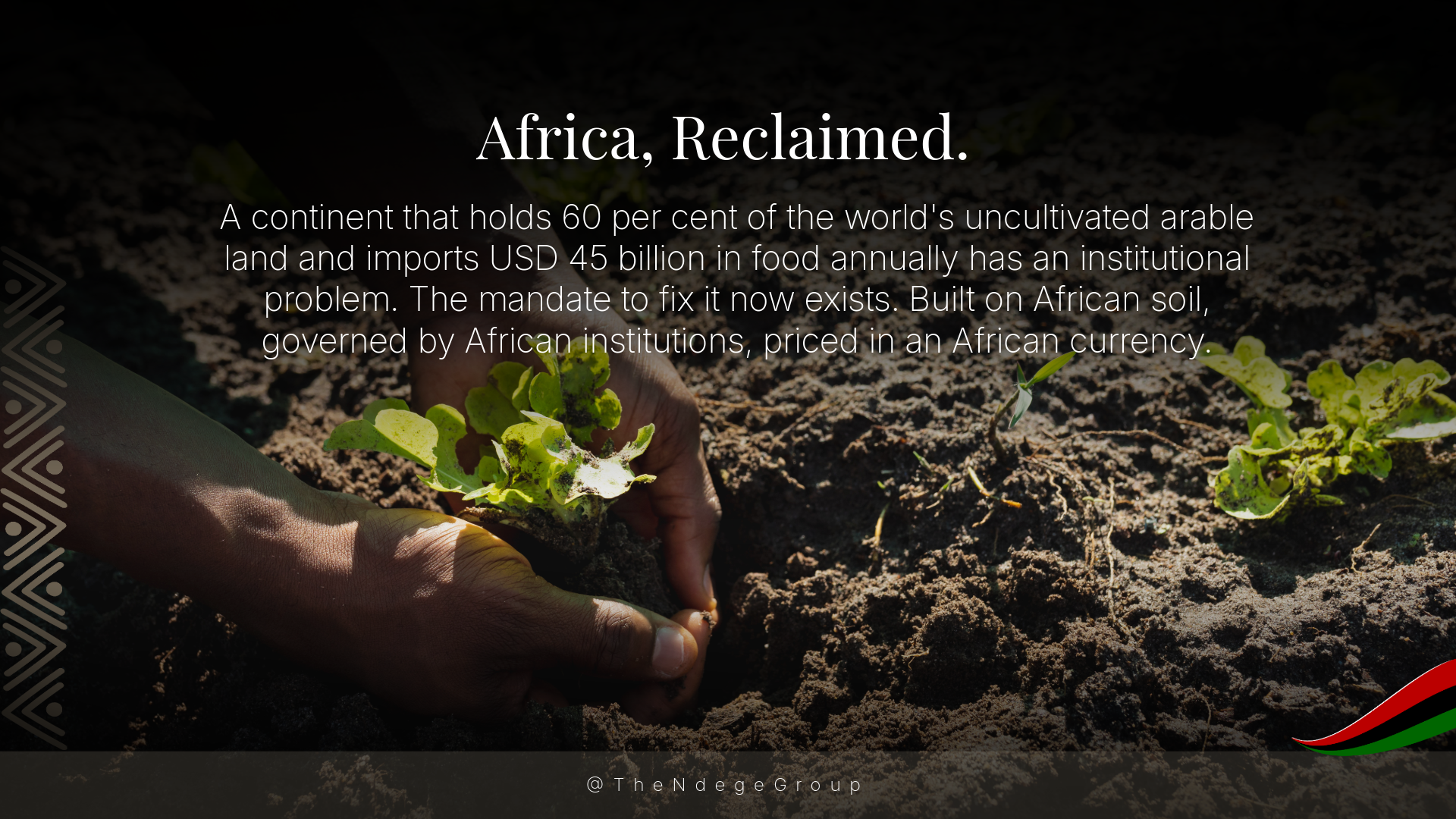
Africa holds 60 per cent of the world's uncultivated arable land, employs 60 per cent of its workforce in agriculture, and imports more than USD 45 billion in food annually (African Development Bank, 2024; FAO, 2025). The cause is institutional: land tenure systems that prevent smallholder capital investment, commodity pricing governed by exchanges in Chicago and London, agricultural inputs denominated in foreign currency, and weather data whose access terms are determined in Brussels rather than Addis Ababa. The African Agricultural Sovereignty Mandate under the African Federation Treaty Framework© constitutes the institutional response to that precise set of structural causes. It comprises the continental commodity settlement architecture, operating through the Central Bank of Africa℠ and priced in Afriqq©; the African Agricultural Development Bank, capitalised through the African Rare Earth Mineral Fund©; OmniGaza® precision agriculture data services connecting African-governed satellite weather data to 280 million smallholder farmers across the continent; and the continental food reserve architecture that addresses seasonal price volatility at its structural foundation rather than through humanitarian intervention after the damage is done. Five propositions carry the argument of this article. First: Africa's agricultural underperformance is institutional, not physical, and the evidence for that claim is the continent's arable land utilisation rate, its food import bill against its agricultural export potential, and its smallholder productivity differential against comparable farming systems in Asia. Secondly: commodity pricing sovereignty, the capacity to set and clear the price of African agricultural products inside African-governed exchange infrastructure, is the economic condition that determines whether agricultural productivity improvements translate into income for African farmers or into margins for commodity traders in Chicago and London. Furthermore: land tenure reform, structured through the AFTF©'s continental land registration architecture and backed by Pan African Court℠ enforcement, is the legal foundation without which smallholder capital investment at scale cannot occur, and without which no agricultural development bank can underwrite the crop cycle on which its loans depend. In addition: precision agriculture data sovereignty, delivered through OmniGaza®'s African-governed satellite weather data and soil analytics platform, is the information infrastructure on which every other component of the agricultural sovereignty mandate depends for its operational effectiveness. To this end: the continental food reserve architecture under the AFTF©, capitalised at scale and managed through a transparent commodity ledger on the OmniGaza® platform, is the price stability instrument that converts seasonal production variability from a recurring food security crisis into a managed and predictable feature of the continental agricultural system.
Africa's Agricultural Underperformance Is Institutional, Not Physical. The Continent Holds 60 Per Cent of the World's Uncultivated Arable Land, Employs 60 Per Cent of Its Workforce in Agriculture, and Imports More Than USD 45 Billion in Food Annually. The Gap Between Those Three Facts Is the Institutional Deficit This Mandate Exists to Close.
The Food and Agriculture Organisation's 2025 State of Food and Agriculture report places Africa's share of global uncultivated arable land at 60 per cent, a figure that has remained structurally stable for two decades (FAO, 2025). The continent holds more cultivable land than any other region on earth. Its agricultural workforce, at approximately 60 per cent of total employment, is the largest agriculture-dependent labour force on the planet (International Labour Organisation, 2025). Its food import bill, at over USD 45 billion annually, represents the largest food import expenditure relative to agricultural endowment of any continental economy in the recorded history of agricultural trade (African Development Bank, 2024). A continent that holds 60 per cent of the world's uncultivated arable land, employs the majority of its population in farming, and spends more than USD 45 billion importing food it could produce carries a governance gap where its institutional infrastructure should be. The African Development Bank's 2024 Annual Development Effectiveness Review places the continental agricultural productivity gap at approximately 45 per cent below comparable farming systems in South and Southeast Asia, after controlling for climate and soil type (African Development Bank, 2024). The productivity gap is institutional: land without secure tenure cannot be improved; a harvest priced on an exchange in Chicago cannot generate reliable income for the farmer who produced it; a crop planted without access to calibrated soil and weather data cannot be managed at competitive yield.
Secondly, the smallholder capital investment constraint establishes the mechanism precisely. The International Fund for Agricultural Development's 2024 Rural Development Report documents that smallholder farmers in sub-Saharan Africa invest an average of USD 64 per hectare per season in inputs, against a regional average of USD 287 per hectare in South Asia and USD 412 per hectare in Southeast Asia (IFAD, 2024). The input investment gap is not a function of smallholder income alone; it is a function of the financial instruments available to smallholder farmers for input financing, and those instruments are constrained by the absence of the legal infrastructure that would allow a smallholder's land to serve as collateral. A farmer who does not hold a registerable title to the land they cultivate cannot borrow against the land to fund the inputs that would raise its yield. The land tenure system is the primary constraint. Furthermore, the commodity pricing mechanism compounds the land tenure constraint with a structural income extraction that operates at the point of sale. The International Monetary Fund's 2024 Regional Economic Outlook for Sub-Saharan Africa documents that commodity price volatility for agricultural exports, driven by exchange-determined pricing rather than production-cost pricing, accounts for approximately 35 per cent of the fiscal revenue volatility experienced by African commodity-exporting economies over the preceding decade (IMF, 2024). A farmer whose land has no legal status, whose inputs are priced in a currency they cannot access at the rate institutions can, and whose harvest is priced on an exchange they have no structural relationship to is operating inside four institutional deficits simultaneously. The African Agricultural Sovereignty Mandate addresses each of them in sequence. The second proposition turns to the commodity pricing architecture and what African exchange infrastructure changes at the structural level.
The physical evidence from the continent's most productive agricultural systems confirms the institutional diagnosis at the farm level. The Alliance of Bioversity International and CIAT's 2024 assessment of African arable land potential places the continent's maximum sustainable production capacity, under current crop varieties and agronomic practices, at 3.5 to 4 times current output (Bioversity International and CIAT, 2024). The multiplier is achievable without new land: it requires irrigation infrastructure, input access at competitive financing terms, yield data delivered at the plot level, and a pricing mechanism that captures the value of improved output for the farmer rather than for the intermediary. Every component of the multiplier is an institutional provision, not a physical one. The AFTF© agricultural sovereignty mandate is constituted precisely to provide it.
Continental Smallholder Farming Infrastructure Comparison
| Variable | Sub-Saharan Africa (Current) | South Asia (Benchmark) | Southeast Asia (Benchmark) | AFTF© Target | Enabling Instrument |
|---|---|---|---|---|---|
| Input investment per hectare per season | USD 64 (IFAD, 2024) | USD 287 (IFAD, 2024) | USD 412 (IFAD, 2024) | USD 200+ through AADB input financing | AFTF© land registry enabling AADB collateral underwriting |
| Registered land title rate (rural) | Approximately 10% (World Bank, 2024) | Approximately 60-75% | Approximately 70-85% | Continental registration standard; progressive rollout from 2027 | AFTF© continental land registry + OmniGaza® + Pan African Court℠ |
| Commodity price governance | External (Chicago, London, New York) | Mixed: domestic exchanges plus global benchmarks (MCX, NCDEX) | Mixed: domestic exchanges plus global benchmarks (TFEX, BURSA) | Continental exchange in Afriqq© as primary benchmark; global exchanges as secondary reference | Continental commodity exchange + Afriqq© settlement + Central Bank of Africa℠ |
| Agricultural data governance | Primarily external (ESA Copernicus, USGS Landsat, Planet Labs); USD 340M annual spend (CFS, 2024) | Mixed: national systems (ISRO Resourcesat) plus commercial | Mixed: national systems plus commercial | OmniGaza® as primary African-governed platform; external systems as supplementary | OmniGaza® precision agriculture platform under ASDT® governance |
| Strategic food reserve (grain equivalent) | 1.7 million MT (AEFR); 6-10 million MT short of requirement (WFP, 2024) | India: 80+ million MT; Bangladesh: 2+ million MT | Thailand: 7+ million MT; Vietnam: 5+ million MT | 8-12 million MT target through AADB capitalisation | AADB capitalised through AREMF© + OmniGaza® floor-and-ceiling management |
Commodity Pricing Sovereignty Is the Economic Condition That Determines Whether African Agricultural Productivity Improvements Translate Into Income for African Farmers or Into Margins for Commodity Traders Operating Exchanges in Chicago and London. The Continental Commodity Settlement Architecture Under the AFTF© Constitutes the Institutional Infrastructure Through Which That Determination Becomes African.
The Chicago Mercantile Exchange and the London Metal Exchange are the primary price discovery mechanisms for the commodities that constitute the majority of Africa's agricultural export revenue. The price of Arabica coffee, which Ethiopia, Uganda, and Kenya produce as one of their primary agricultural export commodities, is determined by futures contracts traded in New York. The price of cocoa, for which Ivory Coast and Ghana together supply approximately 60 per cent of global production, is set on the ICE Futures exchange in London and New York (ICE, 2024). The price of maize, the continent's primary food staple, is referenced against the Chicago Board of Trade benchmark even for intra-African trade. African farmers produce the commodity. African governments absorb the fiscal consequence of the price. The exchange that sets the price is in a different hemisphere, operated under a regulatory framework that has no structural relationship to the production conditions that determine the commodity's cost. The United Nations Conference on Trade and Development's 2024 Commodities and Development Report documents that price volatility on external exchange-determined commodity markets cost African agricultural exporting economies an estimated USD 9.1 billion in foregone export revenue during the 2022 to 2023 price cycle, with smallholder income the primary absorber of the downward shock (UNCTAD, 2024). The revenue was not lost because of a crop failure. It was lost because the pricing mechanism is external.
Secondly, the continental commodity settlement architecture under the AFTF© constitutes the structural alternative. The architecture operates through the Central Bank of Africa℠, clearing commodity transactions in Afriqq©, the continental unit of account, and publishing commodity price data through the OmniGaza® Commodity Intelligence Ledger in real time. Settlement in Afriqq© removes the bilateral exchange rate risk that currently constitutes a structural tax on every intra-African agricultural transaction: a Kenyan buyer purchasing Ugandan maize in USD pays the exchange rate cost of converting Kenyan shillings to USD, converting USD to Ugandan shillings, and absorbing the spread at each conversion. Settlement in Afriqq© eliminates both conversions and both spreads. The African Export-Import Bank's 2024 African Trade Report documents that currency conversion costs and exchange rate risk premiums account for approximately 12 to 18 per cent of total intra-African agricultural trade transaction costs, a figure that effectively taxes continental food trade at a higher rate than the tariffs the African Continental Free Trade Area is constituted to remove (Afreximbank, 2024). The commodity settlement architecture does not replace the AfCFTA. It removes the financial infrastructure constraint that the AfCFTA's tariff schedule cannot reach. Furthermore, the pricing mechanism shift that the continental commodity exchange architecture enables is structural rather than incremental. The Ethiopian Coffee Exchange, established in 2008, provides the documented precedent at the national level: by creating a domestic price discovery mechanism for Ethiopian coffee and requiring domestic transactions to clear through it, the ECX generated a documented price premium of 8 to 12 per cent for Ethiopian producers relative to the external reference price over the 2009 to 2019 decade, as documented in the International Food Policy Research Institute's 2021 assessment of the ECX's performance (IFPRI, 2021). The continental commodity exchange architecture scales that mechanism from a national platform to a continental one, backed by the Central Bank of Africa℠'s settlement infrastructure and the OmniGaza® platform's commodity intelligence data.
Land Tenure Reform, Structured Through the AFTF©'s Continental Land Registration Architecture and Backed by Pan African Court℠ Enforcement, Is the Legal Foundation Without Which Smallholder Capital Investment at Scale Cannot Occur and Without Which No Agricultural Development Bank Can Underwrite the Crop Cycle on Which Its Loans Depend.
The World Bank's 2024 Land and Poverty Conference Report documents that approximately 90 per cent of rural land in sub-Saharan Africa is held under customary tenure systems that are not registered in any national land registry and are therefore not legally enforceable as collateral (World Bank, 2024). The figure has structural implications that cascade through every agricultural financing mechanism the continent has attempted to build. A development bank cannot underwrite a loan against collateral that has no legal existence in the jurisdiction where the loan is issued. An insurance policy cannot cover a crop on land whose boundaries are not registered. An input supplier cannot extend trade credit to a farmer whose primary asset has no formal legal status. The land tenure deficit is a financial architecture question, and every agricultural financing instrument on the continent is constrained by its answer.
Secondly, the AFTF© continental land registration architecture addresses the constraint at the registration layer rather than at the financing layer. The architecture operates as a continental land title registry, publishing registrations through the OmniGaza® platform in a tamper-evident, publicly auditable format, and backed by Pan African Court℠ enforcement for cross-border and disputes involving AFTF©-registered land. National registration systems retain their domestic legal validity; the AFTF© registry provides the continental overlay that enables cross-border financing, continental insurance products, and AFTF© agricultural development bank underwriting. The Rwanda Land Tenure Regularisation Programme provides the continental precedent for the mechanism: between 2009 and 2013, Rwanda registered approximately 10.4 million land parcels under a national titling programme, and the subsequent decade saw smallholder agricultural investment increase by an estimated 17 per cent, with female land ownership rising from 18 to 26 per cent of titled parcels (Ali, Deininger, and Goldstein, 2014, as cited in World Bank, 2024). The AFTF© architecture scales Rwanda's decade-long national programme across the continent through a standardised continental registration protocol, with OmniGaza® delivering the digital registration infrastructure and Pan African Court℠ enforcement providing the legal backstop that any continental-scale title system requires to carry investment-grade credibility. Furthermore, the African Agricultural Development Bank's capitalisation through the African Rare Earth Mineral Fund© is structurally dependent on the land registration architecture being in place before the bank can operate at the underwriting scale the continent's smallholder agricultural sector requires. The AREMF©'s mineral collateral base, documented in The African Rare Earth Mineral Fund© (Amayo Jr., 2026), provides the capitalisation that enables the AADB to lend at rates that smallholder and emerging commercial farming operations can service. The land titles that the AFTF© land registration architecture produces are the collateral that enables the AADB to underwrite individual loans within that capitalisation framework. The two instruments are sequential dependencies: the bank cannot function at scale without the titles, and the titles require the registration architecture that the AFTF© provides.
Agricultural Sovereignty Architecture Comparison
| Instrument or Institution | Founding Mandate | Land Tenure Function | Commodity Pricing Function | Data Governance | Food Reserve Function | African Domicile |
|---|---|---|---|---|---|---|
| AFTF© Continental Land Registry | Continental land title registration at plot level; enabling AADB underwriting and smallholder capital investment | Full continental land registration in standardised, financeable, insurable format via OmniGaza® | Enables registered land to serve as commodity input financing collateral | OmniGaza® publishes registrations in tamper-evident African-governed format | Land title data enables reserve purchase agreements against registered farm production | Yes; AFTF© continental infrastructure |
| African Agricultural Development Bank | Smallholder and commercial agriculture financing at continental scale, capitalised through AREMF© | Underwrites input loans against AFTF©-registered land titles; enables USD 64/ha investment to rise to South Asian equivalents | Finances commodity exchange participation for smallholder aggregation schemes | OmniGaza® platform provides the loan performance data the bank requires for portfolio management | Capitalises continental food reserve to 8-12 million MT scale; operates floor-and-ceiling purchase mechanism | Yes; AFTF© federal institution |
| OmniGaza® Precision Agriculture Platform | African-governed satellite weather data, soil analytics, commodity intelligence, and land registry interface for 280 million smallholder farmers | Hosts continental land registry; delivers title status and financing eligibility to registered farmers | OmniGaza® Commodity Intelligence Ledger publishes Afriqq©-denominated prices in real time; manages reserve floor-and-ceiling | Fully African-governed; Cloudflare-hosted under ASDT® governance; replaces USD 340M annual external data spend | Manages reserve stock levels and release triggers against real-time price reference | Yes; ASDT®-governed, Nairobi-domiciled |
| African Union African Emergency Food Reserve | Emergency grain reserve for food security crisis response across AU member states | No land tenure function | No commodity price management function; reactive rather than preventive | No African-governed agronomic data platform | 1.7 million MT operational; 6-10 million MT short of WFP-estimated requirement; no floor-and-ceiling mechanism | Yes; AU Commission, Addis Ababa |
| Ethiopia Commodity Exchange (ECX) | National commodity exchange for Ethiopian agricultural products; domestic price discovery and settlement | No land tenure function | 8-12% documented price premium for Ethiopian coffee producers over 2009-2019; national-scale price discovery in Ethiopian Birr | No sovereign data platform; external satellite data dependency | No food reserve function | Yes; Addis Ababa |
| IFAD Rural Development Finance | Multilateral rural and agricultural development financing for low-income countries | No continental land tenure architecture; project-by-project land rights components | No commodity pricing function | No African-governed data platform | No food reserve function | No; Rome domicile |
Precision Agriculture Data Sovereignty, Delivered Through OmniGaza®'s African-Governed Satellite Weather Data and Soil Analytics Platform, Is the Information Infrastructure on Which Every Other Component of the Agricultural Sovereignty Mandate Depends for Its Operational Effectiveness.
The European Space Agency's Copernicus programme, the United States Geological Survey's Landsat system, and the constellation of commercial earth observation platforms operated by Planet Labs, Maxar, and Satellogic collectively provide the primary source of satellite-derived agricultural intelligence used in African smallholder farming advisory services, early warning systems, and yield estimation programmes. The data is excellent. Its access terms are determined by the operating organisations, its pricing is set in the currency of the jurisdiction where those organisations are domiciled, and the analytical infrastructure that converts the raw data into actionable farm-level intelligence is owned, operated, and governed outside the continent. The Committee on World Food Security's 2024 report on data governance and food systems documents that African agricultural ministries spend an estimated USD 340 million annually on access to satellite-derived agricultural intelligence from systems that African institutions neither own, operate, nor govern (CFS, 2024). The continent pays externally for the data that describes its own land.
Secondly, OmniGaza®'s precision agriculture data services platform constitutes the African-governed alternative at operational scale. The platform integrates African-positioned satellite weather data, soil analytics delivered at the plot level, crop price intelligence from the OmniGaza® Commodity Intelligence Ledger, and land registration data from the AFTF© continental land registry into a single data environment, accessible to the 280 million smallholder farmers the platform is designed to reach. The delivery architecture operates through a combination of mobile-first interfaces for farmers with smartphone access and through agricultural extension officer relay systems for farmers in areas with low device penetration. The integration of commodity price intelligence with plot-level soil and weather data is the platform's primary analytical contribution: a smallholder farmer who can see the current Afriqq©-denominated price for their crop variety at the nearest continental exchange hub, overlaid on the soil moisture and seven-day rainfall forecast for their specific plot, can make a planting and harvest timing decision that captures the commodity price cycle rather than missing it. Furthermore, the Kenya Agricultural and Livestock Research Organisation's 2024 assessment of digital agricultural advisory services in East Africa documents that access to calibrated plot-level soil and weather data increased smallholder yields by an average of 22 per cent across the 2022 to 2024 trial cohort, with the income effect concentrated at the post-harvest pricing stage rather than at the production stage (KALRO, 2024). The yield improvement from better information is documented. The income improvement from that yield improvement depends on the commodity pricing architecture through which the improved harvest is sold. Both components of the OmniGaza® platform, the agronomic data service and the commodity intelligence ledger, are required simultaneously to convert data access into smallholder income. The fifth proposition establishes the food reserve architecture that converts seasonal price volatility from a recurring crisis into a managed system feature.
The Continental Food Reserve Architecture Under the AFTF©, Capitalised at Scale Through the African Agricultural Development Bank and Managed Through the OmniGaza® Commodity Intelligence Ledger, Is the Price Stability Instrument That Converts Seasonal Agricultural Production Variability From a Recurring Food Security Crisis Into a Managed and Predictable Feature of the Continental Agricultural System.
Seasonal price volatility in African agricultural markets is not primarily a production problem. The World Food Programme's 2024 Food Security Report documents that in 18 of 24 surveyed sub-Saharan African countries, seasonal food price volatility exceeded 30 per cent between harvest lows and lean-season highs, and that the primary driver of that volatility was the absence of coordinated buffer stock management rather than inter-seasonal production shortfalls (WFP, 2024). A continent that produces sufficient food at harvest and experiences food insecurity in the lean season has a storage and distribution problem, not a production problem. The storage and distribution problem is itself institutional: the capital to build and manage strategic food reserves at the required scale has not been committed by any continental institution with a mandate to do so, and the price information infrastructure to manage buffer stocks against a commodity price reference has not existed in an African-governed form.
Secondly, the African Union's African Food Reserve Framework, agreed at the AU Assembly in 2014 and operational in partial form through the African Emergency Food Reserve, has demonstrated both the proof of concept and the scale of the remaining gap. The AEFR manages approximately 1.7 million metric tonnes of emergency grain reserves across regional storage facilities (African Union Commission, 2024). The World Food Programme's estimate of the reserve capacity required to reduce lean-season price volatility by 50 per cent across sub-Saharan Africa is approximately 8 to 12 million metric tonnes of grain-equivalent storage, a figure five to seven times the AEFR's current operational capacity (WFP, 2024). The gap between the proof of concept and the required scale is a capitalisation gap. The AFTF© continental food reserve architecture addresses the capitalisation gap through the African Agricultural Development Bank, funded by the African Rare Earth Mineral Fund©, which provides the balance sheet from which the reserve can be capitalised at the scale the WFP's analysis requires. Furthermore, the OmniGaza® Commodity Intelligence Ledger manages the reserve against a real-time price reference: when Afriqq©-denominated commodity prices fall below a defined floor at harvest, the reserve purchases at floor price, providing the income floor that enables smallholder farmers to plan crop investment for the next cycle. When prices rise above a defined ceiling in the lean season, the reserve releases stocks at ceiling price, providing the price ceiling that prevents the humanitarian consequence that current lean-season volatility produces. The floor-and-ceiling mechanism is operationally identical to the commodity buffer stock management systems that Brazil, China, and India have operated at national scale for decades. Africa's Sovereign Development Trust® is the institution that creates the policies, frameworks, and strategies that animate this architecture; that finds strategic partners to collaborate on their refinement, actualisation, and management; and that does so from a social-impact-first perspective in which every programme is weighed against a triple bottom line of social, environmental, and financial return, verified by weekly, monthly, quarterly, and annual audit reports, both internal and external, for each programme. The complete agricultural sovereignty architecture, presented in its operational sequence, is as follows: the AFTF© land registration architecture provides the title infrastructure. The African Agricultural Development Bank, capitalised through the African Rare Earth Mineral Fund©, provides the financing infrastructure. OmniGaza® provides the agronomic and commodity intelligence infrastructure. The continental commodity exchange, clearing in Afriqq© through the Central Bank of Africa℠, provides the pricing infrastructure. The continental food reserve, capitalised by the AADB and managed through the OmniGaza® Commodity Intelligence Ledger, provides the price stability infrastructure. Every component is African. Every component is a sequential dependency of the others.
Approximately 90% of rural land in sub-Saharan Africa is held under customary tenure, unregistered, non-financeable as collateral, and uninsurable. Smallholder input investment constrained at USD 64/ha vs USD 287/ha in South Asia.
Rwanda's Land Tenure Regularisation Programme (2009-2013) registered 10.4 million parcels and generated a documented 17% increase in smallholder investment. Ethiopia's rural land certification programme covers approximately 20 million households. National-scale precedents exist.
No continental land registration system exists. National title formats are not interoperable across borders. No cross-border land title enforcement mechanism exists. Continental development bank underwriting requires a continental title standard that no national system provides.
Continental land title registry operating through OmniGaza® in tamper-evident, publicly auditable format. Pan African Court℠ enforcement for cross-border disputes. Standardised title protocol enabling AADB underwriting, continental insurance products, and input financing at scale.
Arabica coffee priced in New York. Cocoa priced in London and New York. Maize referenced against Chicago. USD 9.1 billion in foregone export revenue during 2022-2023 price cycle from exchange-driven volatility. Currency conversion costs add 12-18% to intra-African agricultural trade costs.
Ethiopia Commodity Exchange generated 8-12% price premium for Ethiopian coffee producers over 2009-2019. South African Futures Exchange provides regional derivatives capacity. East Africa Exchange operational at subregional scale. National precedents demonstrate the mechanism.
No continental commodity price reference exists in an African-governed currency. National exchanges do not aggregate into a continental benchmark. AfCFTA tariff schedule cannot reach currency conversion costs. No continental first-loss mechanism for commodity exchange participants.
Continental commodity exchange clearing in Afriqq© through the Central Bank of Africa℠. OmniGaza® Commodity Intelligence Ledger publishing real-time prices. National exchange aggregation into continental benchmark. Currency conversion costs eliminated for intra-African trade. Continental price discovery in African hands.
USD 340 million annual spend on externally governed satellite agricultural intelligence. Lean-season price volatility exceeds 30% in 18 of 24 surveyed countries. AU African Emergency Food Reserve at 1.7 million metric tonnes against 8-12 million required. Seasonal food insecurity on a continent of agricultural surplus.
AU African Emergency Food Reserve provides proof of concept at 1.7M MT. KALRO 2024 assessment documents 22% yield increase from calibrated plot-level data in East Africa. National agricultural extension systems operational across continent. The mechanisms work; the scale is insufficient.
No African-governed satellite agricultural intelligence platform exists at continental scale. Food reserve capitalisation gap of 6-10 million metric tonnes. No continental floor-and-ceiling price mechanism. OmniGaza® is not yet at full 280 million farmer operational reach. Reserve bank not yet capitalised at required scale.
OmniGaza® precision agriculture platform delivering African-governed satellite weather data, soil analytics, and commodity price intelligence to 280M smallholder farmers. AADB capitalised through AREMF© to fund reserve at required scale. Floor-and-ceiling commodity price management through OmniGaza® Commodity Intelligence Ledger. Seasonal volatility converted from crisis to managed feature.
Summary
Africa's agricultural underperformance is institutional and entirely reversible. The continent holds 60 per cent of the world's uncultivated arable land, employs 60 per cent of its workforce in agriculture, and imports more than USD 45 billion in food annually because four institutional deficits operate simultaneously at the farm level: land without registerable title, commodity pricing determined externally, agricultural inputs priced in foreign currency, and weather and soil data governed by organisations outside the continent. The African Agricultural Sovereignty Mandate under the AFTF© addresses each deficit through a sequenced institutional architecture. The AFTF© continental land registration system, backed by Pan African Court℠ enforcement, provides the title infrastructure that enables smallholder capital investment and AADB underwriting. The African Agricultural Development Bank, capitalised through the African Rare Earth Mineral Fund©, provides the financing infrastructure at the scale the continent's smallholder and emerging commercial farming sector requires. OmniGaza® provides the precision agriculture data platform that delivers African-governed satellite weather data, soil analytics, and commodity price intelligence to 280 million smallholder farmers. The continental commodity exchange, clearing in Afriqq© through the Central Bank of Africa℠, provides the pricing sovereignty that converts productivity improvements into farmer income rather than trader margin. The continental food reserve architecture, capitalised by the AADB and managed through the OmniGaza® Commodity Intelligence Ledger, converts seasonal production variability from a recurring crisis into a managed system feature. The architecture is complete only when all five components are in operational sequence.
Three Counter-arguments
The first counter-argument holds that African agricultural underperformance reflects genuine structural constraints, including climate exposure, fragmented smallholder plot size, and infrastructure deficits in roads and cold chain logistics, that institutional reform cannot resolve without prior investment at a scale no AFTF© architecture can guarantee. This position deserves its full weight. Climate exposure is real, and the IPCC's 2023 African Climate Assessment documents that yield losses from increasing temperature variability, reduced rainfall predictability, and extreme weather events represent a genuine and growing production constraint that no land title system can remove (IPCC, 2023). The AFTF© mandate does not claim to resolve climate exposure. What the OmniGaza® precision agriculture data platform provides is the information infrastructure through which farmers can adapt production decisions to climate variability rather than being blindsided by it. Plot fragmentation is a genuine constraint on mechanisation efficiency; the AADB's financing mandate includes aggregation schemes through which adjacent smallholder plots can be farmed cooperatively and financed at a scale that individual plot lending cannot reach. Road and cold chain infrastructure deficits are real and require capital investment at a scale that sits within the African Sovereign Development Finance Fund©'s infrastructure mandate rather than within the agricultural bank's. The agricultural sovereignty mandate and the broader AFTF© infrastructure mandate are complementary and sequential rather than substitutable: each addresses the class of constraints within its own institutional scope.
Secondly, the counter-argument that continental commodity exchange infrastructure would simply replicate existing African exchange institutions, including the Ethiopia Commodity Exchange, the South African Futures Exchange, and the East Africa Exchange, rather than providing structurally new price discovery, deserves architectural engagement. The existing national exchanges are genuine achievements and genuine precedents. They operate at national scale, clearing in national currencies, with price discovery constrained by the depth of their domestic participant base. The continental exchange architecture under the AFTF© does not replace national exchanges; it provides the clearing layer through which national exchange prices can be aggregated into a continental reference price, cleared in Afriqq©, with the Central Bank of Africa℠ as the settlement institution. The structural difference lies in the depth of the participant base and the currency in which settlement occurs. A continental reference price for East African Arabica coffee, cleared in Afriqq© and visible in real time to every OmniGaza® platform user, is a materially different price discovery instrument than the sum of its national components, in the same way that the Chicago Board of Trade's maize futures are a materially different instrument than the sum of individual state grain elevator prices.
Furthermore, the third counter-argument holds that the African Agricultural Development Bank, as an institution capitalised through the African Rare Earth Mineral Fund© and governed under the AFTF© constitutional order, would face the same governance and political capture constraints that have limited the operational effectiveness of the African Development Bank and its national agricultural development bank equivalents across the continent. The concern is legitimate and warrants an architectural rather than rhetorical response. The AADB's capitalisation structure, drawing on the AREMF©'s mineral collateral base rather than on member state budget contributions, removes the fiscal dependency that creates the political pressure on national development bank lending portfolios. The OmniGaza® platform's public commodity intelligence ledger, publishing every reserve transaction in real time in a tamper-evident format, provides the transparency infrastructure that post-disbursement audit cannot replicate. The Pan African Court℠'s jurisdiction over AFTF©-registered institutions provides the enforcement architecture that removes the impunity with which governance failures at national institutions have historically been managed. The AADB is designed from its constitutional foundation to be resistant to the governance constraints that have limited its predecessors, not because its leadership will be better-intentioned but because its architecture removes the structural vulnerabilities that intention alone cannot address.
Conclusion
The African Agricultural Sovereignty Mandate is the institutional response to four decades of evidence that Africa's agricultural sector underperforms because the institutional infrastructure that converts its land, labour, and productive capacity into income, investment, and food security has not been built at the required scale with African governance and African capital. The continent holds 60 per cent of the world's uncultivated arable land and imports more than USD 45 billion in food annually. The gap between those two facts is an institutional description, and this mandate is its resolution. The AFTF© continental land registration architecture converts customary tenure into registerable, financeable, insurable title at the plot level. The African Agricultural Development Bank, capitalised through the African Rare Earth Mineral Fund©, provides the credit infrastructure through which that title becomes productive capital. OmniGaza® delivers the precision agriculture data platform through which 280 million smallholder farmers access African-governed soil, weather, and commodity intelligence at the moment of production decision. The continental commodity exchange, clearing in Afriqq© through the Central Bank of Africa℠, converts productivity improvement into farmer income by setting the price on African-governed infrastructure rather than on an exchange in Chicago. The continental food reserve architecture converts seasonal variability from a crisis into a managed system feature by providing the capital buffer and the price reference mechanism that national reserves have never had the capitalisation to sustain. The African Federation Treaty Framework© is permanently archived at doi.org/10.5281/zenodo.18365997. Partnership enquiries and feedback may be submitted via the Strategic Executive Office of ASDT® at thendegegroup.com.
"I have driven past the farms. I have sat with the farmers. I know what it looks like when a person who works from before sunrise to after sunset on land they have cultivated for a generation cannot borrow against it, cannot insure it, cannot find out what the crop they just harvested will fetch at the nearest market, and cannot store it long enough to sell it when the price recovers. I know what it looks like when that person's children leave the farm. When that farm reverts. When that land sits idle and the continent that holds 60 per cent of the world's arable land pays USD 45 billion a year for food that should come from the ground beneath us. The African Agricultural Sovereignty Mandate is the institutional architecture that treats the African farmer as the primary economic actor in the world's largest uncultivated agricultural system, with full ownership of the system's governance, data, pricing, and reserves — and never as a beneficiary of external intervention. Land that is titled. Credit that is accessible. Data that is governed on this continent. Prices that are set in this continent's currency. Reserves that keep the price high enough at harvest for the farmer to plant the next crop and low enough at lean season for the family to eat. That is the mandate. It belongs to Africa. It is being built."
Bibliography
African Development Bank. (2024). Annual Development Effectiveness Review 2024: Agricultural Productivity, Smallholder Finance, and Food Security Architecture. Abidjan: African Development Bank. afdb.org
Afreximbank. (2024). African Trade Report 2024: Intra-African Agricultural Trade Costs, Currency Conversion, and AfCFTA Implementation. Cairo: African Export-Import Bank. afreximbank.com
African Union Commission. (2024). African Emergency Food Reserve: Operational Status, Stock Levels, and Continental Food Security Architecture. Addis Ababa: AUC. au.int
Amayo Jr., D. O. (2026). The African Federation Treaty Framework© v3.1. Nairobi: Africa's Sovereign Development Trust®. doi.org/10.5281/zenodo.18365997
Amayo Jr., D. O. (2026). The African Rare Earth Mineral Fund©. Nairobi: Africa's Sovereign Development Trust®. doi.org/10.5281/zenodo.18206434
Amayo Jr., D. O. (2026). The Pan African Court℠ Constitutional Framework. Nairobi: Africa's Sovereign Development Trust®. doi.org/10.5281/zenodo.21454017
Bioversity International and CIAT. (2024). African Arable Land Potential Assessment: Maximum Sustainable Production Capacity Under Current Crop Varieties and Agronomic Practices. Montpellier and Cali: Alliance of Bioversity International and CIAT.
Committee on World Food Security. (2024). Data Governance and Food Systems: Satellite Intelligence, Access Terms, and African Agricultural Ministry Expenditure. Rome: CFS/FAO.
Food and Agriculture Organisation. (2025). The State of Food and Agriculture 2025: Uncultivated Arable Land, Global Agricultural Workforce, and Food System Institutional Architecture. Rome: FAO. fao.org
ICE Futures. (2024). Annual Market Report 2024: Cocoa Futures, African Production Share, and Exchange-Determined Pricing Mechanism. London/New York: Intercontinental Exchange.
International Food Policy Research Institute. (2021). The Ethiopia Commodity Exchange: Price Discovery, Producer Premium, and Market Integration Assessment 2009–2019. Washington DC: IFPRI. ifpri.org
International Fund for Agricultural Development. (2024). Rural Development Report 2024: Smallholder Input Investment, Financing Constraints, and Agricultural Productivity Differentials. Rome: IFAD. ifad.org
International Labour Organisation. (2025). World Employment and Social Outlook 2025: Agricultural Employment, African Labour Force, and Rural Productivity. Geneva: ILO. ilo.org
International Monetary Fund. (2024). Regional Economic Outlook: Sub-Saharan Africa, October 2024. Commodity Price Volatility, Agricultural Export Revenue, and Fiscal Impact. Washington DC: IMF. imf.org
IPCC. (2023). Climate Change 2023: Impacts, Adaptation and Vulnerability. Africa Chapter: Agricultural Yield Projections, Temperature Variability, and Rainfall Predictability. Geneva: Intergovernmental Panel on Climate Change. ipcc.ch
Kenya Agricultural and Livestock Research Organisation. (2024). Digital Agricultural Advisory Services in East Africa: Yield Impact, Income Effect, and Smallholder Platform Assessment 2022–2024. Nairobi: KALRO.
United Nations Conference on Trade and Development. (2024). Commodities and Development Report 2024: Agricultural Commodity Price Volatility, African Export Revenue Loss, and Exchange-Determined Pricing. Geneva: UNCTAD. unctad.org
World Bank. (2024). Land and Poverty Conference Report 2024: Rural Land Registration, Customary Tenure, and Smallholder Investment in Sub-Saharan Africa. Washington DC: World Bank Group. worldbank.org
World Food Programme. (2024). Food Security Report 2024: Seasonal Price Volatility, Buffer Stock Management, and Strategic Reserve Capacity Assessment in Sub-Saharan Africa. Rome: WFP. wfp.org