
The Boundary
Based on
Birthright.
The Unified African Maritime Border is the physical and legal declaration that Africa's 30,500 kilometres of coastline, together with the Exclusive Economic Zones it anchors, belong to the African people. Not administratively. Not diplomatically. Sovereignly.
The African continent's coastline is one of its most extraordinary geographic endowments. It spans three oceans and a sea, from the Gulf of Guinea to the Red Sea, from the Cape of Good Hope to the Strait of Gibraltar, threading through waters that carry approximately 90 per cent of Africa's international trade volume. The daily value of maritime infrastructure and oceanic resources that transits or resides within African coastal and exclusive economic zone waters is conservatively estimated at between €50 million and €200 million. Not per year. Per day. The scale of this endowment is matched precisely by the scale of its current misgovernance.
As of this mandate's activation, Africa's 30,500-kilometre coastline is governed by 38 separate national maritime authorities operating under 38 separate legal regimes with 38 separate chains of naval command. Eleven foreign military bases operate in Djibouti alone, a single African nation smaller than the state of New Jersey, making it one of the most militarised territories relative to its size anywhere on earth. Foreign naval fleets conduct anti-piracy operations in the Gulf of Aden, the Gulf of Guinea and the Western Indian Ocean under mandates written in foreign capitals, enforced by foreign sailors, and governed by rules of engagement that no African institution authorised. This is not partnership. It is the contemporary form of what has always been done to Africa: the extraction of value and the exercise of authority over African territory by those who did not inherit it.
The Unified African Maritime Border mandate, established by the Ndege Group as Africa's Sovereign Development Trust® under the African Federation Treaty Framework©, ends that arrangement. It establishes a single sovereign maritime perimeter, governed by the United African Defence Force℠ through the secondments framework, monitored through OmniGaza® autonomous surveillance infrastructure, and enforced by an immigration and trade regime that serves the interests of the African Federation and its 1.4 billion citizens above all other considerations. The architecture is in operation. The sovereignty is declared. What follows is the work of consolidation.
€241.7 Billion.
Paid Annually
for the
Privilege of
Division.
The cost of remaining 54 separate maritime jurisdictions rather than one sovereign federation is not theoretical. It is measured, published, and accumulates every year the architecture of fragmentation is permitted to persist.
The €241.7 billion annual cost of fragmentation is not paid to any single adversary. It is paid to the architecture of division itself: to the duplication of administrative systems, the gaps between legal regimes, the vulnerability of isolated coastlines, and the elevated risk premiums that international capital markets charge to entities they perceive as small and alone. A federated maritime border does not merely reduce these costs. It eliminates the structural conditions that make them inevitable.
From Frontier
of Exposure
to Anchor
of Sovereignty.
The strategic value of a unified maritime border extends across five distinct dimensions: economic protection, defence integration, trade facilitation, global bargaining power, and immigration sovereignty. None of these dimensions is independent of the others. Each is amplified by the presence of the others, and each is diminished in the absence of the unified institutional structure that governs them all.
The Unified African Maritime Border is not a security measure alone. It is the territorial anchor that makes the African Continental Free Trade Area operationally viable, the physical weight that substantiates Africa's claim to two permanent seats on the United Nations Security Council, and the jurisdictional foundation upon which the continent's offshore resource endowment can finally be governed as sovereign African wealth.
The African Continental Free Trade Area represents a €3.4 trillion market potential, the largest free trade area in the world by number of participating nations. Its activation, however, is contingent on the reliability of the trade corridors through which goods move. Approximately 90 per cent of African international trade moves by sea. A market whose maritime corridors are subject to piracy, illegal interdiction, inconsistent customs enforcement and foreign naval control is not a single market in any operational sense. It is a collection of bilateral arrangements dressed in multilateral language. The Unified African Maritime Border provides the prerequisite condition for AfCFTA's actual operationalisation: a set of trade corridors that are governed by a single sovereign authority, enforced by a single naval command, and settled through a single digital infrastructure. Without the border, the market is potential. With it, the market is real.
The Exclusive Economic Zones generated by Africa's 30,500-kilometre coastline extend 200 nautical miles into the surrounding oceans and seas. Within these zones, international law as codified under UNCLOS grants coastal states sovereign rights over the exploration, exploitation, conservation and management of all natural resources, both living and non-living, in the water column, on the seabed and in the subsoil. Africa's combined EEZ encompasses some of the world's most productive fishing grounds, proven offshore hydrocarbon reserves across the Gulf of Guinea, the Mozambique Channel and the Red Sea, and emerging offshore mineral and renewable energy resources. The Western Indian Ocean region alone loses USD 1.14 billion annually to illegal, unreported and unregulated fishing, representing 5.7 per cent of the region's gross marine product. A unified maritime border, enforced by the UADF and monitored by OmniGaza® autonomous buoy infrastructure, secures these resources for the benefit of African citizens rather than the foreign fleets and corporations that currently exploit them with insufficient accountability.
The Ezulwini Consensus, adopted by the African Union Executive Council in 2005, establishes Africa's collective position that the continent is entitled to no fewer than two permanent seats with full veto power on the United Nations Security Council, given its status as the most represented region in the world in terms of UN agenda items and the least represented in terms of permanent decision-making authority. The current architecture of the Security Council was designed before the independence of most African states. Its permanent membership reflects the power arrangements of 1945, not the demographic and resource realities of 2050. A continent that governs its own maritime border, commands its own naval forces, and manages its own territorial resources as a unified sovereign entity carries a categorically different weight in any negotiation over institutional reform than 54 separate states each pressing individual claims. The Unified African Maritime Border is not merely a security instrument. It is the physical evidence that Africa speaks with one sovereign voice, and that voice is entitled to a permanent seat at every table where the rules of the world are written.
The Treaty of Pelindaba, which entered into force in 2009, established Africa as a nuclear-weapon-free zone — a designation that sounds principled until one reads the Protocol provisions under which nuclear-weapon states retain the right to withdraw based on their own assessment of their "supreme national interests." Africa declared its own disarmament while the nations that retained nuclear weapons reserved the right to nullify that commitment unilaterally and without African consent. This asymmetry is not historical. It is structural. It defines the current relationship between Africa and the global security architecture: Africa bound by rules it accepted in good faith, whilst the architects of those rules retained the authority to exempt themselves at will. The Unified African Maritime Border, backed by the United African Defence Force℠ and the full institutional apparatus of the African Federation Treaty Framework©, provides the sovereign counterweight to this asymmetry. A continent that controls its own territorial waters, its own naval approaches, and its own resource endowment is a continent that cannot be managed from outside it.
One
Command.
Fifty-Four
Sovereigns.
Zero
Compromise.
Every previous attempt at African security integration has failed for the same reason: it asked sovereign governments to surrender command authority over their national military assets to a supranational body without first demonstrating that the supranational body served their interests more reliably than their own chain of command. The UADF secondments framework does not ask that question. It makes it irrelevant.
Under the secondments model, military personnel from all member nations of the African Federation are seconded to the UADF Central Command for specific operational periods, retaining their national rank, pay structure and legal protections throughout. The Central Command provides unified doctrine, unified procurement, unified intelligence and unified operational authority over the continental maritime perimeter. Member nations benefit from the capabilities of a continental force without bearing the full cost of developing those capabilities independently. At the conclusion of each operational period, seconded personnel return to their national militaries having served in, and developed relationships within, the most capable military structure on the continent.
The procurement efficiency gains of this model are not projected. They are the direct arithmetic consequence of buying one standardised fleet rather than 38 customised ones. Procurement duplication, bespoke logistics chains and incompatible equipment standards collectively cost African defence budgets between €10 billion and €15 billion annually in excess expenditure. A unified procurement programme, administered through the African Defence Fund© and settled through OmniGaza®, eliminates that duplication entirely. The continent does not merely become safer. It becomes safer at a fraction of the current cost, and the savings are redirected into the sovereign capitalisation of the institutions that govern the border it now controls.
The UADF's effectiveness is not theoretical. It is modelled on proven African precedents: the Multinational Joint Task Force, which demonstrated coordinated cross-border military operations in the Lake Chad Basin; and the SADC intervention in Mozambique's Cabo Delgado province, which produced a documented and statistically significant reduction in armed incidents and a corresponding increase in regional foreign direct investment. Security integration works when the command structure is clear, the mandate is sovereign, and the resources are sufficient. The UADF secondments framework provides all three.
| Dimension | Path One — Continued Fragmentation | Path Two — UADF Integration |
|---|---|---|
| Naval Command | 38 separate national commands with no unified doctrine or interoperability | UADF Central Command with standardised doctrine, seconded national personnel and unified operational authority |
| Defence Procurement | €10B–15B annual duplication in bespoke equipment and incompatible logistics | Continental procurement programme eliminating duplication, with savings redirected to sovereign capitalisation |
| Maritime Surveillance | National coast guard vessels with limited range and unshared intelligence | OmniGaza® autonomous buoy network providing continuous near-shore and EEZ monitoring with real-time data sovereignty |
| Response to Piracy | Dependence on foreign naval mandates (EU Operation Atalanta, US Combined Maritime Forces) written and governed elsewhere | Sovereign UADF response capability, with African rules of engagement governing African waters |
| External Military Presence | 11 foreign military bases in Djibouti alone; additional foreign presence across West and East African littoral zones | Sovereign territorial control that renders foreign basing agreements subject to African institutional consent and African conditions |
| National Sovereignty | Nominally preserved but structurally compromised by foreign naval dependency | Genuinely enhanced through pooled capability that each nation could not independently afford or sustain |
Sovereign
Eyes on
Every Nautical
Mile.
The digital substrate of the Unified African Maritime Border is governed by OmniGaza®, the proprietary sovereign technology platform of the Ndege Group. Built on quantum-resistant blockchain architecture with a capacity of 100,000 transactions per second and two-second finality, OmniGaza® manages the surveillance, settlement and identity verification functions of the continental maritime perimeter in real time, without any point of external access or control.
The intelligence advantage in maritime governance belongs to the party with the most comprehensive, most current and most legally secure picture of its own territorial waters. OmniGaza® gives that advantage to Africa, permanently and exclusively.
Autonomous Wave-Solar Monitoring Buoys
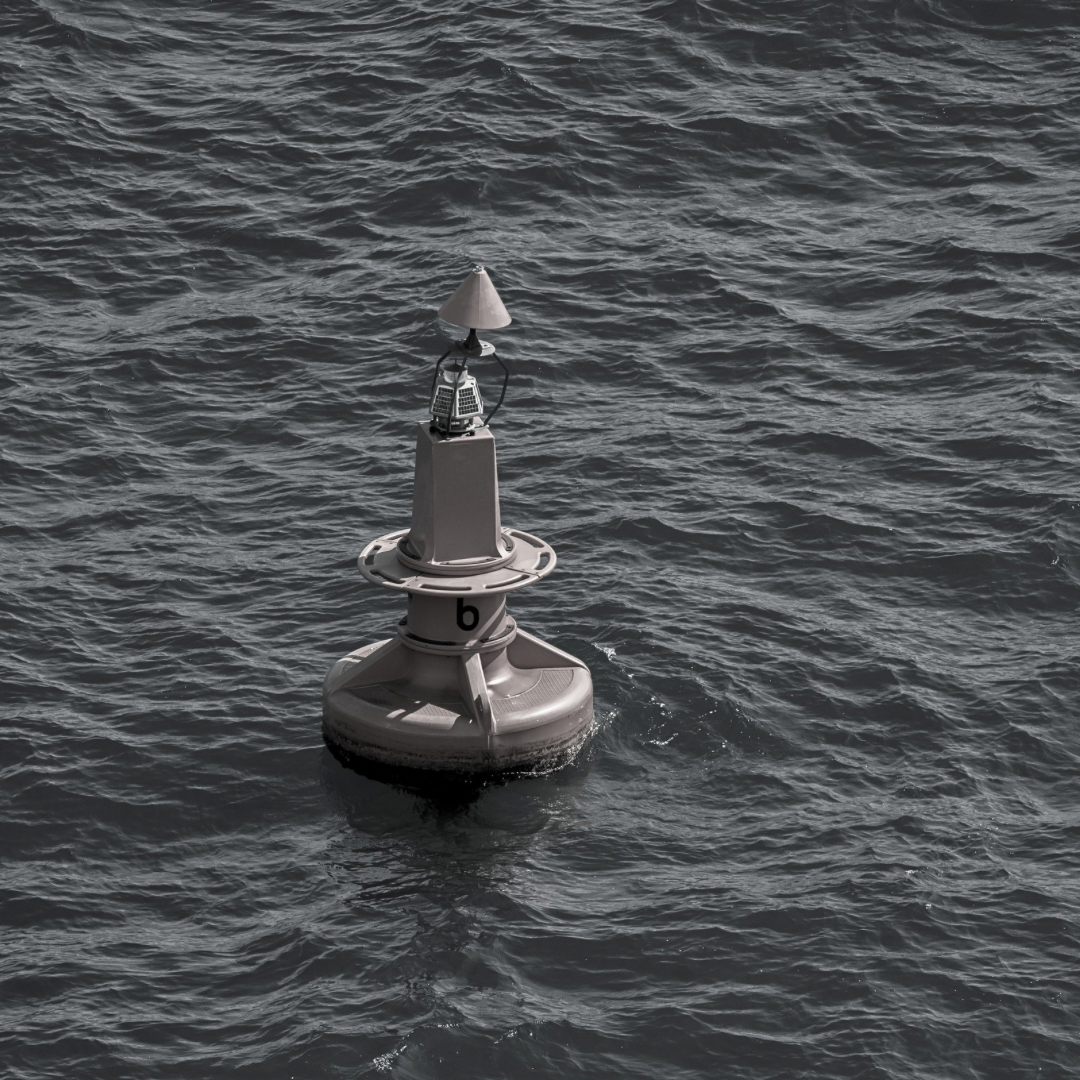
Hybrid wave-solar energy buoys deployed across near-shore coastal zones and critical EEZ waypoints provide continuous, low-maintenance ecological and security monitoring without human crew requirements. Each buoy integrates AIS transponder detection, radar cross-section measurement, subsurface acoustic monitoring and environmental sensors, transmitting encrypted real-time data to OmniGaza® via satellite uplink. A network of 2,000 buoys covering Africa's priority maritime zones would provide coverage density comparable to the most advanced maritime domain awareness systems currently operated by any nation on earth. The energy source is the ocean itself. The governance authority is African.
OmniGaza® Sovereign Data Architecture
Every vessel transit, every cargo declaration, every border crossing and every financial settlement within the maritime perimeter of the African Federation is recorded on the OmniGaza® blockchain as an immutable, timestamped and cryptographically verified entry. Data residency remains within African jurisdictions at all times. Algorithmic governance is transparent and auditable by the institutions of the Federation. No foreign intelligence agency, no foreign commercial entity and no foreign government has any right of access to this data. OmniGaza® is the sovereign eye of the continental maritime border: comprehensive, incorruptible and wholly African.
Project Boma — Strategic Infrastructure
Project Boma is the ASDT®'s dedicated strategic infrastructure programme for the physical hardening of critical maritime nodes: ports, straits, offshore platforms and cable landing stations that constitute the arterial system of the continental economy. Capitalised through sovereign ASDT® assets and governed under the UADF's critical infrastructure protection mandate, Boma installs hardened monitoring, access control and emergency response capability at every node designated as strategically essential to the Federation's maritime economy. The objective is to ensure that no single point of the continental maritime infrastructure can be disrupted, interdicted or compromised by any external actor without triggering an immediate, coordinated and sovereign African response.
Sovereign Digital Defence Shield
The Sovereign Digital Defence Shield provides the cyber security layer for mission-critical data management across land, sea and air domains. In an era where maritime conflicts increasingly begin with the disruption of communications, navigation and financial settlement systems before any physical engagement occurs, the integrity of the data architecture is as strategically important as the integrity of the naval architecture it governs. The Shield operates on quantum-resistant encryption protocols, meaning that it is hardened against not only current threat actors but against the cryptographic capabilities that quantum computing will make available within the coming decade. Africa's maritime sovereignty does not expire when the threat landscape evolves.
| Component | Operational Domain | Sovereign Function |
|---|---|---|
| Wave-Solar Buoy Network | Near-shore and EEZ maritime zones | Continuous autonomous surveillance; AIS, radar and acoustic monitoring without foreign dependency |
| OmniGaza® Blockchain Substrate | Continental data governance | Immutable record of all vessel transits, cargo declarations and border events; 100,000 TPS, 2-second finality |
| Project Boma | Critical maritime infrastructure nodes | Physical hardening and emergency response capability for ports, straits and offshore installations |
| Sovereign Digital Defence Shield | Cyber and communications domain | Quantum-resistant encryption for mission-critical data across land, sea and air command networks |
| Continental Digital ID Integration | Immigration and crew verification | OmniGaza® identity verification of all persons crossing the maritime border in under two seconds per scan |
Reciprocity
is Not
Hostility.
It is the
Condition
of Equality.
The African Federation extends unrestricted freedom of movement to every citizen of the Federation across the full continental geography. That freedom is the right of Africans in Africa. It is not a right that is automatically extended to those who have no equivalent generosity to offer in return.
The immigration architecture of the Unified African Maritime Border operates on a clearly articulated principle of strict reciprocity with non-member states. If a nation's citizens may enter the African Federation without restriction, it is because the Federation's citizens may enter that nation without restriction. If a nation imposes visa requirements on African citizens, the Federation imposes equivalent requirements on that nation's citizens. This is not punitive. It is the standard by which every other major economic bloc in the world governs its external borders, and there is no principled argument for treating Africa differently.
The enforcement of this regime is made operationally reliable through OmniGaza® identity verification at every maritime and land port of entry. Every person crossing the continental border is verified against the OmniGaza® ledger within two seconds of presentation. Visa permit status, duration of stay, previous entry history and any compliance flags are available to border authorities in real time. The misuse of visit or tourist permits for unauthorised work or extended residence, which represents both an economic and a revenue loss to the Federation, is detectable and addressable at the point of entry rather than discovered months or years after the breach has occurred. The integrity of the border is the integrity of the market it protects.
The reciprocity framework also serves a function that is rarely acknowledged in immigration policy discussions: it generates leverage. A federation of 1.4 billion people, controlling access to the world's most resource-abundant landmass and the fastest-growing consumer market in the world, holds substantial negotiating power in any bilateral or multilateral discussion about travel access. The African Federation does not need to accept unfavourable terms in mobility agreements. It has the demographic and economic weight to insist on equal terms, and the Unified African Maritime Border is the sovereign instrument through which that insistence is enforced.
The Border
is Funded
by What
It Protects.
The conventional model of African security infrastructure financing has been donor dependency: the acceptance of foreign capital on foreign terms to fund the protection of African territory on African soil. The ASDT® financing architecture inverts that model permanently, capitalising the continental maritime border through the continent's own mineral wealth.
Africa's Sovereign Development Trust® pioneers the self-financing of sovereign African infrastructure through the Central Bank of Africa℠, capitalised by Africa's extraordinary mineral wealth. The Democratic Republic of Congo alone holds untapped mineral reserves valued at approximately USD 24 trillion, encompassing cobalt, coltan, lithium, copper, gold and rare earth elements that are essential to the global transition to electric vehicles, renewable energy and advanced electronics. This is not a historical resource. It is the most strategically relevant mineral endowment in the world at this precise moment in the global economy's transition.
The African Rare Earth Mineral Fund©, operating as a dedicated vehicle within the ASDT® sovereign capital structure, transitions the continent from raw material extraction to high-value manufacturing, capturing the ten-times value multiplier that accrues to processed and refined materials over unprocessed ore. The revenues from this transition capitalise the Central Bank of Africa℠, which issues Ndege Money© as the mineral-backed digital currency of the Federation, settled through OmniGaza®, and allocated in part to the ongoing operational costs of the UADF and the Unified African Maritime Border surveillance infrastructure.
The self-reinforcing logic of this financing architecture is the point. The border protects the resources. The resources fund the border. The Fund captures the value of the resources. The Bank issues the currency that settles the Fund's transactions. OmniGaza® governs every step of the cycle with sovereign transparency. Africa does not need foreign permission, foreign capital or foreign goodwill to operate this system. It needs only the institutional will to run it, and that will is now in operation.
| Financial Substrate | Purpose | Backing and Mechanism |
|---|---|---|
| Africa's Sovereign Development Trust® | Private pan-African trust — institutional anchor of the Federation's sovereign capital | Continental mineral assets and sovereign IP portfolio |
| Central Bank of Africa℠ | Central bank for the Federation's member central banks; issuer of Ndege Money© | USD 24 trillion DRC mineral wealth and African Rare Earth Mineral Fund© |
| Ndege Money© | Continental digital currency for trade, defence procurement and immigration settlement | Asset-backed via AREMF; Coinbase Base infrastructure with Ethereum OP Stack |
| OmniGaza® | Sovereign technology platform for all border, trade and identity transactions | Quantum-resistant blockchain; 100,000 TPS; African data residency guaranteed |
| African Defence Fund© | Dedicated financing vehicle for UADF procurement and maritime infrastructure | ASDT® sovereign capital allocation with ring-fenced maritime border mandate |
Four Phases.
One
Sovereign
Border.
The implementation of the Unified African Maritime Border proceeds across four phases between 2025 and 2035, each phase building measurable and irreversible capability upon the foundations of the last. Implementation follows the proven African model: begin where the political will is strongest, demonstrate results that cannot be disputed, and allow the logic of demonstrated success to drive expansion.
Pilot and Confidence
OmniGaza® substrate and UADF command architectureEstablishment of the OmniGaza® maritime border data infrastructure in pilot coastal jurisdictions where ASDT® has the deepest existing operational relationships. Simultaneous activation of UADF Central Command secondments framework at pilot level, with naval personnel from willing member states beginning the integration process. Deployment of first-generation buoy monitoring networks in Gulf of Guinea and Western Indian Ocean priority zones. Target: demonstrable reduction in illegal fishing incidents and measurable improvement in cargo documentation compliance within pilot zones.
Regional Integration
Five regional commands and immigration harmonisationExtension of the UADF secondments framework to all five African regional power blocs: ECOWAS, SADC, EAC, IGAD and the North African regional grouping. Harmonisation of immigration entry protocols under the Strict Reciprocity Framework, with OmniGaza® identity verification operational at all major maritime ports of entry. Activation of the African Defence Fund© as the procurement financing vehicle for the continental naval standardisation programme. Target: unified entry data for all maritime border crossings and first continental maritime domain awareness picture.
Full Perimeter Control
30,500 km sovereign maritime perimeter operationalFull buoy network deployment across all priority maritime zones. UADF Central Command operational at continental scale, with unified response capability for all maritime security contingencies across the full 30,500-kilometre perimeter. Project Boma hardening of all designated critical maritime infrastructure nodes. OmniGaza® fully operational as the settlement layer for all continental maritime trade, managing cargo manifests, customs declarations and financial settlement under Ndege Money© in real time. Target: full continental maritime domain awareness and measurable reduction in IFF-enabling documentation gaps.
Absolute Sovereignty
Full resource sovereignty and global bargaining parityFull realisation of EEZ sovereign rights across all African maritime zones, with fishing rights, offshore energy exploration and seabed mineral extraction governed entirely under African institutional authority. African Defence Force intervention capability across all maritime domains, eliminating operational dependence on foreign naval mandates. Formal submission of Africa's claim to two permanent UN Security Council seats with full veto rights, backed by the institutional weight of a continental federation governing its own territory, its own resources and its own borders. The arithmetic of 2050 is a fact already written. The maritime border is how Africa writes it on its own terms.
The Map
Has Always
Belonged
to Us.
The question of who governs Africa's maritime border has been answered by default for too long, and the answer has always been the same: whoever had the naval capacity to be there. That era is not ending. It has ended. The African Federation Treaty Framework© establishes, as a matter of jurisprudential fact, that the authority over African territorial waters belongs to the African people.
The geopolitical trajectory of the African continent is not a forecast to be managed. It is a structural reality to be recognised. By 2050, Africa will be home to 2.5 billion people — the largest single demographic endowment on earth. That population will be younger, more urban, more connected and more economically consequential than any comparable population in any comparable geography at any previous point in human history. The institutions being built by the African Federation Treaty Framework© are the governance architecture for that population. They are not aspirational. They are operational, indexed, legally deposited and advancing.
The Unified African Maritime Border is the outer perimeter of that architecture. It is where the continent's sovereignty is most directly tested — by piracy, by illegal resource extraction, by the presence of foreign forces operating under foreign mandates on African water — and it is where the sovereign response of the African Federation is most directly expressed. The border does not merely protect the continent from external actors. It defines the terms on which the continent engages with them: as a sovereign equal, with the full weight of 1.4 billion present and 2.5 billion future citizens behind every position it takes.
Institutions, governments and international partners that understand the significance of what is being built are invited to initiate formal engagement through the Strategic Executive Office of ASDT®. The window for participation in the architecture of African sovereignty is not indefinitely open. Those who choose to engage now do so as partners in a continental project whose success is not contingent on their participation. It is merely improved by it.