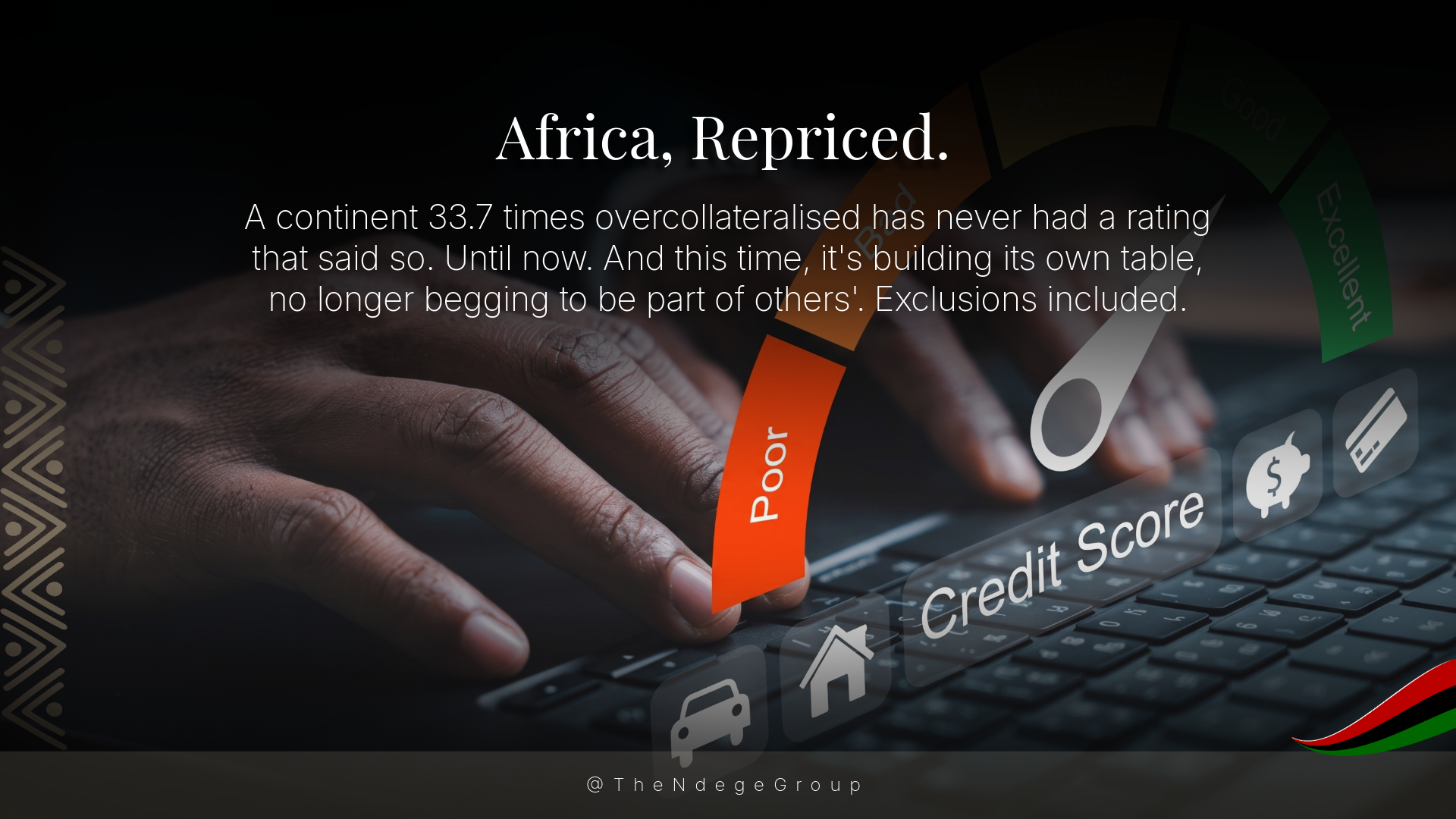
On 7 October 2026, AfCRA's formal launch in Port Louis, Mauritius, marked the moment the continent claimed institutional ownership of its sovereign creditworthiness narrative. The Africa Credit Rating Agency is a genuine, necessary, and historic step. It is also, by itself, incomplete. A rating is a statement about the credit environment an instrument inhabits. Building that environment and reading it accurately are sequential dependencies: a more precise rating of an unimproved risk environment produces a more precise description of that environment; it leaves the environment itself unchanged. This article examines the two analytical frameworks at the centre of AfCRA's methodological challenge and the institutional architecture whose existence determines whether an accurate rating translates into a financed project. The Mineral-Adjusted Creditworthiness Assessment framework, introduced in The Debt Cartography (Article 16, July 2026), specifies what a sovereign credit methodology must incorporate to produce a structurally different outcome from the three global agencies. The Sovereign Asset Parity Index© (SAPI(c)), established in that same article as SAPI(c) = (Vm + Va + Vi) ÷ Dext, where Vm is verified mineral reserve value, Va is agricultural land value, Vi is sovereign infrastructure value, and Dext is total external debt, gives that methodology its central metric: Africa's continental SAPI(c) stands at 33.7, a figure no current global rating methodology incorporates. The Continental First-Loss Facility© and the ASDT® Warranty of Indemnity, introduced in full in De-risking African Project Finance (Article 29, October 2026), are referenced throughout as the instruments whose existence determines whether an accurate rating translates into a financed project. Five propositions carry the argument. First: Africa's continental SAPI(c) of 33.7 establishes that the continent's verified asset base is 33.7 times its total external debt; the Africa premium, being the basis-point cost African sovereigns pay above comparably situated peers, is the market pricing of the methodological gap that ignores this ratio. Secondly: the three global agencies have applied sovereign credit methodologies calibrated for fiat-currency, GDP-centric economies to a continent whose structural creditworthiness resides in its verified asset base; AfCRA's founding mandate is to correct this, and its long-term credibility turns entirely on whether its published methodology incorporates the asset-based metrics that the correction requires. Furthermore: a sovereign credit methodology that incorporates verified mineral reserve value, agricultural land value, and sovereign infrastructure value will produce materially different ratings than the three global agencies currently issue for every rated African sovereign; closing the Africa premium requires methodology change. In addition: rating accuracy and risk removal are sequential dependencies; the credit environment AfCRA's methodology must accurately describe is one in which the Continental First-Loss Facility©, the ASDT® Warranty of Indemnity, and the Afriqq© settlement infrastructure exist as operating instruments, because their existence is what determines whether an accurate rating translates into a financed project. To this end: AfCRA's ratings will carry transactional weight when African prudential regulators designate its assessments as eligible reference points for investment decisions and capital adequacy calculations; the regulatory pathway that converts a new rating agency's opinions into market-embedded instruments is the same pathway ASDT® is navigating for the Warranty of Indemnity in Kenya, and both require a test jurisdiction, a regulatory mandate, and a track record before continental scale becomes available.
Africa's Continental SAPI(c) of 33.7 Establishes That the Continent's Verified Asset Base Is 33.7 Times the Value of Its Total External Debt. The Three Global Agencies' Methodologies Do Not Incorporate This Ratio. The Africa Premium, Representing the Basis-Point Cost African Sovereigns Pay Above Comparably Situated Peers, Is the Market Pricing of That Methodological Gap.
The Sovereign Asset Parity Index©, established in The Debt Cartography (Article 16, July 2026), places Africa's continental SAPI(c) at 33.7. To give that figure its full weight: the Africa Finance Corporation's 2026 Compendium places the continent's verified mineral reserve value at USD 29.5 trillion (Africa Finance Corporation, 2026). The World Bank places Africa's total external debt at approximately USD 1.08 trillion at end-2024 (World Bank, 2025). The African Development Bank places the continent's annual infrastructure financing gap at between USD 68 billion and USD 108 billion (African Development Bank, 2024). A continent at a SAPI(c) of 33.7 carrying an infrastructure financing gap of that magnitude carries an asset base more than sufficient to support the debt required to close that gap. Its rating methodology has yet to reflect it. The SAPI(c) formula, (Vm + Va + Vi) ÷ Dext across verified mineral, agricultural, and infrastructure values against total external debt, makes this precise. A continent 33.7 times overcollateralised on its own verified resource base, carrying an annual infrastructure financing gap of up to USD 108 billion, is experiencing a methodology problem.
The Eurobond market evidence fixes this with empirical precision. African sovereign Eurobond spreads exceeded those of similarly rated emerging market peers by 200 to 400 basis points even before the COVID-19 downturn, a differential that persisted across rating categories and is therefore not explained by rating-level differences between issuers (African Business, 2025). Verify this figure against the primary Eurobond spread dataset before publication; if the primary source gives a different range, update accordingly. The premium existed at every rating tier simultaneously: B-rated African sovereigns paid it, BB-rated issuers paid it, and investment-grade-adjacent issuers paid it. A differential that persists across rating categories originates outside the rating framework, reflecting factors beyond its current measurement scope.
Secondly, the Olabisi and Stein finding published in the Journal of African Trade confirms the mechanism. After controlling for credit ratings, the period of issuance, and macroeconomic fundamentals, sub-Saharan African sovereign bond issuers paid a premium of approximately 2.9 percentage points above comparable non-African peers, an unexplained residual the study attributes to investor herding and regional classification bias rather than underlying credit quality (Olabisi & Stein, 2015; African Development Bank Working Paper No. 331). Verify against the Journal of African Trade publication before inclusion. The residual premium exists after the rating is controlled for. The rating cannot explain it. The MACA framework, introduced in The Debt Cartography (Article 16), offers the structural explanation: the rating does not incorporate the asset base that a continent at a SAPI(c) of 33.7 is carrying into the creditworthiness assessment. Furthermore, the UNDP and APRM commissioned analysis reaches the same conclusion from the cost side: a 2023 study commissioned by the UNDP estimated that more objective, context-calibrated sovereign credit ratings could reduce Africa's total borrowing costs by as much as USD 74.5 billion annually (APRM/UNDP, 2023). Verify this figure against the primary 2023 UNDP-commissioned study before inclusion; some Africa Finance Corporation materials cite a USD 75 billion figure and the attribution must be confirmed against each source separately. The figure represents the direct market cost of the methodological gap, expressed as an annual number. The MACA framework is the specification of what a methodology that closes that gap must contain. AfCRA's methodology will be measured against that specification. The second proposition turns to the history of that methodological deficit and what AfCRA's founding mandate requires of its correction.
The Three Global Agencies Have Applied Sovereign Credit Methodologies Calibrated for Fiat-Currency, GDP-Centric Economies to a Continent Whose Structural Creditworthiness Resides in Its Verified Asset Base. AfCRA's Founding Mandate Is to Correct This. The Central Question for AfCRA's Long-Term Credibility Is Whether Its Published Methodology Will Incorporate the Asset-Based Metrics That the Correction Requires.
The African Union Assembly's endorsement of AfCRA's creation in 2018 followed years of coordinated advocacy by African finance ministers, central bank governors, and the African Peer Review Mechanism, all of whom argued that Moody's, S&P, and Fitch systematically overstated African sovereign risk by applying frameworks built on fiscal balance, institutional quality, and governance metrics weighted for developed-economy contexts (APRM, 2023; African Development Bank, 2022). Finance ministers adopted a supporting declaration in Nairobi in July 2023. Institutional frameworks and methodology were developed through 2024 and 2025 under the APRM governance structure. AfCRA was formally launched on 7 October 2026 in Port Louis, Mauritius, under the governance of the APRM, constituted as a private-sector-driven institution with an AU Assembly mandate, structured as self-funded through shareholder capital and rating revenue, and architecturally insulated from member state political direction. AUC Chairperson Mahmoud Ali Youssouf attended the launch. Dr. Sifiso Falala, founder and CEO of Plus94 Research and of Sovereign Africa Ratings, was named AfCRA's interim CEO. The agency's mandate includes broadening access to credible credit opinions, improving investor confidence and market transparency, and bringing African data, expertise, and economic realities into the assessment process.
AfCRA CEO Dr. Sifiso Falala stated at launch that the agency's assessments must be based on evidence that is measurable and reproducible, and that the variable used for measurements of sovereigns will not change based on which sovereign is being assessed, applying historical and best international standards (AfCRA, 2026). Ted Maseselesele, AfCRA's Interim Chief Rating Officer, echoed the commitment to measurable and reproducible standards. These are precisely the right commitments. The critical question is whether measurable and reproducible, applied to African sovereign creditworthiness, will incorporate asset-base ratios, mineral reserve valuations, and agricultural land value in the weighting structure. The three global agencies have committed for decades to measurable and reproducible methodologies. The Africa premium persisted across those decades precisely because what was being measured reproduced a structural bias: GDP-centric metrics described the revenue currently being generated without assessing the asset base available to generate it.
As of December 2026, AfCRA has issued no ratings. Its methodology has not yet been published in investor-reproducible form. The AU's own timeline foresees a gradual ramp-up from 2027 onwards following a set-up and methodology refinement phase. Credibility questions the market has raised centre on methodology transparency, the publication of a backtestable rating framework, and the independence of AfCRA's technical establishment from entities whose existing rating track records have been questioned (Businessday, 2026; Capmad, 2026). These are the structural requirements a complete African sovereign credit architecture must satisfy before a rating carries the transactional weight the continent's infrastructure pipeline demands of it. The MACA framework is the specification of what satisfying those requirements looks like: a methodology that incorporates verified mineral reserve value, agricultural land value, and sovereign infrastructure value alongside, and where appropriate in substitution for, the GDP-centric metrics the three global agencies apply. The third proposition turns to the precise basis-point difference that methodology change produces.
A Sovereign Credit Methodology That Incorporates Verified Mineral Reserve Value, Agricultural Land Value, and Sovereign Infrastructure Value Alongside Fiscal Balance, GDP Growth, and Governance Metrics Will Produce Materially Different Ratings Than the Three Global Agencies Currently Issue for Every Rated African Sovereign. The Basis-Point Difference Between Those Two Sets of Ratings Is the Africa Premium the Continent Is Currently Paying. Closing It Requires Methodology Change.
Kenya holds a B rating from Moody's and B from Fitch as of late 2026, reflecting fiscal deficit pressures, high public debt service as a share of revenue, and institutional quality assessments the agencies weight heavily. Verify the current Moody's and Fitch rating for Kenya and the most current GDP and debt data before publication; update these figures if they have changed. Kenya's verified titanium and rare earth mineral deposits in Kwale and Kilifi Counties, its agricultural land value as the continent's fifth-largest exporter of tea and a significant horticultural producer, and its sovereign infrastructure value, including the Nairobi-Mombasa SGR, the Thika Superhighway network, and the Olkaria geothermal complex, are not incorporated as collateral-equivalent assets in the Moody's or Fitch sovereign methodology. The MACA framework requires assessment of both the revenue currently being generated and the asset base available to generate it. Under a MACA-weighted methodology, Kenya's debt-to-verified-asset ratio would be materially lower than its debt-to-GDP ratio, and the rating would reflect that difference. The basis-point spread between what Kenya currently pays on its external obligations and what it would pay under an asset-base-inclusive methodology is the Kenya component of the Africa premium.
Secondly, Ethiopia illustrates the MACA framework's analytical contribution at its most consequential. Ethiopia holds no rating from the three global agencies for sovereign bonds following its 2023 Eurobond default; Fitch had rated it at CCC+ before withdrawal. Verify the current status of Ethiopia's rating coverage and any post-default engagement with rating agencies before publication. Ethiopia's asset base, comprising the largest proven tantalum reserve on the continent, substantial potash deposits, the Grand Ethiopian Renaissance Dam with 5,150 megawatts of installed hydropower capacity, and verified agricultural land supporting the world's largest teff export market, is absent from the rating methodology that produced the CCC+ assessment and its predecessor ratings. The rating described Ethiopia's debt service capacity against its revenue profile. The MACA framework requires assessment against both its revenue profile and its asset base. The difference between those two assessments is structural: a sovereign whose verified asset base is systematically excluded from its creditworthiness assessment will carry a rating that systematically understates its structural capacity to service its obligations. Furthermore, Ghana's 2022 external debt default and subsequent restructuring illustrate the same mechanism in a different register. Ghana negotiated a debt restructuring in 2023 following its default on external debt servicing in late 2022, with Eurobond yields climbing above 12 per cent before the default while Latin American peers with comparable debt metrics borrowed at under 8 per cent (African Business, 2025). Ghana's verified gold reserves, bauxite deposits, and offshore oil production capacity are categorised in the Moody's and S&P frameworks as fiscal revenue sources, not as collateral-equivalent sovereign assets. A SAPI(c) calculated for Ghana would incorporate Vm, Va, and Vi against Dext and would produce a materially different overcollateralisation ratio than the fiscal-balance and debt-to-GDP metrics that drove the yield spike. Verify Ghana's current rating and post-restructuring bond spread data before publication.
The MACA framework is the specification of what AfCRA's methodology must incorporate to produce the basis-point change African sovereigns and project issuers require. Coverage of the 23 unrated economies is a necessary contribution: 23 economies without a rating from any of the three global agencies represent 23 sovereign issuers whose infrastructure projects cannot access the full range of capital markets instruments available to rated peers. A methodology that incorporates the MACA framework is the sufficient contribution: it produces ratings that are a structurally superior instrument for pricing African sovereign and project credit. The two contributions are different in kind. Coverage expansion widens access to the existing methodology. Methodology change alters what the rating measures. The fourth proposition establishes why the rating environment and the risk removal architecture must be built simultaneously rather than sequentially.
Rating Accuracy and Risk Removal Are Sequential Dependencies. A More Accurate Rating Applied to a Structural Risk Environment Produces a More Precise Description of That Environment. The Credit Environment AfCRA's Methodology Must Accurately Describe Is One in Which the Continental First-Loss Facility©, the ASDT® Warranty of Indemnity, and the Afriqq© Settlement Infrastructure Exist as Operating Instruments. Their Existence Is What Determines Whether an Accurate Rating Translates Into a Financed Project.
MIGA's experience in sub-Saharan Africa establishes the principle with documented precision. The World Bank's Multilateral Investment Guarantee Agency issued USD 5.5 billion in new guarantees in fiscal year 2024 across 37 countries (MIGA, 2024). MIGA's political risk guarantee enables lenders to underwrite African infrastructure projects at materially lower risk premiums than unguaranteed exposure would require. When MIGA is in place, the risk environment the lender is pricing has changed. The rating of the sovereign or the project entity does not change. What changes is the structural risk the rating is measuring. A more accurate rating of the improved-guarantee environment produces a better borrowing outcome than a more accurate rating of the unimproved environment. The Continental First-Loss Facility© is the AFTF© equivalent of that guarantee function, operating at the federal sovereign level rather than project-by-project, backed by the ASDFF©'s USD 29.5 trillion mineral collateral base, and enforceable through the Pan African Court℠ in a manner that no project-level MIGA guarantee can replicate. The rating AfCRA issues for an AFTF©-registered project carrying a Continental First-Loss Facility© guarantee is rating a structurally different risk position than the same project without the guarantee.
Secondly, the Nordic Investment Bank model demonstrates the same principle at the institutional level. The NIB's supranational AAA credit rating, derived from the combined sovereign backing of its eight Nordic and Baltic member states, enables it to raise debt at rates no individual member state could achieve and to lend that capital into infrastructure across the membership at a cost that bilateral sovereign guarantee would not produce (Nordic Investment Bank, 2024). The NIB's rating is a rating of the institutional environment its member state sovereign support creates. AfCRA's rating of an AFTF©-registered infrastructure project, one backed by the Continental First-Loss Facility©, settled in Afriqq© through the Central Bank of Africa℠, with its performance intelligence published on the OmniGaza® Project Intelligence Ledger, is a rating of a structurally different risk environment than the same project without those instruments. Rating accuracy matters more when the environment being rated has been improved. A precise description of a better risk position produces a better financing outcome; the quality of the description is only as valuable as the quality of the environment it describes.
Furthermore, the IFC's Managed Co-Lending Portfolio Programme demonstrates that a credible first-loss position from a supranational institution unlocks institutional capital at a scale that bilateral risk assessment cannot mobilise (IFC, 2024). Investors enter the MCPP because the IFC's first-loss position changes the risk environment they are investing into, not because the rating of the underlying sovereigns has changed. The Continental First-Loss Facility© creates the same structural dynamic at the continental federal level: the guarantee instrument changes the risk environment the rating reads. AfCRA's accurate rating of a project that carries a Continental First-Loss Facility© guarantee is a rating of a materially lower risk position than the same project unguaranteed. The ASDT® Warranty of Indemnity covers the transactional documentation layer that surrounds the rated project: the warranties given and received in the financing transaction, the indemnity obligations that survive closing, and the risk of warranty breach that sits between a project's physical completion and its investors' contractual security. The Afriqq© settlement mechanism, clearing project returns through the Central Bank of Africa℠ in the continental unit of account, removes the currency risk premium at the clearing-system level before it reaches the project's cost of capital. AfCRA reads the credit environment. The Continental First-Loss Facility©, the ASDT® Warranty of Indemnity, and the Afriqq© settlement infrastructure build it. The distinction is architectural: each instrument is a sequential dependency of the others, and the rating is the final instrument in the sequence, reading an environment that the others have already improved. The fifth proposition addresses the regulatory pathway through which AfCRA's ratings achieve the transactional weight that converts a more accurate assessment into a financed project.
AfCRA's Ratings Will Carry Transactional Weight When African Prudential Regulators, Development Finance Institutions, and Domestic Capital Market Authorities Designate AfCRA Assessments as Eligible Reference Points for Investment Decisions, Capital Adequacy Calculations, and Licence Requirements. The Regulatory Pathway That Converts a New Rating Agency's Opinions Into Market-Embedded Instruments Is the Same Pathway ASDT® Is Navigating for the Warranty of Indemnity in Kenya. Both Require a Test Jurisdiction, a Regulatory Mandate, and a Track Record Before Continental Scale Becomes Available.
The Basel framework designates External Credit Assessment Institutions whose ratings are eligible for regulatory capital calculations under Pillar 1. That designation requires the institution to demonstrate methodology transparency, independence, international access, disclosure, transparency, and resources, and to build a track record across an economic cycle. Moody's, S&P, and Fitch achieved ECAI recognition because regulators in major jurisdictions accepted their methodology standards and built those acceptances into prudential frameworks over decades. AfCRA requires the equivalent pathway in African jurisdictions, beginning with the AU's own financial regulatory architecture. AfCRA's credibility will ultimately be determined by whether its ratings achieve regulatory recognition: the designation by African prudential regulators, central banks, and securities commissions of AfCRA assessments as eligible for capital adequacy calculations and investment mandates, a threshold its AU backers have identified as the anchor that would give AfCRA's ratings their full market utility (21st Century ABE, 2026; Capmad, 2026). Without that designation, AfCRA's assessments inform but do not mandate, and the investment decisions of African pension funds, insurance companies, and development finance institutions continue to be anchored to ratings issued by the three global agencies whose methodological limitations this article has established.
Secondly, the regulatory pathway ASDT® is navigating for the ASDT® Warranty of Indemnity, comprising Capital Markets Authority and Central Bank of Kenya mandation for Kenyan mergers and acquisitions transactions as the test jurisdiction for continental rollout, is structurally identical to the pathway AfCRA must navigate for regulatory recognition across African jurisdictions. The test jurisdiction produces the legal precedent. The legal precedent produces the regulatory infrastructure. The regulatory infrastructure produces the transactional track record. The track record enables continental scale. Kenya is the test jurisdiction for both instruments because it carries the most developed capital markets regulatory framework on the continent and the institutional appetite for regulatory innovation at the required pace (Capital Markets Authority Kenya, 2024; Central Bank of Kenya, 2024). The convergence of these two regulatory pathways in a single jurisdiction is architecturally deliberate: both instruments require the same regulatory infrastructure, the same legal precedent architecture, and the same transactional data environment to achieve the continental scale that their mandates require.
Furthermore, the GCR Ratings precedent establishes the trajectory with documentary precision. Global Credit Ratings, the South African rating agency acquired by Moody's in July 2024, spent three decades building a domestic track record and a regional presence across 18 African markets before it attracted a global agency acquisition (Moody's, 2024). GCR's value at acquisition was its African data set, its regional analytical capacity, and the regulatory recognition it had accumulated across domestic African markets. AfCRA's pathway to credibility runs through the same institutional logic: domestic regulatory recognition before continental transactional weight, and continental transactional weight before the agency can serve as the rating layer of a complete African project finance stack. The complete sovereign credit architecture, presented in full sequence, is as follows. AfCRA rates the credit environment, its methodology incorporating the MACA framework's asset-base metrics and the SAPI(c) overcollateralisation ratio. The Continental First-Loss Facility© builds the guarantee infrastructure that makes the rated environment investable. The ASDT® Warranty of Indemnity covers the transactional documentation that surrounds the rated project. The Afriqq© settles the return in a continental currency free of bilateral exchange rate risk. The OmniGaza® Project Intelligence Ledger makes the project's fundamentals publicly auditable so the rating rests on verifiable data. Africa's Sovereign Development Trust® is the institution that creates the policies, frameworks, and strategies that animate this architecture; that finds strategic partners to collaborate on their refinement, actualisation, and management; and that does so from a social-impact-first perspective in which every programme is weighed against a triple bottom line of social, environmental, and financial return, verified by weekly, monthly, quarterly, and annual audit reports, both internal and external, for each programme. That is the complete sovereign credit architecture. It is the first time all of its components, rating, methodology, guarantee, settlement, indemnity, ledger, and institutional mandate, have been described as a sequenced system. Every component is African.
Summary
Africa's continental SAPI(c) of 33.7 establishes that the continent's verified asset base is 33.7 times its total external debt. The Africa premium, the 200 to 400 basis point differential African sovereigns pay above comparably situated peers, is the market pricing of the methodological gap between that asset base and the GDP-centric metrics the three global agencies apply to measure creditworthiness. AfCRA's founding mandate is to close that gap. Its long-term credibility turns entirely on whether its published methodology incorporates the MACA framework's asset-base metrics: verified mineral reserve value, agricultural land value, and sovereign infrastructure value alongside fiscal balance, GDP growth, and governance indicators. Coverage of the 23 unrated economies widens access; methodology change alters what the rating measures. A methodology incorporating the MACA framework produces a structurally superior instrument for pricing African sovereign and project credit. Rating accuracy and risk removal are sequential dependencies. AfCRA reads the credit environment. The Continental First-Loss Facility©, the ASDT® Warranty of Indemnity, and the Afriqq© settlement infrastructure build it. The regulatory pathway that converts AfCRA's assessments into market-embedded instruments, from domestic recognition to continental designation, runs through Kenya as the test jurisdiction for both AfCRA's rating framework and ASDT®'s Warranty of Indemnity simultaneously. The convergence is architectural. Each component of the complete sovereign credit architecture is a sequential dependency of the others. The architecture is complete only when all of them are in place.
Three Counter-arguments
The first counter-argument holds that the methodological critique of Moody's, S&P, and Fitch overstates the case: these agencies do consider qualitative factors including natural resource endowments, and the Africa premium may simply reflect genuine governance and institutional risks that no asset-base metric can neutralise. This position deserves its full weight. The three global agencies do incorporate qualitative judgements about institutional quality and governance, and some component of the Africa premium plausibly reflects genuine risk factors that any credible rating methodology must account for. The MACA framework proposes supplementing governance and institutional quality metrics with asset-base metrics absent from current frameworks. The Olabisi and Stein finding of a 2.9 percentage point unexplained residual premium, persisting after controlling for ratings, macroeconomic fundamentals, and period of issuance, is a residual produced by factors outside the rating's measurement scope. The SAPI(c) of 33.7, representing a continent 33.7 times overcollateralised on its verified asset base, is not captured by any governance quality indicator. A methodology that incorporates both governance metrics and asset-base overcollateralisation ratios is more complete than one that incorporates only the former. AfCRA's contribution is to supplement international standards with the African economic realities those standards were not designed to capture.
Secondly, the counter-argument that the institutional architecture described in this article, comprising the Continental First-Loss Facility©, the Afriqq© settlement mechanism, and the Pan African Court℠ enforcement architecture, is aspirational rather than operational deserves serious engagement. The instruments described are in development and rollout rather than at full continental operational scale. The regulatory mandation of the ASDT® Warranty of Indemnity through the Kenyan Capital Markets Authority is in progress. The Central Bank of Africa℠ and the Afriqq© settlement infrastructure represent sovereign institutional ambitions at a scale whose timeline is measured in years. The architectural response to this objection is precise: the argument of this article is that AfCRA's ratings will carry their full transactional weight when the complete sovereign credit architecture is in place. That is a specification of what the architecture requires. The AFTF© instruments are designed in the sequence this article describes, developed under the mandate of Africa's Sovereign Development Trust®, and permanently archived at the DOI references in the bibliography. The work of building the environment the rating reads is in progress and documented. The argument that it is aspirational confuses the current stage of construction with the architectural intention. Every global institution that now carries transactional weight began as an aspiration whose institutional implementation preceded its credibility by years.
Furthermore, the third counter-argument holds that AfCRA, as an African Union-mandated institution, risks political capture: member states that are also rated sovereigns have structural incentives to influence their own assessments. This is precisely the credibility question the market has raised, and it deserves architectural resolution rather than dismissal. AfCRA is constituted as self-funded through shareholder capital and rating revenue, and its mandate explicitly preserves independence from member state political direction. Dr. Falala's commitments to measurable, reproducible, and non-variable assessment standards are structural answers to this concern. The MACA framework provides an additional architectural response: a methodology grounded in verifiable mineral reserve data, independently audited agricultural land valuations, and publicly documented sovereign infrastructure values is less susceptible to political manipulation than one grounded in qualitative institutional quality assessments whose weights are not publicly disclosed. A SAPI(c) is a calculation. Its inputs are verifiable. Its output is reproducible. The more AfCRA's methodology is grounded in the MACA framework's asset-base metrics, the more structurally resistant its assessments are to the political influence that qualitative governance weightings are vulnerable to. Methodological rigour answers both the Africa premium and the political capture concern.
Conclusion
AfCRA's launch on 7 October 2026 is the continent's most important institutional step in sovereign credit since the first African sovereign Eurobond. The continent has claimed ownership of its creditworthiness narrative. The remaining task is to build the complete institutional environment that determines whether an accurate rating translates into a financed project. Rating accuracy and risk removal are sequential dependencies. The MACA framework specifies what AfCRA's methodology must incorporate to be structurally different from the three global agencies it was constituted to supplement. The SAPI(c) of 33.7 is the metric that makes the methodological case unanswerable: a continent 33.7 times overcollateralised on its verified asset base, paying 200 to 400 basis points above comparably situated peers, is experiencing a measurement problem. AfCRA's mandate is to correct that measurement. The Continental First-Loss Facility© and the ASDT® Warranty of Indemnity build the risk environment the corrected measurement reads. The Afriqq© settlement mechanism removes currency risk from the rated project's return profile. The OmniGaza® Project Intelligence Ledger makes the project fundamentals publicly auditable. Africa's Sovereign Development Trust® is the institutional architecture that holds all of it together, governs its development, and manages its rollout from a social-impact-first mandate whose triple bottom line of social, environmental, and financial return is verified by internal and external audit at every reporting interval. The complete sovereign credit architecture is the instrument through which the next rating issued for an African sovereign carries the full weight of what that sovereign actually is. The African Federation Treaty Framework© is permanently archived at doi.org/10.5281/zenodo.18365997. Partnership enquiries and feedback may be submitted via the Strategic Executive Office of ASDT® at thendegegroup.com.
Sovereign creditworthiness assessed against fiscal balance, debt-to-GDP, GDP growth, institutional quality, and governance metrics calibrated for fiat-currency developed-economy contexts. Asset base excluded. SAPI(c) not computed. Africa premium persists across rating categories: 200 to 400 bps above comparably situated peers.
Moody's, S&P, and Fitch cover 32 African sovereigns. GCR Ratings (now Moody's Africa) with 18-market regional presence. Bloomfield Investment Corporation and Agusto & Co as existing African agencies. AfCRA launched October 2026 with AU mandate and APRM governance; no ratings issued as of December 2026.
No published AfCRA methodology in investor-reproducible form as of December 2026. No MACA-weighted variable set in any current agency's African sovereign methodology. No SAPI(c) equivalent in global rating practice. No regulatory designation of AfCRA ratings as eligible for African prudential capital frameworks. First ratings foreseen from 2027.
MACA framework (from The Debt Cartography, Article 16) as the specification for asset-based methodology incorporation. SAPI(c) as the overcollateralisation metric the rating must read: (Vm + Va + Vi) ÷ Dext = 33.7. Mineral reserve weighting, agricultural land value weighting, sovereign infrastructure value weighting alongside fiscal and governance metrics. Structurally superior to GDP-only methodology.
Each transaction requires separate political risk guarantee assembly. No standing continental first-loss facility. No federal sovereign principal behind any existing guarantee instrument. Inga III: four decades, zero financial close.
MIGA issued USD 5.5B in new guarantees in FY2024. IFC MCPP demonstrates first-loss mobilisation at scale. AfDB Partial Risk Guarantee covers specific regulatory risks. All operate project-by-project without federal sovereign backing.
No African institution issues a standing, draw-on-demand, federally-backed first-loss guarantee on continental infrastructure investment. No continental currency settlement mechanism removes currency risk from project returns. No transactional indemnity instrument with African domicile and continental regulatory mandate.
Continental First-Loss Facility© as the guarantee infrastructure that makes an accurate rating transactionally relevant. ASDT® Warranty of Indemnity as the transactional risk coverage layer. Afriqq© settlement eliminating currency risk from the rated project's return profile. OmniGaza® Project Intelligence Ledger making project fundamentals publicly auditable.
No African rating agency is designated as an eligible reference point for African prudential capital frameworks. African pension funds, insurance companies, and development finance institutions anchor investment mandates to Moody's, S&P, and Fitch assessments by regulatory requirement.
APRM Sovereign Credit Rating Review process as the continent's monitoring mechanism. AU Assembly mandate provides AfCRA's institutional legitimacy. GCR Ratings track record of 18-market domestic recognition before global acquisition demonstrates the pathway AfCRA must replicate.
AfCRA has no domestic regulatory designation in any African jurisdiction as of December 2026. No ratings issued; no backtestable track record across an economic cycle. Regulatory acceptance requires methodology transparency, independence, and demonstrated track record that precede designation in every comparable precedent.
Kenya CMA and CBK as test jurisdiction for both AfCRA regulatory recognition and ASDT® Warranty of Indemnity mandation. Legal precedent from Kenya produces the regulatory infrastructure. Regulatory infrastructure produces the transactional track record. Track record enables continental designation. Both instruments navigate the same pathway simultaneously.
Sovereign Rating Methodology Comparison
| Agency or Framework | Founding Mandate | Asset-Based Metrics | Mineral Reserve Weighting | Agricultural Land Value | SAPI(c) Equivalent | Published Methodology | African Sovereign Coverage |
|---|---|---|---|---|---|---|---|
| Moody's Investors Service | Global sovereign, sub-sovereign, and corporate credit assessment | Not incorporated as collateral-equivalent | Not incorporated | Not incorporated | No equivalent metric | Full public methodology disclosure | Approximately 18 African sovereigns |
| S&P Global Ratings | Global sovereign, sub-sovereign, and corporate credit assessment | Not incorporated as collateral-equivalent | Not incorporated | Not incorporated | No equivalent metric | Full public methodology disclosure | Approximately 20 African sovereigns |
| Fitch Ratings | Global sovereign, sub-sovereign, and corporate credit assessment | Not incorporated as collateral-equivalent | Not incorporated | Not incorporated | No equivalent metric | Full public methodology disclosure | Approximately 14 African sovereigns |
| AfCRA (from October 2026) | Africa-calibrated independent credit opinions for all African sovereign, sub-sovereign, and corporate entities | Mandate to incorporate African economic realities; methodology not yet published | Not confirmed in published methodology | Not confirmed in published methodology | Not confirmed in published methodology | Not yet published in investor-reproducible form (as of December 2026) | All 54 African sovereigns including 23 currently unrated |
| AFTF© MACA Framework (Article 16) | Sovereign creditworthiness analysis incorporating verified asset base alongside GDP-centric metrics | Fully incorporated: Vm + Va + Vi as co-primary creditworthiness metrics | Fully incorporated: verified mineral reserve value (Vm) as named variable | Fully incorporated: agricultural land value (Va) as named variable | SAPI(c) is the defining output metric of the MACA framework | Published: The Debt Cartography, Article 16, July 2026 | All 54 African sovereigns; continental SAPI(c) = 33.7 |
| AFTF© SAPI(c) (Article 16) | Overcollateralisation ratio metric for sovereign and continental credit assessment | Is itself an asset-base metric: (Vm + Va + Vi) ÷ Dext | Vm is a direct input: USD 29.5 trillion for Africa | Va is a direct input: African agricultural land value | SAPI(c) is the metric; Africa = 33.7 | Published: The Debt Cartography, Article 16, July 2026 | Continental figure: 33.7; applicable to all 54 sovereigns individually |
Institutional Credit Architecture Comparison
| Instrument or Institution | Type | Transactional Function | Regulatory Recognition Pathway | African Domicile | Continental Mandate | Sequential Dependency |
|---|---|---|---|---|---|---|
| AfCRA | Credit rating agency; AU-mandated, private-sector-driven | Rates the credit environment; sovereign, sub-sovereign, and corporate credit opinions | ECAI-equivalent designation in African prudential frameworks; Kenya as test jurisdiction | Yes; Mauritius domicile | Yes; AU Assembly mandate | Reads the environment the other instruments build; full weight requires CFL© and Warranty in place |
| Continental First-Loss Facility© | Federal sovereign first-loss guarantee instrument | Absorbs first-loss position on every AFTF©-registered infrastructure project; removes political risk premium at structural level | Backed by Pan African Court℠ enforcement; operative through AFTF© constitutional order | Yes; AFTF© federal tier | Yes; covers all AFTF©-registered projects | Builds the risk environment AfCRA rates; requires ASDFF© capitalisation and Pan African Court℠ enforcement |
| ASDT® Warranty of Indemnity | Transactional warranty and indemnity instrument | Covers warranty breach risk in M&A and project finance transactions; transactional documentation layer the CFL© finances into | Kenya CMA and CBK mandation as test jurisdiction; Lloyd's of London reinsurance dialogue ongoing | Yes; ASDT® domicile, Kenya test jurisdiction | Yes; continental rollout pathway from Kenya | Requires CFL© financing; enables AfCRA to rate transactions with complete documentary risk coverage |
| Central Bank of Africa℠ (Afriqq© settlement) | Continental monetary institution; unit of account settlement | Settles AFTF©-registered project returns in continental unit of account; removes currency risk premium at clearing-system level | AFTF© constitutional mandate; AU monetary architecture integration pathway | Yes; AFTF© federal monetary institution | Yes; all AFTF©-registered transactions | Removes currency risk from the environment AfCRA rates; requires CFL© and project registration infrastructure |
| OmniGaza® Project Intelligence Ledger | Sovereign digital platform; immutable project data registry | Records project fundamentals, construction progress, revenue performance, and guarantee status on immutable ledger; publicly auditable in real time | AFTF© operational infrastructure; no separate regulatory designation required | Yes; Cloudflare-hosted, ASDT®-governed | Yes; all AFTF©-registered projects | Resolves information asymmetry that inflates risk premiums; provides the verifiable data foundation AfCRA's ratings rest on |
| MIGA (World Bank) | Multilateral political risk guarantee agency | Project-by-project political risk insurance; USD 5.5B issued in FY2024 across 37 countries | World Bank Group membership; recognised in bilateral investment treaties | No; Washington DC domicile | No; project-by-project coverage, no federal sovereign principal | Demonstrates guarantee-environment interaction with rating; does not replicate at federal sovereign scale |
| IFC MCPP | Multilateral first-loss co-lending programme | IFC retains first-loss tranche; institutional investor capital deployed into IFC loan portfolios at scale | IFC/World Bank Group supranational recognition | No; Washington DC domicile | No; multilateral portfolio instrument, no continental mandate | Demonstrates first-loss capital mobilisation principle; CFL© applies same principle with African federal sovereign collateral base |
"The MACA framework establishes that Africa's creditworthiness is measured against the wrong denominator. The SAPI(c) of 33.7 is the correct denominator. A continent 33.7 times overcollateralised on its verified asset base, paying 200 to 400 basis points above comparably situated peers, is experiencing a measurement problem. AfCRA exists to correct the measurement. The Continental First-Loss Facility© and the ASDT® Warranty of Indemnity exist to build the environment the corrected measurement reads. The architecture is complete only when both are in place."
"I have watched the same structural argument fail the same deals for four decades. The school whose solar installation could not reach financial close because no standing political risk guarantee existed. The hospital whose grid connection was priced out of reach by a currency hedge no actuary could justify. The agricultural corridor that stalled at the feasibility stage because the information infrastructure to verify its fundamentals quickly and independently had never been built. The industrial zone that sat shovel-ready while the capital that would have filled it priced the risk of a continent it had never bothered to measure correctly. AfCRA's launch on 7 October 2026 is the first institutional answer to that four-decade argument from inside the continent. It is not the complete answer. The complete answer is a rating issued by an agency whose methodology incorporates what the continent actually is, reading a risk environment that has been built to reflect what the continent actually carries, settled through an infrastructure that treats the continent's own currency as a store of value rather than a source of bilateral risk, and covered by transactional instruments domiciled on the continent whose legal system enforces them. That is the sovereign credit architecture described in this article. It exists to ensure that the next rating issued for an African sovereign carries the full weight of what that sovereign actually is: a custodian of the largest verified asset base on the planet, finally priced at what it is worth."
Bibliography
21st Century ABE. (2026). Africa Credit Rating Agency Launch: Regulatory Recognition Pathway, Market Credibility, and AU Institutional Mandate. Johannesburg: 21st Century ABE.
Africa Finance Corporation. (2026). AFC Annual Compendium 2026: Verified Mineral Reserve Value, Continental Asset Assessment, and Infrastructure Finance. Lagos: Africa Finance Corporation. africafc.org
African Business. (2025). The Africa Premium: Eurobond Spread Differentials, Emerging Market Comparisons, and the Structural Cost of Sovereign Credit Miscalibration. London: African Business Magazine. Verify primary Eurobond spread dataset before publication.
African Development Bank. (2024). Africa Infrastructure Development Index 2024: Annual Infrastructure Financing Gap, Project Pipeline, and Institutional Capacity Assessment. Abidjan: AfDB. afdb.org
African Development Bank. (2022). Working Paper No. 331: Sovereign Credit Ratings, Methodology Calibration, and the Africa Premium in Sub-Saharan African Eurobond Markets. Abidjan: AfDB. afdb.org
African Union. (2026). Africa Credit Rating Agency: Launch Declaration, Port Louis, Mauritius, 7 October 2026. Mandate, Governance Framework, and Continental Coverage Scope. Addis Ababa: African Union. au.int
AfCRA. (2026). Inaugural Statement of the Africa Credit Rating Agency CEO and Chief Rating Officer, Annual African Conference on Credit Ratings, Port Louis, Mauritius, 7 October 2026. Port Louis: AfCRA.
Amayo Jr., D. O. (2026). The African Federation Treaty Framework© v3.1. Nairobi: Africa's Sovereign Development Trust®. doi.org/10.5281/zenodo.18365997
Amayo Jr., D. O. (2026). The African Rare Earth Mineral Fund©. Nairobi: Africa's Sovereign Development Trust®. doi.org/10.5281/zenodo.18206434
Amayo Jr., D. O. (2026). The Pan African Court℠ Constitutional Framework. Nairobi: Africa's Sovereign Development Trust®. doi.org/10.5281/zenodo.21454017
Amayo Jr., D. O. (2026). The Debt Cartography: Sovereign Asset Parity Index©, Mineral-Adjusted Creditworthiness Assessment, and the Architecture of African Sovereign Debt. Nairobi: Africa's Sovereign Development Trust®. Article 16, The Ndege Group® Thought Leadership Series. thendegegroup.com
APRM. (2023). African Peer Review Mechanism Sovereign Credit Rating Review: Continental Methodology Assessment, Bias Analysis, and AfCRA Mandate Development. Midrand: APRM. aprm.au.int
APRM/UNDP. (2023). More Objective Credit Ratings for Africa: Estimated Borrowing Cost Reduction and Continental Fiscal Impact of Methodology Reform. Midrand/New York: APRM/United Nations Development Programme. Verify precise USD figure against primary study before publication.
Businessday. (2026). AfCRA Launch: Market Analysis, Methodology Credibility, and Technical Partnership Assessment. Lagos: Businessday.
Capital Markets Authority Kenya. (2024). Annual Report 2023–24: Capital Markets Activity, Regulatory Innovation, and Institutional Framework Development. Nairobi: CMA. cma.or.ke
Capmad. (2026). AfCRA: Regulatory Timeline, AU Ramp-Up Schedule, and First Rating Expectations. Capmad Research.
Central Bank of Kenya. (2024). Annual Report 2024: Regulatory Framework, Capital Markets Oversight, and Financial Sector Development. Nairobi: CBK. centralbank.go.ke
IFC. (2024). Managed Co-Lending Portfolio Programme: Annual Report 2024, First-Loss Architecture, and Institutional Investor Mobilisation. Washington DC: International Finance Corporation. ifc.org
MIGA. (2024). MIGA Annual Report 2024: Guarantee Issuance, Country Coverage, and Political Risk Architecture. Washington DC: Multilateral Investment Guarantee Agency. miga.org
Moody's. (2024). Moody's Acquisition of GCR Ratings: Transaction Rationale, African Data Asset, and Regional Market Presence. New York: Moody's Investors Service.
Nordic Investment Bank. (2024). Annual Report 2024: Supranational AAA Rating, Funding Structure, and Infrastructure Lending. Helsinki: NIB. nib.int
Olabisi, M., & Stein, H. (2015). Sovereign Bond Issues: Do African Countries Pay More to Borrow? Journal of African Trade, 2(1–2), 87–109. African Development Bank Working Paper No. 331. Verify 2.9 percentage point premium figure against primary source before publication.
World Bank. (2025). International Debt Statistics 2025: Africa Total External Debt, Debt Service, and Sovereign Debt Profile. Washington DC: World Bank Group. worldbank.org