
The Architecture That Resolves the Deficit
Africa loses USD 241.7 billion every year to institutional fragmentation. These losses are the direct result of an absence of architecture. The Central Bank of Africa℠ is proposed as the sovereign monetary authority designed to resolve them.
This figure comprises USD 88.6 billion in illicit financial flows, USD 44 billion in intra-African trade friction, USD 45 billion in mineral refining value exported unprocessed, USD 50 billion in preventable conflict costs, and USD 9 billion in excess sovereign debt premiums. A further USD 5.1 billion is extracted annually from African households through remittance fees that are more than double the global development target. Every one of these structural deficits is addressable through sound payment systems architecture and continental reserve management.
Africa's Sovereign Development Trust® is actively constructing the physical and technical infrastructure required to serve African central banks. This involves a continental network of testing, hallmarking, processing, vaulting and tokenisation facilities that converts sovereign mineral wealth into verified, blockchain-recorded and digitally tradeable assets, establishing a foundation for macroeconomic stabilisation across 54 nations.
The Central Bank of Africa℠ is designed to serve as the primary coordination node for the African Sovereign Development Finance Fund© (ASDF©), the African Rare Earth Mineral Fund© (AREMF©), and the African Defence Fund©. Under the Master Sovereign Investment Agreement© (MSIA©), these funds would be managed with professional fiduciary precision and remain subject to the judicial oversight of the Pan African Court℠, once ratified. This is a construction programme advancing in parallel with the OmniGaza® platform and the African Federation Treaty Framework© that is designed to govern the entire architecture.
The Mandate Has Always Existed. The Execution Has Not.
The Central Bank of Africa℠ is the monetary sovereignty framework authored, held, and being advanced by Africa's Sovereign Development Trust® (ASDT®). It is a published institutional blueprint, a registered copyright, and an original work of intellectual authorship grounded in sixty years of continental monetary integration attempts and their documented failure modes.
The African Union's Agenda 2063 mandated continental monetary union. The 1991 Abuja Treaty set the architecture in motion. The ECO currency has been delayed seven consecutive times. The CFA franc continues to anchor 14 African economies to French monetary policy despite sustained political opposition across the continent. The pattern is unambiguous: the mandate for African monetary union and financial sovereignty has always existed. The executable infrastructure has not.
The Central Bank of Africa℠ is under development as that infrastructure, operating within the voluntary, sovereign, African-controlled architecture of the African Federation Treaty Framework© v3.1, which is designed to govern its institutional mandate, judicial accountability, and phased implementation roadmap. The AFTF© is the jurisprudential home of this institution.
Now is not an arbitrary moment for this framework to exist. The global shift toward supply chain sovereignty, visible in the Munich Security Conference's February 2026 posture, the proliferation of Central Bank Digital Currencies across 130 countries representing 98% of global GDP, and the strategic repositioning of mineral-dependent economies worldwide, confirms that the window for Africa to build this sovereign monetary authority on its own terms is present. It will not remain so indefinitely.
Published. Indexed. Immutable.
The foundational document of the Central Bank of Africa℠ was authored by David Okiki Amayo Jr. and published under open-access protocol on Zenodo, SSRN and GitHub.
It constitutes the most comprehensive publicly available blueprint for continental African monetary sovereignty, with comparative institutional analysis of the European Central Bank, the Bank for International Settlements, the United States Federal Reserve, and the Bank of England, combined with a forensic accounting of Africa's own integration failures and the specific structural mechanisms that prevent each from recurring.
<The treatise is published. It is globally indexed. It is citable, date-stamped, and immutably recorded. It carries prior publication status that no subsequent claim can displace.
Ndege Money© and the Execution Gap
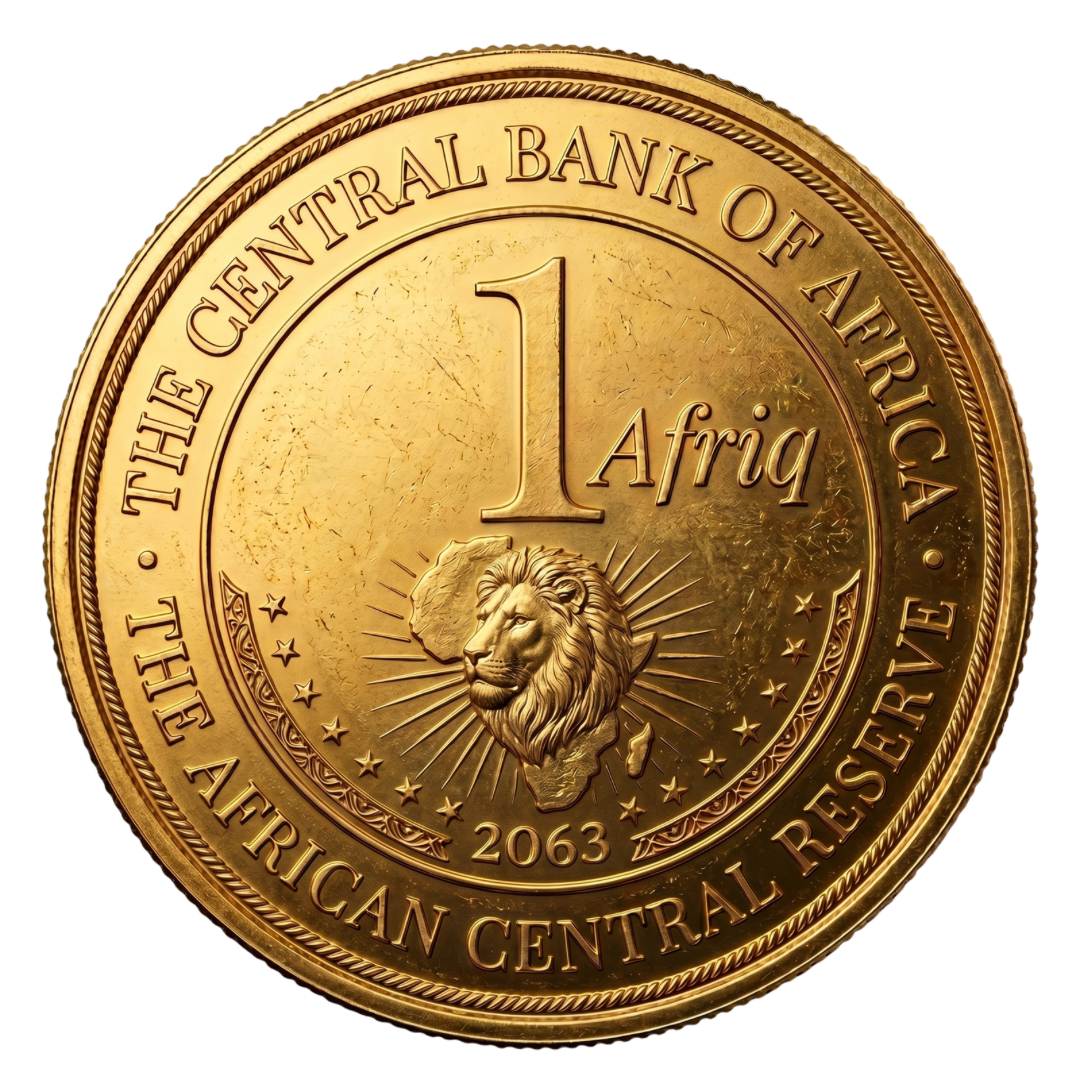
The African Union's Constitutive Act mandates the creation of the African Central Bank as one of its three founding financial institutions. Under Agenda 2063, it is targeted for establishment between 2028 and 2034, with a single continental currency, referred to in secondary literature as the "Afriq", as its eventual issuance. As of February 2026, the AU's own documentation confirms that the draft strategy for the ACB's establishment is still awaiting submission to the AU Assembly. No currency has been designed. No blockchain infrastructure exists. No physical vaulting or tokenisation network has been established. No settlement architecture has been published.
The Afriq remains a name without a mechanism.
Ndege Money© is at a more advanced stage of development than any publicly documented African continental currency initiative. It is a blockchain-based, asset-backed digital currency anchored in verified African mineral reserves held in The African Rare Earth Mineral Fund©, with custody recorded on the OmniGaza® quantum-resistant ledger and subject to independent quarterly audit. The physical infrastructure network that underpins it, encompassing testing, hallmarking, processing, vaulting, and tokenisation facilities across the continent, is under active development alongside the digital architecture. Ndege Money© is in live-testing as the transactional substrate of the Central Bank of Africa℠. Every transaction is timestamped, immutable, and publicly verifiable in real time.
The Democratic Republic of Congo holds 70% of global cobalt reserves. South Africa holds 90% of global platinum group metals. Zimbabwe holds the world's second-largest lithium deposits. The International Energy Agency's 2024 Critical Minerals Outlook projects demand for these strategic reserves to increase between 260 and 418% by 2040, driven by the clean energy transition. When Ndege Money© is backed by the minerals powering that transition, its reserve value moves with global demand for Africa's own sovereign wealth.
Nigeria has devalued the Naira 43% since 2020. Ghana restructured USD 30 billion in debt in 2023 after currency depreciation rendered dollar-denominated obligations unsustainable. Zimbabwe's currency has collapsed five times since 1980. These are not governance failures alone. They are the structural consequences of fiat currencies lacking institutional credibility and continental reserve management. Ndege Money© addresses that deficit at its root. The AU's mandate is legitimate and its timeline is acknowledged. Ndege Money© is the execution that mandate has always required, advancing now rather than awaiting the consensus that has historically proved elusive.
OmniGaza® as Clearing Layer
The Central Bank of Africa℠ operates on the OmniGaza® quantum-resistant blockchain clearing layer, developed and owned wholly by Africa's Sovereign Development Trust® through The Ndege Group®, with registered trademark held at the Kenya Industrial Property Institute (KIPI No. 138985).
OmniGaza® provides real-time gross settlement with 2-second finality, eliminating the overnight counterparty risk embedded in current correspondent banking arrangements. It operates local currency trading pairs, removing the United States Dollar and Euro intermediation that currently adds 4 to 6% to every intra-African commercial transaction. Every monetary policy decision, reserve movement, and bond purchase is immutably timestamped on-chain and visible to the public within 2 seconds, not disclosed quarterly with months of processing delay. This is payment systems architecture designed for the scale and financial sovereignty of a continent.
For comparison, the Bank for International Settlements' Project mBridge, launched in 2024 between China, Hong Kong, Thailand, Saudi Arabia and the UAE, reduced cross-border settlement costs by 50% and settlement time to under 3 seconds. It remains a permissioned system controlled by participating central banks. OmniGaza® is a sovereign African system, reporting to the Pan African Court℠ rather than any external monetary authority, with 3,571 transactions per second throughput sufficient for the entire African Continental Free Trade Area's projected 2030 transaction volume.