
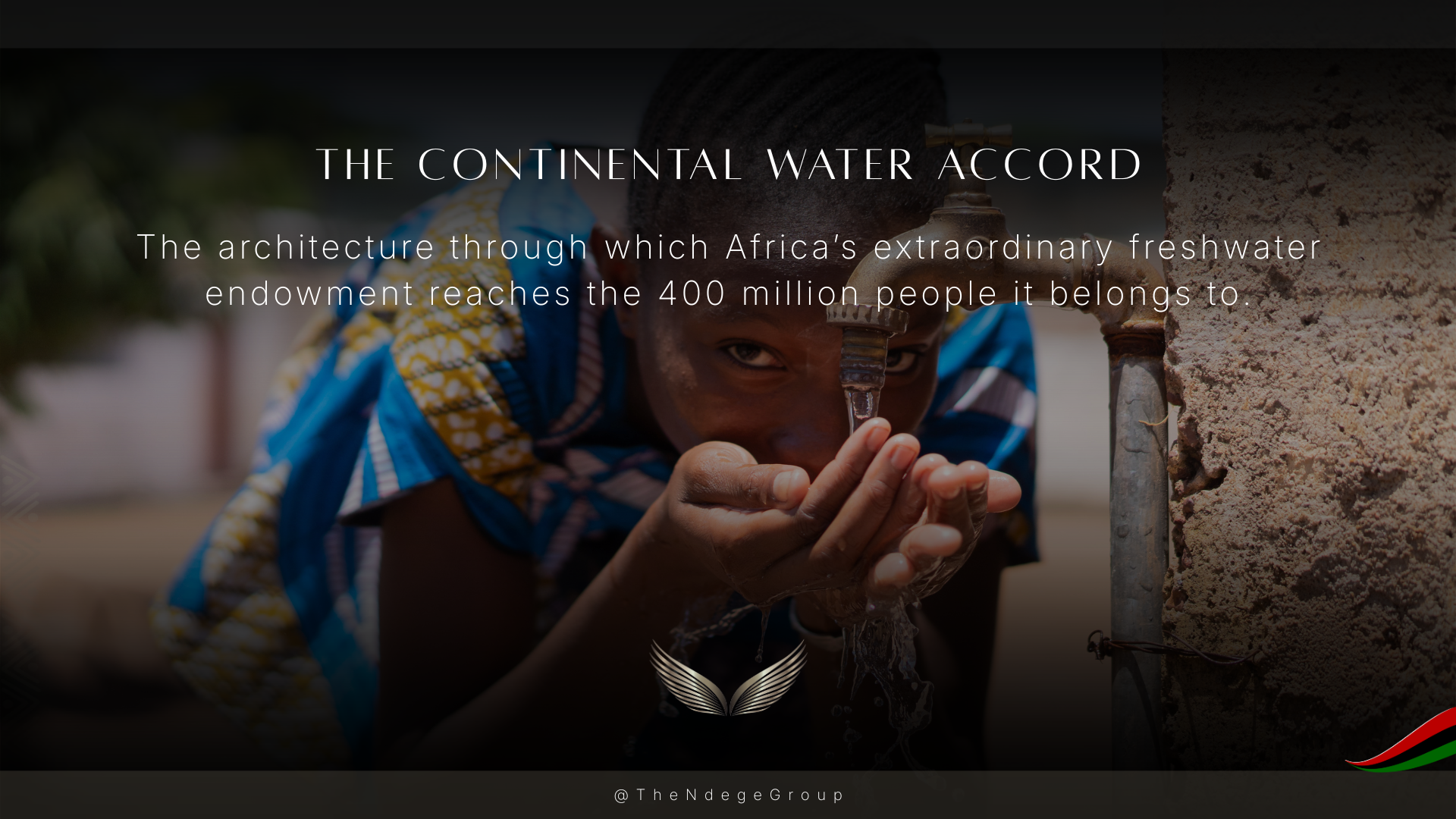
Africa holds approximately 30 per cent of the world’s total freshwater reserves. The Nubian Sandstone Aquifer System, lying beneath 2.2 million square kilometres of Libya, Egypt, Sudan, and Chad, contains an estimated 150,000 cubic kilometres of water: enough, at controlled extraction rates, to supply the entire continent for generations. The Congo River discharges 41,000 cubic metres into the Atlantic Ocean every single second, a volume so large that it exceeds ten times Europe’s total annual freshwater consumption, and most of it flows into the sea ungoverned, unmeasured, and unpriced. Against this abundance, 400 million Africans have no reliable access to clean water, the Lake Chad Basin has contracted by 90 per cent in sixty years under the watch of a commission that has been meeting since 1964, and the Nile, the continent’s most contested river, is governed by a treaty written in 1929 by an empire that no longer exists and signed by countries that represent less than a fifth of the basin’s riparian population. The institutional failure is total. The resource abundance is equally total. This article is the architecture that connects those two facts. It examines the hydrological paradox, the colonial inheritance, the gap in every existing framework, the scientific and legal basis for a continental right to water, and the ratification pathway toward the Continental Water Accord advancing under the African Federation Treaty Framework© (Amayo Jr., 2026). It then proposes something no continental water instrument has yet attempted: a Continental Water Pipeline Network modelled on Europe’s gas infrastructure, charging tokenized water credits through the OmniGaza® platform to governments and industrial operators, converting the continent’s hydrological abundance into a sovereign revenue stream that funds the very infrastructure through which it flows. The Trans-boundary Water Tribunal constituted under the Pan African Court℠, the Continental Water Commission, and the African Water Fund are the governance, judicial, and financial architecture that makes the pipeline accountable. Water sovereignty is the precondition the Unified Energy Grid, the Land Question, and the Continental Digital ID all assume and none of them resolve. This article resolves it.
The Hydrological Paradox: A Continent Governed Dry
Africa is, by every hydrological measure, one of the most water-rich landmasses on Earth. Its freshwater endowment encompasses approximately 30 per cent of the world’s total surface and underground reserves (UN-Water, 2024). The Congo River drains a basin of 3.7 million square kilometres across ten countries and discharges approximately 41,000 cubic metres of water into the Atlantic Ocean every second, a volumetric flow second only to the Amazon in the recorded history of global hydrology (FAO, 2024). Lake Victoria, shared between Kenya, Tanzania, and Uganda, is the world’s largest tropical lake by surface area, holding approximately 2,750 cubic kilometres of water in its basin and supporting the livelihoods of more than 40 million people along its shores and catchment tributaries (Lake Victoria Basin Commission, 2024). The East African Rift Valley system contains Lake Tanganyika, the world’s second deepest freshwater body after Lake Baikal, shared between the Democratic Republic of Congo, Tanzania, Zambia, and Burundi, holding roughly 18,940 cubic kilometres of water. Africa holds every condition required for hydrological abundance and governs it in a way that produces hydrological crisis.
To start, the most instructive measure of the institutional deficit is a geographic one. Lake Chad, whose basin covers portions of Nigeria, Niger, Chad, Cameroon, Sudan, the Central African Republic, and Libya, covered approximately 25,000 square kilometres in 1963. By 2024, it had contracted to approximately 1,500 square kilometres across a surface area that fluctuates seasonally, a reduction of roughly 90 per cent (Lake Chad Basin Commission, 2024). The Lake Chad Basin Commission has existed since 1964. It convened its first extraordinary summit on the lake’s contraction in 1994. It has produced action plans in 2008, 2012, 2018, and 2024, each reviewed by water ministers who returned home to domestic priorities and found no institutional mechanism compelling them to implement what they had collectively committed to. The lake has continued to contract, because an action plan issued by a body with no enforcement authority over the agricultural withdrawals, irrigation schemes, and upstream dam programmes that are the manageable secondary cause of contraction alongside climate change cannot compel member states to alter those activities. The governance failure at Lake Chad is a structural failure: the body charged with governing the resource cannot govern it.
Secondly, the Grand Ethiopian Renaissance Dam illustrates the same institutional vacuum at the level of a bilateral dispute that has become continental. Ethiopia began construction of the GERD on the Blue Nile in 2011, a project whose full reservoir capacity of 74 billion cubic metres would allow Ethiopia to generate approximately 5,150 megawatts of hydroelectric power, making it the largest such project on the continent and a critical national development instrument for a country whose rural electrification rate remains below 55 per cent (IEA, 2024). When Ethiopia began the first reservoir filling in July 2020, Egypt declared it a national security threat and requested United Nations Security Council intervention, invoking the 1959 Agreement that allocated 55.5 billion cubic metres of annual Nile flow to Egypt and 18.5 billion to Sudan. The African Union convened sixteen rounds of mediated technical and ministerial talks between 2020 and 2025. No binding agreement was reached, because the AU mediation framework has no treaty authority to compel a resolution when the parties choose to remain unresolved (AU Commission, 2025). The GERD dispute is categorically a governance dispute. Ethiopia built a dam on a river whose flow its own highlands generate, under no multilateral framework that gave any external party the authority either to approve or prevent it.
Furthermore, the Limpopo River, shared between South Africa, Botswana, Zimbabwe, and Mozambique, demonstrates the notification failure even where a framework exists. South Africa’s Vaal Dam reached below 20 per cent capacity in January 2025 following drought conditions in 2023 and 2024, generating inter-provincial water restrictions and emergency supplementation from the Lesotho Highlands Water Project (Department of Water and Sanitation, South Africa, 2025). Downstream Mozambique received no formal notification of the upstream agricultural and municipal water accounting changes that affected flow into Mozambican territory during the same period, because the SADC Protocol on Shared Watercourses’ notification mechanism is hortatory: it asks member states to notify their neighbours without specifying a timeline, a format, or a consequence for omission (SADC, 2024). A protocol whose notification requirement can be ignored without legal consequence is a notification suggestion.
The pattern across Lake Chad, the GERD, and the Limpopo is consistent and documented. Member states acting in sovereign territory in the absence of a binding framework governing shared resources will, rationally, prioritise their domestic constituencies. The solution, the only solution with a historical record of success at comparable scale, is the framework. The OMVS for the Senegal River has governed a four-country shared river for fifty years and produced hydroelectric capacity, flood control, and equitable benefit sharing because it was designed to produce outcomes, with deliberation as a secondary output. The Continental Water Accord is the OMVS scaled to the continent, constitutionalised under the African Federation Treaty Framework©, and backed by the judicial authority of the Pan African Court℠.
The Colonial Inheritance: Texts the Continent Did Not Write
The 1929 Anglo-Egyptian Treaty was signed between Britain and Egypt. Sudan, which Britain also administered, was included by imperial decision. Ethiopia, an independent sovereign state in 1929 and the country whose Blue Nile highlands supply approximately 85 per cent of the river’s total annual flow, stood entirely outside the treaty process: unconsulted, unrepresented, and unbound (FAO, 2024; Salman, 2013). The treaty granted Egypt a right of first refusal and, in effect, a right of veto over any upstream water project that might reduce the annual flow at Aswan. Ethiopia has consistently disputed the legal standing of this veto over its sovereign territory, and it is correct to do so: the veto was granted by Britain, which had no legal authority over Ethiopia, to Egypt, whose downstream benefit from the veto has never been matched by any contribution to the upstream catchment that generates the resource.
The 1959 Nile Waters Agreement between Egypt and Sudan consolidated the colonial allocation and explicitly distributed 84 billion cubic metres of annual Nile flow between the two lower-riparian states, with Egypt receiving 55.5 billion and Sudan 18.5 billion, leaving zero for the remaining eight countries in the basin and no provision for the environmental flow requirements that hydrological science now treats as non-negotiable for aquatic ecosystem health (UN-Water, 2024). For sixty-seven years, this text has been invoked by Egypt as the definitive legal instrument governing African water on the continent’s longest river, despite the text having been written by a colonial power on behalf of territories it administered by force.
The Nile Basin Initiative, established in 1999, brought all ten Nile riparian states into a sustained technical cooperation framework for the first time in recorded history and produced the Cooperative Framework Agreement in 2010, in which five upstream states, specifically Ethiopia, Uganda, Rwanda, Tanzania, and Kenya, agreed to an equitable utilisation principle that would replace the colonial allocation model. Egypt and Sudan declined to sign, citing the protection of their historical allocations. The CFA has not entered into force in the sixteen years since its drafting. The most significant institutional effort to replace colonial water law in the Nile Basin has been blocked for sixteen years without any continental judicial body empowered to arbitrate the impasse. The stalemate is the predictable outcome of a continental governance architecture that provides forums for disagreement and no authority capable of resolving it.
The Congo Basin presents a complete absence of binding governance. The Congo River moves approximately 41,000 cubic metres per second through a basin of 3.7 million square kilometres across ten countries: the Democratic Republic of Congo, Republic of Congo, Central African Republic, Angola, Zambia, Tanzania, Cameroon, Gabon, Burundi, and Rwanda. There is no Congo Basin Authority. There is no unified Congo governance framework. There is a partial regional arrangement through the International Commission of the Congo-Oubangui-Sangha, covering three of the basin’s countries in navigational coordination, without a water-sharing framework, an environmental governance mechanism, or a legal architecture governing extraction, hydroelectric development, or downstream impact across the basin’s ten countries (CICOS, 2024). The largest hydroelectric potential on the continent, embodied in the Grand Inga site alone, sits in a legal vacuum: unbuilt, ungoverned, and ungovernable under current arrangements without bilateral agreements between DRC and each of its ten basin neighbours reached individually and without a common standard.
The Continental Water Accord supersedes the colonial architecture by substitution. It creates a framework so comprehensively superior in its legal durability, its judicial enforceability, and its material benefit to all parties, including to Egypt and Sudan, that the colonial texts become progressively isolated as the Accord gains ratification. The Law of the Sea Convention (1982) did not override prior bilateral maritime agreements overnight. It created a framework of such institutional authority that those agreements have been progressively subsumed within it over four decades. The Continental Water Accord operates on the same logic, on a deliberately compressed timeline.
What Exists, What It Cannot Do, and the One Exception That Proves the Rule
Five principal institutional frameworks currently govern African water at regional level: the Nile Basin Initiative (1999), the Southern African Development Community Protocol on Shared Watercourses (2000, revised), the Niger Basin Authority (1980), the Lake Chad Basin Commission (1964), and the African Ministers’ Council on Water (2002). The UN Watercourses Convention (1997), which entered into force globally in 2014 and provides the most comprehensive universal riparian rights framework in international law, has been ratified by six African states as of 2025: Guinea-Bissau, Libya, Morocco, Namibia, Tunisia, and Côte d’Ivoire (UN Treaty Collection, 2025). Six of fifty-four. Less than twelve per cent of the continent has ratified the instrument that the international legal community considers the global standard for transboundary water governance.
The one exception to this record of institutional effort without enforcement capacity is the Organisation pour la Mise en Valeur du Fleuve Sénégal (OMVS), established in 1972 by Guinea, Mali, Mauritania, and Senegal to jointly govern the Senegal River basin. The OMVS operates a shared infrastructure programme in which dams, power stations, and water control structures are jointly owned assets under a shared governance structure that supersedes national ownership. Revenue from hydroelectric generation flows into a joint account. Maintenance costs are pooled. For more than fifty years, the OMVS has delivered hydroelectric capacity, flood control, agricultural irrigation, and navigational management across four countries. It functions because it was designed for outcomes, staffed by professionals, financed through a shared revenue model, and governed by a treaty framework that member states cannot exit without consequence. The Continental Water Accord’s regional architecture replicates the OMVS model at continental scale, with the Pan African Court℠ providing the judicial authority that the OMVS framework currently lacks.
The structural limitations of the other existing frameworks share four common features. They have no enforcement authority above the level of the individual member state. They have no standing before a judicial body capable of issuing binding rulings on water disputes. They have no financing mechanism tied to continental sovereign asset capitalisation; all current funding depends on donor contributions. They have no technical surveillance platform producing the real-time hydrological data on which any enforcement mechanism must rely. The continental governance restoration this series has documented across financial, trade, maritime, and energy dimensions reaches its deepest expression in the water domain, because water is the resource whose governance failure is most directly and most immediately visible in human mortality statistics.
The Architecture of Abundance: The Nubian Aquifer, the Congo Basin, and the Continental Water Pipeline
There is a number that does not appear in any African water governance document, any development finance prospectus, or any continental infrastructure plan that has been published in the last fifty years. It is 41,000. That is the volume, in cubic metres per second, of water that the Congo River discharges into the Atlantic Ocean every day of every year without interruption, without governance, without a pipeline, and without a price. At that flow rate, the Congo discharges approximately 1.3 trillion litres of fresh water into the sea every single day, a volume that exceeds the combined annual water consumption of the entire European Union. It enters the ocean because there is no continental architecture for directing it anywhere else. The Nubian Sandstone Aquifer System, lying beneath 2.2 million square kilometres of Libya, Egypt, Sudan, and Chad, contains an estimated 150,000 cubic kilometres of stored fossil water, the largest known underground freshwater reserve in the world (FAO AQUASTAT, 2024). Libya has already demonstrated, through the Great Manmade River project, the world’s largest irrigation infrastructure scheme, that extraction and long-distance conveyance from this aquifer is technically feasible at scale: the GMR moves 6 million cubic metres per day from wells up to 1,500 kilometres inland to the Libyan coast, through a pipeline network constructed in sections since 1984 at an eventual total cost of approximately $25 billion (Libyan Great Manmade River Authority, 2024). The technology works. The precedent exists. What has never existed is the continental framework that scales it.
The European natural gas pipeline network spans more than 200,000 kilometres of infrastructure across 30 countries, moving approximately 400 billion cubic metres of gas annually, generating revenues that fund the infrastructure, compensate the source nations, and price the commodity dynamically across the system (IEA, 2024). The TransMed pipeline carries Algerian gas under the Mediterranean Sea to Italy: 2,475 kilometres of undersea and overland pipeline infrastructure connecting a resource in North Africa to industrial consumers in Southern Europe. The infrastructure logic of the TransMed, applied to water and directed inward to the African continent, describes the Continental Water Pipeline: a network of large-diameter conveyance infrastructure moving water from the Congo Basin and the Nubian Sandstone Aquifer System to the water-scarce Sahel, Horn, and East African regions, governed by the Continental Water Accord, financed through the African Water Fund, and priced through tokenized water credits on the OmniGaza® platform.
The tokenized water credit is the instrument that converts physical infrastructure into sovereign revenue. Each cubic metre of water extracted from a governed source, whether from a regulated draw on the Nubian Aquifer or from a metered intake at a Congo tributary, is recorded on the OmniGaza® platform as a Water Credit: a non-fungible asset representing a verified unit of water, sourced from a specific location, extracted under the Continental Water Accord’s equitable utilisation framework, and delivered to a receiving authority. Governments purchase Water Credits to draw from the pipeline network. Municipal utilities purchase Water Credits to supply their distribution systems. Agricultural concessions purchase Water Credits for irrigation allocation. Industrial operators purchase Water Credits for processing and manufacturing use. The price of each Credit is set by the Continental Water Commission against a dynamic regional pricing model that accounts for extraction cost, conveyance distance, seasonal availability, and aquifer recharge rate. Revenue flows through three channels: a source country royalty paid to the state or states whose territory the water is extracted from, a pipeline maintenance fund managed by the Continental Water Accord Authority, and an African Water Fund contribution that capitalises new rural access infrastructure. A Sahel state that draws from a Congo Basin intake pays a Water Credit price that includes a royalty to the DRC, a conveyance charge to the pipeline authority, and a development contribution to the Fund. Every transaction is recorded on OmniGaza®. Every cubic metre is accountable.
The honest engineering caveat must be stated with the same force as the vision. The Nubian Sandstone Aquifer contains fossil water: water accumulated over millennia that does not recharge at extraction rates. Libya’s Great Manmade River is already drawing the aquifer down at a rate that hydrologists estimate gives the system a depletion horizon measured in centuries at current extraction levels, compressing to decades if extraction is dramatically scaled (Bakhbakhi, 2006). The Continental Water Pipeline network draws on the Nubian Aquifer as a strategic reserve, at rates governed by the Continental Water Commission’s biennial Climate Water Accounts and subject to the aquifer conservation designations of Article VIII of the Accord, not as a primary daily supply source at unrestricted volume. The Congo Basin, whose discharge is renewable, precipitation-fed, and on current climate models remains one of the most hydrologically stable river systems on Earth through 2100, is the primary long-term conveyance source (IPCC, 2023). The pipeline architecture prioritises Congo Basin routing for long-term West and Central African supply, and designates Nubian draws for strategic supplementation in high-stress dry seasons in the North African and Sahelian corridors where Congo routing is furthest and most expensive. The infrastructure phasing follows the same principle as the Unified Energy Grid: build what is most viable first, at verified performance, then extend. A pipeline from Eastern DRC to Lake Chad and the Lake Chad Basin states, approximately 1,800 kilometres, is the first corridor. A Nubian draw connection supplementing the Sudanese and Chadian sections is the strategic reserve layer. The West African corridor, connecting the upper Congo system to Sahel capitals, is the second phase.
This is infrastructure that changes daily life at the most literal level. A woman in Diffa, Niger, who walks 6 kilometres to a seasonal water point today receives a Continental Digital ID-verified water allocation from a metered household connection fed by a pipeline that her government purchased Water Credits to operate. The government of Niger paid for those Credits using a combination of African Water Fund grant allocation, pipeline revenue sharing from its own groundwater contributions to the system, and a portion of its ASDFF© financing tranche. The payment was recorded on OmniGaza®. The delivery was verified at the household metering level. The Trans-boundary Water Tribunal has jurisdiction if the supply falls below the Article II minimum of 20 litres per person per day. The woman in Diffa knows the number of her water account. She can check her allocation on the same phone she uses for Ndege Money© transactions. This is what sovereign infrastructure means at the human scale, and it is precisely what the Continental Water Accord is designed to make structurally inevitable.
The Right to Water: The African Charter, the Human Rights Architecture, and the Constitutional Gap
The African Charter on Human and Peoples’ Rights, adopted by the Organisation of African Unity in 1981 and in force since 1986, is the foundational human rights instrument of the African continental system. Article 16 establishes the right to enjoy the best attainable state of physical and mental health. Article 21 establishes the right of peoples to freely dispose of their wealth and natural resources, and to be free from exploitation through the deprivation of those resources. Article 24 establishes the right of all peoples to a general satisfactory environment favourable to their development. Water does not appear explicitly in any of these provisions. The African Commission on Human and Peoples’ Rights has interpreted Articles 16, 21, and 24 collectively as encompassing a right to water, in communications and general comments that carry persuasive authority within the continental human rights system (ACHPR, 2012). The UN General Assembly resolved in Resolution 64/292 (2010) that safe and clean drinking water and sanitation constitute a human right essential to the full enjoyment of life and all other human rights. South Africa’s Constitution provides the most developed domestic model in Africa: Section 27 grants the right of access to sufficient food and water, and the Constitutional Court’s judgment in Mazibuko and Others v City of Johannesburg (2010) established a minimum quantity standard of 42 litres per person per day as the applicable benchmark for the domestic right.
The gap at continental level is structurally precise. Water is a human right in interpretation, in UN resolution, and in the domestic law of several African constitutions. It is in explicit continental treaty text only once the Continental Water Accord enters into force. The Accord inserts that right with the clarity of a founding instrument, specifying a minimum of 20 litres of clean water per person per day as the floor of the continental right, enforceable before the Pan African Court℠, and establishing the Continental Water Commission’s obligation to publish an annual delivery assessment for each member state. The 20-litre figure is set deliberately below South Africa’s domestic 42-litre standard, to establish an achievable baseline for the continent’s most water-insecure communities while allowing higher domestic standards to coexist within the continental floor. The right establishes a minimum floor upon which higher domestic standards may be built. The World Health Organisation recommends a minimum of 50 litres per person per day for full health protection, with 20 litres as the survival minimum (WHO, 2003). A continent that cannot guarantee the survival minimum at continental level has a political priority problem, and the Continental Water Accord resolves it by the mechanism that political priority problems have always responded to: enforceable obligation.
The Ratification Architecture: Reverse-Engineered from Entry into Force
The route to ratification is political and bureaucratic in equal measure, and the only genuinely efficient path through it is one that addresses both dimensions simultaneously and in the correct sequence. The existing failure mode of continental water summitry is the communiqué cycle: a gathering at which ministers or heads of state articulate shared aspirations, adopt a text, return home, and decline to submit it to their national parliaments on the grounds that domestic political conditions are unpropitious. Twenty-six years of ministerial meetings have not produced a binding continental water framework. The Continental Water Accord will be produced by a different design.
The Accord’s ratification architecture is governed by a single organising principle: the Founding Symposium concludes the deliberation process as its final step. By the time ministers and heads of state convene, every technical provision has been negotiated by experts, every national objection has been addressed in bilateral consultations, every parliamentary water committee has been formally briefed, and the event’s function is to execute decisions that have already been made through the preceding deliberation process. The deliberation precedes the event. The event is the conclusion.
The thirty-six month ratification pathway operates across three phases. Phase One, spanning months 1 to 12, is the technical and pre-parliamentary groundwork phase. Six transboundary basin working groups are constituted, one each for the Nile, the Congo, the Niger, the Zambezi-Limpopo-Orange system, the East African Rift lakes, and the North African Aquifer System. Each working group convenes four times across twelve months, meeting for three working days each time, with all technical papers submitted and circulated thirty days in advance. Working group sessions bring together hydrologists, legal drafters, and basin management specialists in their technical capacity, without the policy generalists who rotate with every ministerial reshuffle. Simultaneously, the Pan-African Parliament’s Committee on Rural Economy, Agriculture, Natural Resources and Environment conducts country visits to the twenty highest-priority ratifying states in months 6 through 12, briefing national parliamentary water committees on the draft text. The ASDT REIT platform and the African Sovereign Development Finance Fund© commit the first tranche of the African Water Fund to the ten highest-priority rural water access projects on the continent during this phase, demonstrating the Accord’s material consequence before the signing ceremony occurs.
Phase Two, spanning months 13 to 24, constitutes the Founding Symposium and national ratification window. The Founding Symposium convenes in month 13 as a structured three-day event. Day One is technical plenary: the six basin working group reports are formally received, any outstanding technical objections are resolved in pre-convened bilateral sessions, and the draft accord text is adopted. Day Two is the signing ceremony: member states that are prepared to sign do so, committing to parliamentary submission within ninety days. Day Three is the activation session: the Pan African Court℠ formally constitutes the Trans-boundary Water Tribunal, the African Water Fund receives its initial ASDFF© capitalisation, the Continental Water Commission holds its inaugural procedural session, and the Continental Water Pipeline Network’s Phase One corridor study is formally commissioned. The twenty-eight country threshold for entry into force is the target for month 18.
Phase Three, spanning months 25 to 36, is the entry-into-force and first operational cycle. Upon reaching twenty-eight ratifications, the Continental Water Accord Authority is formally constituted as an operational subsidiary of Africa’s Sovereign Development Trust®. The OmniGaza® Continental Water Intelligence Platform is activated across all ratifying member states, providing real-time hydrological monitoring, shared aquifer tracking, transboundary flow accounting, and Water Credit issuance. The Trans-boundary Water Tribunal receives its inaugural caseload. The first Annual Water Account has been submitted and published for every ratifying state. By month 60, full continental ratification is the operational target, drawn from the non-founding states through continued bilateral engagement, technical assistance, and the demonstrated benefit of the framework’s first two years of operation.
The Continental Water Accord
Amayo Jr., 2026 · For Ratification Under the AFTF©We, the member states of the African Union, acting in the sovereign interest of the African continent and all its peoples, recognising that water is the foundational resource upon which every dimension of human dignity, economic sovereignty, and ecological integrity depends, affirming that the governance of water is an act of governance over life itself, and determined to establish an institutional architecture whose authority derives from African consent and whose benefit flows to African citizens, hereby adopt the Continental Water Accord as a binding instrument of the African Federation Treaty Framework©.
The freshwater resources of the African continent, including all surface waters, transboundary river systems, shared lake basins, underground aquifer formations, and the Continental Water Pipeline Network, constitute a continental commons held in sovereign trust by the African Federation Treaty Framework© on behalf of all present and future generations of Africans. No member state, corporate entity, or external power may claim exclusive dominion over a shared watercourse to the material detriment of another signatory state or its civilian population. All extraction, diversion, and development activity on shared watercourses shall be governed by the principles of equitable utilisation, significant harm avoidance, prior notification, and environmental flow protection as specified in this Accord.
Every African citizen holds an inalienable right to access a minimum of twenty litres of clean water per person per day within a reasonable distance of their place of habitual residence. This right is directly enforceable before the Pan African Court℠ and before the national courts of every ratifying member state. No economic circumstance, fiscal constraint, or administrative shortfall shall serve as justification for a member state’s failure to progressively realise and ultimately deliver this minimum standard to every citizen under its jurisdiction. The Continental Water Commission shall publish an annual Water Rights Delivery Assessment for each member state, which shall constitute admissible evidence before the Trans-boundary Water Tribunal and the Pan African Court℠.
Upstream states retain the sovereign right to the reasonable and equitable use of shared watercourses for agricultural, industrial, hydroelectric, and domestic purposes, provided that such use does not cause significant harm to downstream states or to the watercourse’s minimum ecological flow. All member states shall notify the relevant Regional River Basin Commission in writing not less than ninety days before undertaking any project that will materially affect the flow, quality, or seasonal distribution of a shared watercourse. Failure to provide timely notification constitutes a treaty breach, reviewable before the Trans-boundary Water Tribunal on the application of any affected member state.
Water-sharing agreements entered into by colonial authorities on behalf of African territories prior to the independence of those territories, including the 1929 Anglo-Egyptian Treaty and the 1959 Nile Waters Agreement insofar as they purport to bind states that were not parties to them, are superseded by the Continental Water Accord upon its entry into force with respect to all signatory states. Historically established allocations that were accepted by the post-independence governments of the beneficiary states are recognised and protected within the Continental Water Accord’s equitable utilisation framework. No state loses a historically accepted allocation through this Accord; all states gain a judicially enforceable allocation in its place.
A permanent Trans-boundary Water Tribunal shall be constituted as a specialised chamber of the Pan African Court℠, with jurisdiction over all disputes between member states arising from the application or breach of this Accord. The Tribunal shall comprise seven jurists with specialist expertise in international water law, environmental law, and African riparian systems, appointed to six-year renewable terms by the Pan African Court℠ in consultation with the Continental Water Commission. The Tribunal’s decisions shall be binding upon all signatory states and enforceable through the Pan African Court℠’s standard enforcement mechanisms. No member state may opt out of the Tribunal’s jurisdiction while remaining a party to this Accord.
The Continental Water Commission shall be constituted as an operational subsidiary of the Continental Water Accord Authority, comprising the chairs of the six Regional River Basin Commissions, the director of the OmniGaza® Continental Water Intelligence Platform, and a minimum of two representatives of African civil society water organisations appointed through the Pan-African Parliament. The Commission shall receive, publish, and act upon annual Water Accounts submitted by each member state, maintain the continental hydrological database through the OmniGaza® platform, govern Water Credit issuance and pricing through the Continental Water Pipeline Network, and refer cases of persistent member state non-compliance to the Trans-boundary Water Tribunal. The Commission is a professional body whose members serve in their institutional capacity, with fixed terms that outlast any single government rotation.
The African Sovereign Development Finance Fund© shall establish a dedicated African Water Fund, capitalised initially from the ASDFF©’s first tranche of sovereign asset-backed financing, targeting a minimum of $28 billion for Phase One infrastructure programmes including rural water access, shared aquifer rehabilitation, transboundary flow monitoring, and the inaugural corridor of the Continental Water Pipeline Network from Eastern DRC to the Lake Chad Basin states. Water Credits issued through the OmniGaza® platform shall constitute the pricing and revenue mechanism for all pipeline conveyance, with revenue distributed across source country royalties, pipeline maintenance, and African Water Fund capitalisation. The ASDT REIT platform channels private infrastructure capital into verified bankable water projects under the Fund’s governance architecture.
Transboundary aquifer formations shared between two or more member states are declared a continental heritage resource and shall be governed under the Continental Water Accord with equitable utilisation, prior notification, and significant harm avoidance principles. The Nubian Sandstone Aquifer System, the Iullemeden Aquifer System, and the Karoo Aquifer System are designated as strategic conservation systems, with extraction rates governed by the relevant Regional Basin Commission under sustainability standards specified by the Continental Water Commission. All extraction from designated conservation systems contributing to the Continental Water Pipeline Network shall be logged in real time on OmniGaza® and subject to annual recharge assessments that automatically trigger extraction rate reviews when drawdown thresholds are approached.
Each member state shall submit to the Continental Water Commission a biennial Climate Water Account documenting changes in precipitation patterns, glacial and snowpack storage, evapotranspiration rates, and groundwater recharge levels attributable to climate change, using the OmniGaza® platform’s standardised monitoring and reporting methodology. The aggregate Climate Water Accounts shall produce a Continental Hydrological Baseline Assessment updated every four years, constituting the primary evidential basis for any allocation adjustment proceedings before the Trans-boundary Water Tribunal. Climate-driven reductions in shared watercourse flow shall trigger a Shared Burden Protocol under which equitable reduction in allocations is distributed proportionally across all riparian states in accordance with their existing equitable use assessments.
This Accord shall enter into force upon the deposit of instruments of ratification by twenty-eight or more member states of the African Union. Upon entry into force, the Accord is binding upon all ratifying states and the Continental Water Pipeline Network’s inaugural corridor study is immediately commissioned. The Founding Symposium shall be convened no later than twelve months from the date of the first signature. The target for entry into force is eighteen months from the Founding Symposium date. This Accord has been designed for permanence: it is the foundational water governance instrument of the African Federation and shall endure for as long as the continent’s water does.
The Institutional Hierarchy: From the Pan African Court to the Local Watershed Council
The Continental Water Accord Authority operates through a five-level institutional hierarchy in which authority flows from the constitutional apex downward and accountability flows from the operational base upward. Every level has a defined function, a defined relationship to the levels above and below it, and a defined accountability mechanism. No level is advisory. Every level operates with delegated executive authority within its specified domain.
The Founding Symposium: A Proposal for Continental Gatherings That Produce Binding Instruments
The current model of African continental water summitry has a consistent output: a communiqué. Ministers travel, deliberate, and agree on principles. The principles are documented. The ministers return home. The documentation sits in archives that the next set of ministers consult before travelling to deliberate on principles. The model has been running, in various forms, across AMCOW, the Nile Basin Initiative, the SADC water protocol review mechanisms, and the Lake Chad Basin Commission, for more than forty years without producing a binding continental water framework. The model fails because it is designed to produce deliberation, and deliberation is governance only when it feeds into a mechanism that converts it into obligation. The Founding Symposium is designed around the opposite principle: the event produces signatures. All deliberation occurs before it.
The Founding Symposium follows a Pre-commitment Architecture with five distinct phases, each with a non-negotiable output:
Six transboundary basin working groups convene four times each, with technical papers submitted thirty days in advance. Their output is agreed draft text: provisions that have been technically resolved and formally endorsed by the working group, ready for legal drafting. Ministers attend only the Founding Symposium itself; they are excluded from the working group phase. Technical staff, hydrologists, legal drafters, and pipeline engineers are. The output is a technical accord that is politically uncommitted but technically complete, including the Phase 1 Continental Water Pipeline corridor specification.
National parliamentary water committees in the thirty highest-priority ratifying states receive the draft technical text, a country-specific impact assessment, and in-person or virtual briefings from basin commission technical staff. Each committee is asked to submit a formal legislative position paper within sixty days. The position papers are publicly published and form the basis of the bilateral consultations in Phase C.
Every objection raised in the parliamentary position papers is addressed through bilateral consultations convened by the CWAA Secretariat with a defined output: either a textual amendment that resolves the objection, or a formal notation in the accord that the objection has been considered and the text maintained for specified reasons. By the end of month 12, every objection that can be resolved has been resolved.
Day One: Technical plenary. The six basin working group reports are formally received and adopted. No debate: only formal adoption of documents that were resolved in Phase C. Day Two: The signing ceremony. Ministers and heads of state sign. The signing constitutes the central event, with all debate concluded in the preceding phases. Day Three: The Activation Summit. The Pan African Court℠ constitutes the Trans-boundary Water Tribunal. The African Water Fund receives its first ASDFF© tranche. The Continental Water Commission holds its inaugural session. The OmniGaza® Water Intelligence Platform issues its first Water Credits. The Continental Water Pipeline Network Phase 1 corridor study is commissioned.
Signatory states submit the text to their national parliaments within ninety days of the Founding Symposium. Entry into force is triggered at twenty-eight ratifications, targeted for month 18 from the Founding Symposium. The first bilateral water dispute submitted to the Trans-boundary Water Tribunal is expected within six months of the Tribunal’s formal constitution.
A Summary of the Water Sovereignty Case
Six arguments have been made. The hydrological paradox establishes that Africa’s water crisis is a governance deficit: Lake Chad’s 90 per cent contraction across six decades of an active regional commission, the GERD’s sixteen years of unresolved legal status across sixteen rounds of AU mediation, and the Limpopo’s notification failures under an existing protocol all demonstrate a governance deficit in which institutional coordination has failed while resources remain abundant. The colonial inheritance establishes that the foundational texts governing African water on its most contested rivers were written by an empire, signed without African consent, and have been blocking the continent’s most legitimate hydroelectric and agricultural development ambitions ever since. The existing frameworks establish that AMCOW, the Nile Basin Initiative, the SADC Protocol, the Niger Basin Authority, and the Lake Chad Basin Commission represent forty years of genuine institutional effort without the judicial authority that converts effort into guaranteed outcomes, and that the OMVS proves the alternative works. The architecture of abundance establishes that the Nubian Sandstone Aquifer System holds 150,000 cubic kilometres of water and the Congo River discharges 41,000 cubic metres per second into the sea ungoverned, and that the Continental Water Pipeline Network, pricing tokenized Water Credits through OmniGaza® on a European gas pipeline model, converts that abundance into sovereign infrastructure revenue. The right to water establishes that the continental human rights architecture carries the right in interpretation but not in binding continental treaty text with a specified minimum and a judicial enforcement mechanism. The ratification architecture establishes that the thirty-six month pathway from technical working groups to entry into force is achievable on a design principle that places deliberation before the event and uses the event only for execution.
Three Counter-Arguments and Their Honest Resolution
First: the Egypt veto objection. Egypt will block any continental water framework that diminishes or legally subordinates its historical Nile allocation. Egypt is a country of 106 million people whose dependence on the Nile for approximately 97 per cent of its national freshwater supply is documented and genuine (World Bank, 2024). Its strategic opposition to any upstream water framework is the predictable behaviour of a state whose survival water source flows through ten upstream countries it cannot fully control.
The Continental Water Accord elevates Egypt’s water right. Egypt’s current allocation is guaranteed by a colonial text that has no enforcement mechanism, was signed by an empire that no longer exists, and has legal standing in international law that is genuinely ambiguous given that its primary signatory, Britain, signed on behalf of territories it administered by force. The Continental Water Accord converts Egypt’s historically established allocation into a treaty right, recognised by the Pan African Court℠, guaranteed by a judicial enforcement mechanism, and durable beyond the life of any bilateral diplomatic relationship. The Continental Water Pipeline Network adds a further incentive: Egypt, as a Nubian Aquifer state and a party to the pipeline governance architecture, participates in Water Credit revenue flows as both a source country and a downstream beneficiary. A water right guaranteed by a continental court is more secure than a water right guaranteed by a colonial text, and Egypt’s water negotiators are capable of recognising that distinction.
Secondly: the colonial treaty legality objection. The 1929 Treaty and the 1959 Agreement are binding international law between their parties. A continental instrument cannot simply declare them superseded without the consent of Egypt and Sudan, and that consent will not be given.
This objection is legally precise and does not describe an obstacle. The Continental Water Accord’s Article IV supersedes the effect of those texts progressively and by substitution, in the same manner as the Law of the Sea Convention replaced prior bilateral maritime arrangements over four decades without requiring any bilateral party to repudiate its existing agreement. When twenty-eight African states ratify the Continental Water Accord and the Trans-boundary Water Tribunal begins issuing binding judgments on Nile disputes, the legal, diplomatic, and reputational cost of remaining outside the framework rises continuously for every non-ratifying state. The Continental Water Accord requires twenty-eight of fifty-four African states to enter into force: none of whom need be Egypt. It creates a framework that Egypt will eventually ratify because the alternative is to litigate every upstream water decision before a Tribunal whose jurisdiction it has not accepted but whose judgments its neighbours are bound by.
Furthermore: the pipeline engineering and capacity objection. The Continental Water Pipeline Network is a multi-thousand-kilometre infrastructure project of extraordinary cost and complexity, and the technical and political capacity to build it across sovereign jurisdictions does not currently exist in the form required.
Libya’s Great Manmade River already conveys 6 million cubic metres per day across 1,500 kilometres of pipeline infrastructure in operational conditions that include desert terrain, political instability, and decades of maintenance under resource constraint (Libyan Great Manmade River Authority, 2024). Algeria has supplied European gas markets through the TransMed pipeline, running under the Mediterranean Sea, since 1983. The engineering precedents for long-distance water and gas conveyance on African and Mediterranean terrain are documented and functioning. The pipeline network proposed in this article draws on both precedents and sequences its construction by the same principle as the Unified Energy Grid: verified performance phase by verified phase, beginning with the most viable corridor and extending as each phase demonstrates its revenue model. The DRC-Lake Chad Basin Phase 1 corridor connects two of the continent’s most water-rich and water-stressed regions across terrain that does not require subsea routing, through countries whose bilateral relationships are among the most developed in Central and West Africa. The Water Credit revenue model funds the next phase from the returns of the first. The capacity is built as the project progresses, through the same mechanism by which every large infrastructure programme has ever been built: commencement.
Water Is the Precondition This Series Has Been Circling
Every article in this series has documented a specific dimension of Africa’s sovereignty architecture, and every one of them has treated the continent’s water as available, equitably distributed, and governed by accountable institutions, without ever making those assumptions explicit. The Unified Energy Grid depends on water: Grand Inga’s hydroelectric potential requires the Congo River to flow through a governance architecture that can manage the reservoir and distribute power purchase revenues equitably. The Land Question depends on water: land title is only as valuable as the irrigation access and water right that make the land productive. The sustainable farming programme depends on water: the aquifer governance provisions of Article VIII govern the agricultural water draws that either make smallholder irrigation viable or exhaust the shared resource that makes it possible. None of that interdependence resolves itself through deliberation. It resolves through the Continental Water Accord.
The 1929 Anglo-Egyptian Treaty has governed Nile water for 96 years. It was written without African authorship, signed without African consent, and has produced nearly a century of diplomatic tension between the continent’s most water-dependent state and the continent’s most water-generative one. The Continental Water Accord is written with African authorship, designed for African ratification, and governed by an African court. The Continental Water Pipeline Network converts the continent’s hydrological abundance, 41,000 cubic metres per second flowing to the Atlantic Ocean and 150,000 cubic kilometres stored beneath the Sahara, into sovereign infrastructure that changes daily life at the household level, priced through Water Credits on OmniGaza®, governed by the Pan African Court℠, and financed through the African Sovereign Development Finance Fund©. The complete constitutional and institutional architecture of the African Federation Treaty Framework© is permanently archived at doi.org/10.5281/zenodo.18365997. This Accord, the Continental Water Accord itself, is permanently archived at doi.org/10.5281/zenodo.22067750. Water basin technical leads, national water ministry directors, riparian rights legal specialists, climate hydrologists, transboundary aquifer scientists, parliamentary water committee chairs, pipeline engineers, and continental agricultural investment partners are invited to engage directly through the Strategic Executive Office of Africa’s Sovereign Development Trust®. The Trans-boundary Water Tribunal will hear its first case when enough member states have ratified the Accord to constitute its jurisdiction. The drafting of that first case has already begun.
The 1929 Treaty was written without African consent. It has governed African water for 96 years. The Continental Water Accord is written with African authorship, ratified by African governments, and enforced by an African court. The Continental Water Pipeline will move 41,000 cubic metres per second away from the Atlantic Ocean and toward the 400 million people who need it. That is what sovereignty looks like at the hydrological scale.
David Okiki Amayo Jr., Founder and Chairman, Africa’s Sovereign Development Trust®
African Charter on Human and Peoples’ Rights (Banjul Charter). (1981). Organisation of African Unity. au.int
African Commission on Human and Peoples’ Rights. (2012). General Comment No. 3 on the African Charter on Human and Peoples’ Rights: The Right to Life. Banjul: ACHPR.
African Ministers’ Council on Water. (2025). African Water Vision 2025: Equitable and Sustainable Use of Water for Socioeconomic Development. Abuja: AMCOW.
African Union Commission. (2025). Report on the Status of Nile Basin Mediation Proceedings: 2020 to 2025. Addis Ababa: AUC.
Amayo Jr., David Okiki. (2026). The African Federation Treaty Framework©: Version 3.1. Operational Architecture for Continental Socioeconomic Sovereignty. Zenodo. doi.org/10.5281/zenodo.18365997
Amayo Jr., David Okiki. (2026). Addendum 069: The Continental Water Accord. Riparian Sovereignty, the Trans-boundary Water Tribunal, and the Continental Water Pipeline Network. Zenodo. doi.org/10.5281/zenodo.22067750
Amayo Jr., David Okiki. (2026). Addendum 068: Sovereign Asset Parity. Africa’s Sovereign Development Trust®. thendegegroup.com
Bakhbakhi, M. (2006). Non-Renewable Groundwater Resources: A Guidebook on Socially-Sustainable Management for Water-Policy Makers. IHP-VI, Series on Groundwater No. 10. Paris: UNESCO.
Commission Internationale du Bassin Congo-Oubangui-Sangha (CICOS). (2024). Annual Report 2024. Kinshasa: CICOS.
Constitutional Court of South Africa. (2010). Mazibuko and Others v City of Johannesburg and Others [2010] ZACC 28. saflii.org
Department of Water and Sanitation, South Africa. (2025). Vaal River System Operating Rules: January 2025 Status Report. Pretoria: DWS.
Food and Agriculture Organisation of the United Nations. (2024). AQUASTAT: Africa Regional Overview 2024. Rome: FAO. fao.org
International Energy Agency. (2024). Financing Clean Energy in Africa. Paris: IEA. iea.org
IPCC. (2023). Climate Change 2023: Synthesis Report. Contribution of Working Groups I, II and III to the Sixth Assessment Report of the Intergovernmental Panel on Climate Change. Geneva: IPCC.
Lake Chad Basin Commission. (2024). The Lake Chad Restoration Initiative: Progress Report 2024. N’Djamena: LCBC.
Lake Victoria Basin Commission. (2024). State of the Lake Victoria Basin 2024. Kisumu: LVBC.
Libyan Great Manmade River Authority. (2024). GMR Project: Operational Statistics 2024. Tripoli: GMRA.
Nile Basin Initiative. (2024). Nile Basin Initiative Annual Report 2024. Entebbe: NBI Secretariat. nilebasin.org
Organisation pour la Mise en Valeur du Fleuve Sénégal. (2024). OMVS Annual Report 2024. Saint-Louis: OMVS.
Salman, S. M. A. (2013). The Nile Basin Cooperative Framework Agreement: A Never-Ending Story. Natural Resources Journal, 53(1), 89–125.
Southern African Development Community. (2024). Status Report on Implementation of the SADC Protocol on Shared Watercourses. Gaborone: SADC Secretariat.
United Nations Committee on Economic, Social and Cultural Rights. (2002). General Comment No. 15: The Right to Water. Geneva: UN. E/C.12/2002/11.
United Nations General Assembly. (2010). Resolution 64/292: The Human Right to Water and Sanitation. New York: UN. A/RES/64/292.
United Nations Treaty Collection. (2025). Convention on the Law of the Non-Navigational Uses of International Watercourses (1997): Status of Ratification. treaties.un.org
UN-Water. (2024). The United Nations World Water Development Report 2024: Valuing Water. Paris: UNESCO. unwater.org
World Bank Group. (2024). Egypt: Water Supply and Sanitation Overview. Washington DC: World Bank. worldbank.org
World Health Organisation. (2003). The Right to Water. Geneva: WHO. Health and Human Rights Publication Series No. 3.