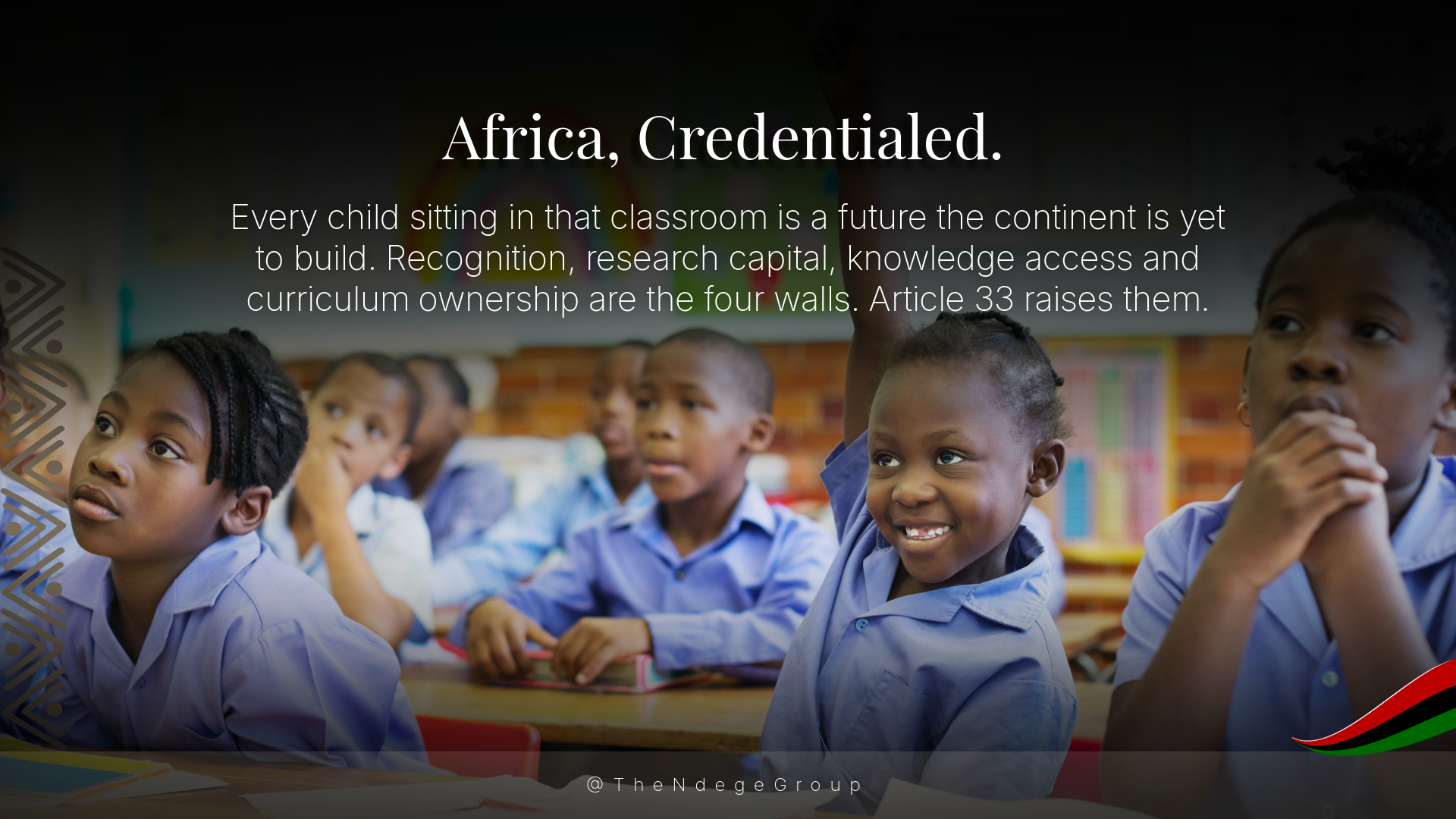
The continent's education instruments are real, funded and advancing. The Addis Convention entered into force on 15 December 2019 and records 14 state parties as of 2026. The African Continental Qualifications Framework reached a further milestone in July 2026 with the launch of a continental Qualifications and Credentials Platform at its seventh forum in Nairobi. The Continental Education Strategy for Africa 2026 to 2035 and the Nairobi Declaration on domestic financing, approved by 17 heads of state, give the policy direction its mandate. I welcome each of them without reservation. They are the foundation of what comes next. The Continental Education Sovereignty Mandate under the African Federation Treaty Framework© builds on that foundation through four layers. Recognised equivalence with binding legal effect across 54 sovereign markets comes through the Continental Accreditation and Qualifications Framework. Sovereign research capital comes through the African Research and Innovation Fund, capitalised through the African Rare Earth Mineral Fund©. A continental open access knowledge commons comes through the OmniGaza® educational data infrastructure. Curriculum owned and licensed by African institutions comes through the curriculum sovereignty protocol. Each layer returns its full value only when the other three stand beside it. This article traces the evidence for the ministers of education, national qualifications authorities, vice chancellors, African Union Commission, research funders and development finance institutions who can act on it.
I was educated on a privilege that most African children will never see, and that fact is the reason this mandate exists
I was fortunate enough to attend St Andrew's Turi in Molo for my secondary education, then St John's College in Johannesburg for my A levels, and then the University of Westminster on London's Regent Street for my undergraduate degree. I want to be clear about what that journey was: a privilege. My mother could afford it, and I got the grades. Those are the two conditions that made it possible, and they are conditions that most African students will never simultaneously hold, through no fault of their own. I had hot showers and three-course meals at school. I flew Emirates first class to term. Every A I earned became negotiating leverage with my mother for the next set of privileges, a private arrangement that I look back on with equal parts fondness and embarrassment. The point is that the arrangement was exceptional.
For the majority of children on this continent, the classroom is a tree, the teaching aid is a shared chalkboard, and the teacher in front of them is underpaid, under-resourced and working inside a system that has treated them as an afterthought. That outcome follows from choices. Public money intended for classrooms, teachers and textbooks has too often been diverted through corruption, and every shilling, naira and rand diverted widens the financing deficit this article documents. I hold that to be wrong, and I hold it to be a direct contributor to the gap between what African education needs and what it receives. The Continental Education Sovereignty Mandate under the AFTF© is, in part, a constitutional instrument designed to close the conditions under which that diversion is permitted to continue.
Africa's young population is the continent's largest asset, and the research output, financing and recognition systems that govern it were assembled with too little African capital
To start with the demographic scale: African youth are projected to exceed 40 per cent of the global youth population by 2030 (BMC Globalization and Health, 2024), and the continent's working-age population is rising from 849 million today to 1.56 billion by 2050, representing 85 per cent of the global increase in that cohort over the period (United Nations World Population Prospects, 2024). No continent in the world is producing human capital at this rate. The question the evidence raises is whether the systems assembled to govern that capital were built to serve it.
Secondly, on financing: the available estimate for annual education spending across sub-Saharan Africa stands at roughly US$106 billion against an estimated need of US$183 billion (Human Rights Watch, June 2025, citing primary UNESCO and World Bank data), a gap above 40 per cent. UNESCO's own reporting places the annual education financing gap in sub-Saharan Africa at US$70 billion, with public spending per learner at approximately US$55 against US$8,543 in high-income countries (UNESCO, 2024 and 2025 reporting). The two estimates rest on different methods and reporting years, and they differ by about US$7 billion, which places the annual gap between US$70 billion and US$77 billion. The 2026 Global Education Monitoring Report records that public education spending as a share of total public expenditure across sub-Saharan Africa fell from 13.6 per cent to 8.5 per cent between 2011 and 2022 (UNESCO GEM Report, 2026). In 2023, sub-Saharan African countries collectively spent more on debt interest than on education, a structural transfer of domestic resources away from human capital and toward external creditors, documented in the Debt Cartography set out in Article 16 of this series (DevelopmentAid, 2026, citing World Bank data).
Furthermore, on research: sub-Saharan Africa produces under 1 per cent of world research output with approximately 12 per cent of the world's population, and every African country invests less than 1 per cent of GDP in research and development; sub-Saharan R&D intensity moved from 0.44 per cent to 0.42 per cent of GDP between 2014 and 2018 (UNESCO Science Report 2021, as reported by Chemistry World and The New Times). The region sustains approximately 90 researchers per million people against a global average of 1,420 (UNESCO Institute for Statistics, as reported by The Standard, 2026). Africa as a whole accounts for approximately 2.2 per cent of global scientific publications, a figure that the broader continental aggregate includes North Africa and conceals the more concentrated deficit in sub-Saharan institutions (ThisDay, December 2025, citing UNESCO figures). The demographic asset is large. The capital assembled behind it is small. The gap between those two facts is a sovereignty deficit.
The instruments the continent has built since 2014 address that deficit with serious intent. What they require is the constitutional, financial and enforcement layer that carries their intent to completion. That layer is what the Continental Education Sovereignty Mandate constitutes.
The continent has built serious recognition, quality and policy instruments, and those instruments reach their full effect when a continental constitutional layer gives recognition binding force and finances the research beneath it
To start with recognition: the Revised Convention on the Recognition of Studies, Certificates, Diplomas, Degrees and Other Academic Qualifications in Higher Education in African States, known as the Addis Convention, was adopted on 12 December 2014 and entered into force on 15 December 2019. As of May 2026, the UNESCO register records 14 state parties among the 55 African Union member states (UNESCO conventions register, May 2026). The Global Convention on the Recognition of Qualifications concerning Higher Education entered into force on 5 March 2023 and records 41 state parties globally as of 26 May 2026, six of them African (UNESCO register; SARUA, 2025). Both instruments represent the most ambitious multilateral recognition architecture the continent has assembled. Neither yet operates with binding legal equivalence across every member state. The architecture currently stands at a precise point, and the specific gap the AFTF© equivalence provisions are constituted to close is the distance between that point and binding continental coverage.
Secondly, on the qualifications framework: the African Continental Qualifications Framework was launched in September 2019 at African Union headquarters, with its first phase supported through the Skills Initiative for Africa in partnership with the European Union and Germany's development cooperation. The ACQF's policy document was validated and its second phase formally launched on 12 July 2023, designed to improve transparency, comparability, recognition and portability of qualifications across the continent (African Union and EEAS, 2023; Learn and Work Ecosystem Library, 2026). The framework functions as a reference instrument: it allows national qualification frameworks to be mapped against a common continental standard, supporting mobility and trust between education systems. At the seventh ACQF Forum held in Nairobi from 28 to 30 July 2026, delegates officially launched a continental Qualifications and Credentials Platform designed to improve the transparency and verification of qualifications across member states, and endorsed national referencing reports from multiple authorities (KNQA, 2026). The forum represents a material advance in the infrastructure of recognition, and the Continental Accreditation and Qualifications Framework under the AFTF© is constituted to supply the binding legal effect that the ACQF's reference architecture establishes the foundation for.
Furthermore, the policy and quality layer rests on the Continental Education Strategy for Africa 2026 to 2035, the Nairobi Declaration on domestic financing for education approved by 17 heads of state, the Continental Teacher Qualifications Framework workshop convened by the African Union Commission from 25 to 27 March 2026 under the AU Decade of Education and Skills Development, the Pan African University established in 2014 as the first continental postgraduate university, and the African Quality Rating Mechanism, which provides an institutional quality framework applied across African higher education institutions (African Union press release, 30 March 2026; IPP Media, February 2026). Every one of these instruments is real, funded and advancing. What remains open at continental scale is binding equivalence, a continental research fund capitalized through African mineral assets, and a continental knowledge commons with verifiable credentials. The mandate states each gap precisely, and the architecture constituted in the AFTF© addresses each in turn.
Education Sovereignty Architecture Comparison
| Instrument or Institution | Founding Mandate | Binding Equivalence Across States | Quality Assurance and Accreditation | Research Funding | Open Access Knowledge Commons | Curriculum Ownership and Licensing | Enforcement Authority |
|---|---|---|---|---|---|---|---|
| Addis Convention | Recognition of qualifications in higher education across African states | Reference instrument; 14 of 55 state parties | Outside scope | Outside scope | Outside scope | Outside scope | No dedicated judicial mechanism |
| African Continental Qualifications Framework | Transparency, comparability, recognition and portability of qualifications | Reference and transparency framework; not binding | Referencing and comparability across national frameworks | Partner financed; no sovereign fund | Qualifications and Credentials Platform launched 2026; not a full knowledge commons | Outside scope | No judicial mechanism |
| Continental Education Strategy for Africa 2026 to 2035 | Continental education policy direction and targets | Policy framework; not legally binding | Policy targets for quality and accreditation | Financing targets; no sovereign fund | Outside scope | Outside scope | No enforcement mechanism |
| Pan African University | Continental postgraduate university network | Network; no cross-system equivalence mechanism | Quality standards within the network | Research programmes within the network | Research output within network only | Outside scope | Outside scope |
| UNESCO Global Convention | Recognition of higher education qualifications globally | 41 state parties globally; 6 African as of 2026 | Outside scope | Outside scope | Outside scope | Outside scope | No dedicated judicial mechanism |
| European Higher Education Area | Three-cycle degree structure and credit transfer across 49 participating countries | Binding across participating states; comparable degree cycles and credit system | National quality assurance aligned to European Standards and Guidelines | Research through separate EU frameworks | Outside core scope | Outside core scope | Mutual recognition enforced through national law |
| AFTF© Continental Education Sovereignty Mandate | Constitutional instrument constituting four interdependent layers of education sovereignty | Binding equivalence with legal effect in every ratifying member state | Continental Accreditation and Qualifications Framework built on ACQF, Addis Convention and AQRM | African Research and Innovation Fund capitalised through African Rare Earth Mineral Fund© | OmniGaza® in Sovereign Data Centres; Continental Digital ID for learner identity and credentials | Curriculum sovereignty protocol; authorship recorded; open licensing permitted; academic freedom protected | Pan African Court℠ for equivalence and licensing disputes; Afriq℠ settlement of fees and licensing |
An education sovereign continent rests on four interdependent layers: recognised equivalence across every member state, sovereign research capital, a continental knowledge commons with verifiable credentials, and curriculum owned and licensed by African institutions
To start with recognition and the precedent that proves the architecture is achievable: the Bologna Process created the European Higher Education Area, establishing comparable three-cycle degree structures, a common credit transfer system, and mutual recognition across 49 participating countries, enabling the free movement of students and academics across a continent with as much linguistic and institutional diversity as Africa (European Higher Education Area, n.d.). The ASEAN Qualifications Reference Framework performs an equivalent function for the ten member states of the Association of Southeast Asian Nations, providing a common reference framework for the recognition and comparability of qualifications across diverse national systems (ASEAN Secretariat, n.d.). Both demonstrate that continental or regional qualification equivalence is an institutional achievement with documented precedent, delivered at comparable scale to what Africa now requires. The Continental Accreditation and Qualifications Framework under the AFTF© applies that logic to 54 sovereign markets, building on the Addis Convention, the ACQF and the African Quality Rating Mechanism, and supplying the binding legal effect and enforcement mechanism that the existing reference frameworks establish the architecture for.
Secondly, on knowledge access and credentials: within the continent, the African Research Universities Alliance, comprising 16 leading African research universities, demonstrates the capacity for collaborative research and knowledge sharing at continental scale (African Research Universities Alliance, n.d.). The African Open Science Platform, an initiative connecting African research institutions to open science infrastructure, provides an institutional precedent for continental knowledge commons architecture (African Open Science Platform, 2018). The European Digital Credentials for Learning, adopted across European Union member states, supplies the nearest comparable precedent for verifiable credentials with cross-border recognition (European Commission, n.d.). The OmniGaza® educational data infrastructure applies a federated architecture with national partitions, learner identity and consent carried by the Continental Digital ID constituted in Article 22, and infrastructure domicile in the Sovereign Data Centres constituted in Article 26. The result is a continental open access knowledge commons in which every institution can contribute and every learner can access, with credentials recorded on an immutable ledger and verified without dependence on the institution that issued them.
Furthermore, on curriculum ownership: the evidence that African institutions are already shaping their own intellectual frameworks is documented across the continent's largest systems. Nigeria's Core Curriculum and Minimum Academic Standards, issued by the National Universities Commission and unveiled in 2022, covers 17 disciplines and 238 academic programmes, setting 70 per cent of each programme as core content and leaving the remaining 30 per cent to each university (National Universities Commission, 2022). Kenya's Competency Based Curriculum, introduced through the Kenya Institute of Curriculum Development and implemented progressively from 2017, restructures learning outcomes around demonstrable competencies owned and designed by Kenyan educators (Kenya Institute of Curriculum Development, 2019). Rwanda's language-of-instruction policy, revised by the Ministry of Education in December 2019 to make English the medium of instruction from the first year of primary school with Kinyarwanda taught as a subject, represents a curriculum sovereignty decision made by a national government on behalf of its learners (Ministry of Education, Rwanda, 2024; KT Press, 2019). Each of these is a national expression of the same logic the curriculum sovereignty protocol constitutes at continental scale: African institutions develop, own and license the intellectual frameworks their students are taught by, with authorship recorded, open licensing permitted and international partnership welcomed on African terms. The academic freedom of every institution is protected within the protocol, and no licensing arrangement operates without the institution's express consent. The African Research and Innovation Fund, capitalised through the African Rare Earth Mineral Fund© constituted in Article 14, provides the continental research capital that fills the knowledge commons the curriculum sovereignty protocol draws from. The sizing guardrail applies: a 1 per cent allocation from the US$38.8 trillion Total Verified Asset Value of the African Sovereign Development Finance Fund© (Amayo Jr., 2026c) yields US$388 billion across the full facility, and any specific allocation to the African Research and Innovation Fund is a proposal for ratification within the AFTF© architecture, subject to the ratification process that governs every instrument in this series. ASDT® has constituted each of these four layers within the AFTF©, and each advances through registration and ratification. The economic logic of that architecture is the subject of the next section.
Continental scale converts fragmented national systems into the mobility, research volume and licensing revenue that a knowledge economy requires, and the capital now spent on dependence becomes capital invested in African institutions
To start with the aid and financing trajectory: bilateral aid to sub-Saharan Africa fell 26.3 per cent in 2025, with a further 11.6 per cent fall projected for 2026, and direct aid to education globally stood at US$12.2 billion in 2024 (DevelopmentAid, 2026, citing OECD DAC data). The dependence of the ACQF's first phase on EU-German partnership financing, the reliance of the continent's research institutions on externally funded grants and journal access subsidies, and the fall in public education spending as a share of total expenditure all point in the same direction: the financing base assembled beneath the continent's education architecture is structurally exposed to decisions made elsewhere. The African Research and Innovation Fund, capitalised through the African Rare Earth Mineral Fund©, supplies the alternative. It converts the continent's documented mineral asset base into African-owned research funding, doctoral fellowships and laboratory infrastructure that does not depend on donor cycles or external grant calendars. The Unified Energy Grid constituted in Article 19 powers the campuses and connectivity the system requires.
Secondly, on the research economy: at approximately 90 researchers per million people against a global average of 1,420 (UNESCO Institute for Statistics, as reported by The Standard, 2026), and with sub-Saharan Africa producing under 1 per cent of world research output on 12 per cent of world population (UNESCO Science Report 2021), the gap between researcher density and population scale is a capital and infrastructure gap. A continental fund that finances doctoral pipelines, a knowledge commons that makes findings accessible without paywalls, and continental mobility that allows researchers to collaborate across 54 sovereign markets without re-proving their credentials at each border are three structural interventions with documented precedent in every knowledge economy that has emerged in the last four decades. The Continental Accreditation and Qualifications Framework supplies the mobility. The African Research and Innovation Fund supplies the capital. OmniGaza® supplies the commons. Each amplifies the effect of the other two.
Furthermore, on the cost of dependence: African institutions pay substantial sums for journal access and textbook licensing, and much of it flows to publishers headquartered outside the continent. An estimated 80 per cent of the collections in South African academic libraries are purchased from international publishers (University of the Witwatersrand, 2018), and Research4Life offers free access only to eligible institutions in lower income countries (Research4Life, n.d.). The curriculum sovereignty protocol retains that licensing value within African institutions, permitting open licensing where institutions choose it and fee-based licensing where they do not. The Afriq℠ settlement currency constituted through the Central Bank of Africa℠ settles fees, scholarships and licensing revenue across the system without dependence on external currency infrastructure. Each flow of value that currently leaves the continent through dependence on external curriculum, external research infrastructure or external credentials verification is a flow the AFTF© architecture redirects. The mandate is an investment architecture with measurable returns, and its returns are denominated in research output, graduate mobility, institution revenue and sovereign control over what the continent's young people are taught.
Education Value Chain Sovereignty Comparison
| Value Chain Stage | Where Control Sits Today | Verified Current Position | AFTF© Instrument | Sequential Dependency |
|---|---|---|---|---|
| Qualification recognition | National systems; bilateral agreements; Addis Convention for 14 of 55 states | Recognition binding for 14 of 55 African Union member states under the Addis Convention (UNESCO, 2026) | Continental Accreditation and Qualifications Framework; Pan African Court℠ enforcement | Prerequisite for continental mobility and research collaboration |
| Accreditation and quality assurance | National higher education commissions; ACQF as reference framework | ACQF reference framework advancing; QCP launched July 2026; not binding across all states (AU, 2026) | Continental Accreditation and Qualifications Framework; African Quality Rating Mechanism integration | Prerequisite for recognition having legal force |
| Curriculum ownership and licensing | Nationally recorded; some curriculum developed with international publishers and institutions | National frameworks in Nigeria, Kenya, Rwanda and South Africa demonstrate African ownership at national scale (NUC Nigeria; KICD Kenya; Government of Rwanda) | Curriculum sovereignty protocol; IP first methodology from Article 25 | Prerequisite for credential value and licensing revenue retention |
| Research funding | National budgets below 1% of GDP; external grants and bilateral programmes | Sub-Saharan R&D intensity 0.42% of GDP (2018); every African country below 1% of GDP (UNESCO Science Report, 2021) | African Research and Innovation Fund capitalised through African Rare Earth Mineral Fund© | Prerequisite for research output at continental scale |
| Publication and knowledge access | Predominantly external publishers; Research4Life subsidies for institutional access | Sub-Saharan Africa under 1% of world research output (UNESCO Science Report, 2021); access dependent on external licensing | OmniGaza® educational data infrastructure; continental open access knowledge commons | Prerequisite for curriculum having African-sourced evidence base |
| Learner identity and credentials | Nationally issued; paper or institutional digital records with limited cross-border verification | ACQF QCP launched for transparency and verification (KNQA, 2026); no continental immutable credential ledger | Continental Digital ID (Article 22); OmniGaza® credential ledger | Prerequisite for recognition without re-verification at each border |
| Education financing | National budgets; bilateral aid; multilateral grants | US$70bn annual gap in sub-Saharan Africa; spending share of public expenditure fell from 13.6% to 8.5% (UNESCO GEM Report, 2026) | ASDFF©; African Research and Innovation Fund; Daudi Mutuku Fund for Education©; Afriq℠ settlement | Prerequisite for all other layers operating at continental scale |
| Enforcement | National courts; no continental judicial forum for equivalence or licensing disputes | No continental judicial mechanism for qualification recognition disputes (UNESCO register, 2026) | Pan African Court℠; AFTF© constitutional hierarchy | Prerequisite for binding equivalence having effect beyond policy commitment |
The Continental Education Sovereignty Mandate is a constitutional instrument with a defined legal hierarchy, named financing, a named settlement currency, a named data platform and a named judicial authority
To start with the constitutional architecture: the African Federation Treaty Framework© supplies the continental qualifications standard and the equivalence provisions that give recognition binding legal effect in every ratifying member state. The Pan African Court℠ supplies judicial oversight over equivalence disputes and curriculum licensing disputes, providing the enforcement mechanism without which any equivalence standard remains a reference instrument. The African Sovereign Development Finance Fund© and the African Rare Earth Mineral Fund© supply the African Research and Innovation Fund, with the Continental First-Loss Facility© and the ASDT® Warranty of Indemnity constituted in Article 29 de-risking campus and laboratory finance and AfCRA's ratings constituted in Article 30 pricing it. The Central Bank of Africa℠ and the Afriq℠ settle fees, fellowships and licensing revenue across the continental system. OmniGaza® records credentials, authorship and access on an immutable ledger. The Continental Digital ID constituted in Article 22 carries learner identity and consent. The Sovereign Data Centres constituted in Article 26 hold the data. The Unified Energy Grid constituted in Article 19 powers campuses and connectivity. The Continental Health Sovereignty Mandate constituted in Article 32 and the African Agricultural Sovereignty Mandate constituted in Article 31 draw their clinical and agricultural researchers from the same pipeline this mandate supplies.
Secondly, three documented gaps tie directly to the instruments that address them. The Addis Convention records 14 state parties among 55 African Union member states. Recognition across all member states is the destination. The AFTF© equivalence provisions and the Pan African Court℠ are the constitutional and judicial instruments that carry it there. The ACQF's first-phase development was financed through the EU-German Skills Initiative for Africa. Continental research funding independent of donor cycles is the destination. The African Research and Innovation Fund and the ASDFF© are the financial instruments that carry it there. The Nairobi Declaration on domestic education financing was approved by 17 of 55 heads of state, and public education spending as a share of total public expenditure fell from 13.6 per cent to 8.5 per cent between 2011 and 2022. Continental commitment with enforcement is the destination. The AFTF© constitutional framework is the instrument that carries it there.
Furthermore, Africa's Sovereign Development Trust® is the institution that creates the policies, frameworks and strategies that animate this architecture; that finds strategic partners to collaborate on their refinement, actualisation and management; and that does so from a social impact first perspective in which every programme is weighed against a triple bottom line of social, environmental and financial return, verified by weekly, monthly, quarterly and annual audit reports, both internal and external, for each programme.
Education sovereignty is the layer that renews every other mandate in this series, because every institution in the architecture is staffed, governed and led by people the education system produces. The doctoral researcher whose findings populate the knowledge commons, the engineer whose credentials are recognised at every border, the vice chancellor whose institution owns the framework it teaches, the teacher whose qualification is valid across 54 sovereign markets: each of these is a product of the system this mandate constitutes. Every component is African by design. OmniGaza® runs predominantly on African infrastructure today, and its migration to fully African domiciled infrastructure completes by 2030.
The AFTF© Education Sovereignty Architecture: From Recognition to Knowledge
14 of 55 state parties to Addis Convention
Addis Convention (in force 2019)
No binding continental equivalence
Continental Accreditation and Qualifications Framework
Research output under 1% of world total
ACQF and ACQF II; QCP launched 2026
No continental research fund
African Research and Innovation Fund via African Rare Earth Mineral Fund©
R&D below 1% of GDP in every African country
CESA 2026 to 2035; Nairobi Declaration
Researcher density far below global average
OmniGaza® in Sovereign Data Centres; credentials via Continental Digital ID
No continental knowledge commons
Pan African University; AQRM
No continental open access commons
Curriculum sovereignty protocol
Curriculum authorship recorded nationally only
National frameworks: Nigeria, Kenya, Rwanda, South Africa
No continental judicial forum for equivalence disputes
Pan African Court℠ enforcement; Afriq℠ settlement
The Architecture in Summary
The sections of this article resolve into one argument. Africa holds the world's fastest-growing youth population and a projected working-age cohort of 1.56 billion by 2050. The financing, recognition and research systems assembled to govern that cohort operate below the scale the population requires: a financing gap of US$70 billion annually in sub-Saharan Africa alone, research output under 1 per cent of the world total on 12 per cent of world population, and binding qualification recognition in force for 14 of 55 member states. The continent has responded with serious instruments: the Addis Convention, the ACQF and its Qualifications and Credentials Platform, the Continental Education Strategy for Africa 2026 to 2035, the Continental Teacher Qualifications Framework, the Pan African University and the African Quality Rating Mechanism. Each is real and each is advancing. What they require to reach their full effect is the constitutional, financial and enforcement layer the AFTF© provides: binding equivalence, sovereign research capital, a continental open access knowledge commons and curriculum ownership. The Continental Accreditation and Qualifications Framework, the African Research and Innovation Fund, OmniGaza® and the curriculum sovereignty protocol are that layer. Recognition creates the continental mobility that research collaboration requires. Research capital creates the findings the knowledge commons holds. The commons gives every curriculum its evidence. Curriculum ownership gives every credential its meaning. The four layers stand fully when they stand together.
Three Objections Considered
The first objection is that existing multilateral instruments are sufficient and that an additional constitutional layer duplicates their work. The Addis Convention is a genuine multilateral achievement. The ACQF provides a genuine and advancing reference architecture. The Global Convention extends the principle of recognition across 41 states globally. Each instrument is valuable, and each advances the destination. The destination is binding equivalence with judicial enforcement across every African Union member state, and each instrument moves toward it. The Continental Accreditation and Qualifications Framework builds directly on those instruments, constituting the binding legal layer that carries the reference architecture to legal effect. The ACQF's own second-phase mandate explicitly includes advancing the Addis Convention's reach. The AFTF© architecture is the constitutional mechanism through which that advance reaches every member state simultaneously, with the Pan African Court℠ supplying the enforcement that converts a reference framework into a legal right.
The second objection is that sovereign research funding requires revenue certainty that an African continental fund cannot provide, given the continent's historical dependence on external financing. The objection identifies a genuine condition. The historical dependence is documented and real: the ACQF's first phase was EU-German funded, the continent's research institutions rely substantially on externally administered grants, and direct aid to education globally fell to US$12.2 billion in 2024 against a sub-Saharan gap of US$70 billion. The African Research and Innovation Fund is capitalised through the African Rare Earth Mineral Fund©, which converts the continent's documented mineral asset base into research infrastructure. The revenue base is African. The governance is African. The allocation decisions are African. The fund operates with a capital structure independent of the aid cycles and donor calendars that have historically exposed African research financing to decisions made elsewhere.
The third objection is that curriculum sovereignty risks academic insularity, reducing African institutions' access to the global knowledge produced by international partnerships and established publishers. The concern for academic quality that underlies it is genuine, and the curriculum sovereignty protocol addresses it directly. The protocol protects academic freedom, explicitly permits open licensing, and welcomes international partnership on African terms. International collaboration is embedded in the protocol's design: the record it establishes is of authorship, ownership and licensing terms, applied to the African component of any jointly developed framework. An African university that co-develops a curriculum framework with an American or European partner retains the authorship and licensing rights for the African component. A framework adopted from an external source without adaptation or ownership is the arrangement the protocol replaces with a documented authorship relationship: the full force of international academic exchange, with African institutions owning what they build.
Conclusion and Invitation
The case for the Continental Education Sovereignty Mandate rests on four observations that the evidence in this article supports in detail. Africa has the world's fastest-growing youth population and the largest working-age expansion projected for any continent in this century. The continent has built serious education instruments, and each of those instruments is advancing. The financing base assembled behind those instruments is structurally exposed to decisions made outside the continent. The constitutional, financial and enforcement architecture to close that exposure exists, is constituted within the AFTF©, and advances through registration and ratification. The child sitting under a tree in front of a shared chalkboard deserves the same architecture as the child sitting in a laboratory in Molo or Johannesburg or London. The difference between them is a political choice. This mandate is the instrument that changes it.
I invite ministries of education, national qualifications authorities, commissions for higher education, vice chancellors, the African Union Commission, the Association of African Universities, research funders and development finance institutions to engage with the full architecture of the African Federation Treaty Framework© at https://doi.org/10.5281/zenodo.18365997. Partnership enquiries and feedback are submitted through the Strategic Executive Office of ASDT® at https://www.thendegegroup.com/operations/intelligence/the-strategic-executive-office/index.html.
"The graduate who arrives in Accra with a degree from Nairobi and is asked to prove it again at the border is the product of a system that was never constituted to recognise her. The lecturer who teaches from a text written for another economy is teaching from the material available to him. The researcher whose findings sit behind a paywall on another continent sees her work held behind a lock she did not place there. The teacher whose qualification is valid in one country and invisible in the next is working inside a border that the architecture was never constituted to remove. The Continental Education Sovereignty Mandate exists for each of them. Recognition, research capital, knowledge access and curriculum ownership are one sovereignty. The architecture in this article is how the next generation of Africans is taught, certified and published by a system the continent owns."
Bibliography
African Open Science Platform. (2018). The Future of Science and Science of the Future: Vision and Strategy for the African Open Science Platform. Zenodo. https://doi.org/10.5281/zenodo.2222418
African Research Universities Alliance. (n.d.). ARUA concept. https://arua.org
African Union and European External Action Service. (2023, July 12). African Continental Qualifications Framework validated and Phase II launched in Addis Ababa. https://www.eeas.europa.eu/delegations/african-union-au/african-continental-qualifications-framework-acqf-validated-and-phase-ii-launched-addis-ababa_en
African Union Commission. (2026, March 30). Conclusions of the continental workshop on the Continental Teacher Qualifications Framework under the AU Decade of Education and Skills Development. African Union. https://au.int/sites/default/files/pressreleases/46205-pr-Revised_Continental_Workshop_Conclusion_PR.doc_.pdf
Amayo Jr., D. O. (2026a). The African Federation Treaty Framework©: Version 3.1. Operational Architecture for Continental Socioeconomic Sovereignty. Zenodo. https://doi.org/10.5281/zenodo.18365997
Amayo Jr., D. O. (2026b). The Debt Cartography (Article 16). The Thought Leadership Blog, The Ndege Group®. https://www.thendegegroup.com/operations/intelligence/the-thought-leadership-blog/the-debt-cartography
Amayo Jr., D. O. (2026c). Sovereign Asset Parity Index©: A Mineral-Adjusted Framework for African Sovereign Creditworthiness (Addendum 068 to the AFTF©). Zenodo. https://doi.org/10.5281/zenodo.21454017. SSRN Abstract ID 7146878.
ASEAN Secretariat. (n.d.). ASEAN Qualifications Reference Framework (AQRF). https://asean.org/our-communities/economic-community/services/aqrf/
BMC Globalization and Health. (2024). Africa's youth population projections. Globalization and Health, 20(1). https://globalizationandhealth.biomedcentral.com/articles/10.1186/s12992-024-01039-7
Chemistry World. (2021). Scientific freedom lacking in Africa, UNESCO finds. Royal Society of Chemistry. https://chemistryworld.com/news/scientific-freedom-lacking-in-africa-unesco-finds/4020252.article
DevelopmentAid. (2026). Two demographic worlds, one aid system built for neither. DevelopmentAid News. https://www.developmentaid.org/news-stream/post/210271/two-demographic-worlds-one-aid-system-built-for-neither
European Commission. (n.d.). European Digital Credentials for Learning. Europass. https://europass.europa.eu/en/european-digital-credentials
European Higher Education Area. (n.d.). About the EHEA and the Bologna Process. EHEA Secretariat. https://ehea.info/about-ehea/
Human Rights Watch. (2025, June). African governments on education funding. JURIST. https://www.jurist.org/news/2025/06/human-rights-watch-calls-out-african-governments-on-education-funding/
IPP Media. (2026, February 23). Education funding in Africa falls short of continental targets. The Guardian Tanzania. https://ippmedia.com/the-guardian/business/read/education-funding-in-africa-falls-short-of-continental-targets-2026-02-23-111122
Kenya Institute of Curriculum Development. (2019). Series 2: Rollout of the Competency Based Curriculum. KICD. https://kicd.ac.ke/wp-content/uploads/2019/08/SERIES-2-ROLLOUT-OF-COMPETENY-BASED-CURRICULUM-2.pdf
Kenya National Qualifications Authority. (2026, July). Nairobi hosts landmark 7th ACQF Forum as Africa advances qualifications recognition and skills mobility. KNQA. https://knqa.go.ke/nairobi-hosts-landmark-7th-acqf-forum-as-africa-advances-qualifications-recognition-and-skills-mobility/
KT Press. (2019, December). Education ministry clears air on English as medium of instruction in primary school. https://www.ktpress.rw/2019/12/education-ministry-clears-air-on-english-as-medium-of-instruction-in-primary-school/
Learn and Work Ecosystem Library. (2026). African Continental Qualifications Framework. https://learnworkecosystemlibrary.com/initiatives/african-continental-qualifications-framework-african-union/
Ministry of Education, Rwanda. (2024). Foundational Learning Strategy 2024. UNESCO IIEP Planipolis. https://planipolis.iiep.unesco.org/sites/default/files/ressources/rwanda_Foundational_Learning_Strategy_2024.pdf
Nairametrics. (2025, January 20). Sub-Saharan Africa faces US$70 billion annual education financing gap, UNESCO. https://nairametrics.com/2025/01/20/sub-saharan-africa-faces-70-billion-annual-education-financing-gap-unesco
National Universities Commission. (2022). CCMAS unveiled at NUC diamond jubilee celebrations. NUC, Nigeria. https://www.nuc.edu.ng/ccmas-unveiled-nuc-diamond-jubilee-celebrations/
New Times Rwanda. (2021). New report makes case for more investment in Africa's research and development agenda. https://www.newtimes.co.rw/article/186885/News/new-report-makes-case-for-more-investment-in-africaas-research-and-development-agenda
Research4Life. (n.d.). How much does Research4Life cost? https://research4life.org/faq/research4life-cost
SARUA. (2025). Qualification conventions are the key to mobility and trust. Southern African Regional Universities Association. https://sarua.africa/qualification-conventions-are-the-key-to-mobility-and-trust/
The Standard Kenya. (2026). PS urges Africa to invest in data generation. https://www.standardmedia.co.ke/health/health-science/article/2001547766/ps-urges-africa-to-invest-in-data-generation
ThisDay. (2025, December 6). Africa produces just 2.2% of global scientific publications, says US-based scholar. https://www.thisdaylive.com/2025/12/06/africa-produces-just-2-2-of-global-scientific-publications-says-us-based-scholar
Uganda Daily Monitor. (2026). High entry, high dropout: Uganda's education paradox and the GEM Report. https://www.monitor.co.ug/uganda/news/education/high-entry-high-dropout-uganda-s-education-paradox-5403492
UNESCO. (2021). UNESCO Science Report: The race against time for smarter development. UNESCO Publishing. https://www.unesco.org
UNESCO. (2026). Conventions register: Revised Convention on the Recognition of Studies, Certificates, Diplomas, Degrees and Other Academic Qualifications in Higher Education in African States (Addis Convention). https://www.nicjp.niad.ac.jp/en/site/unesco-conventions.html
UNESCO. (2026). Global Education Monitoring Report 2026. UNESCO Publishing. https://www.ei-ie.org/en/item/32242:global-education-monitoring-report-2026
United Nations. (2024). World Population Prospects 2024. United Nations Department of Economic and Social Affairs. https://www.un.org
University of the Witwatersrand. (2018). Cost of accessing academic research is way too high. https://www.wits.ac.za/news/latest-news/in-their-own-words/2018/2018-10/cost-of-accessing-academic-research-is-way-too-high.html