
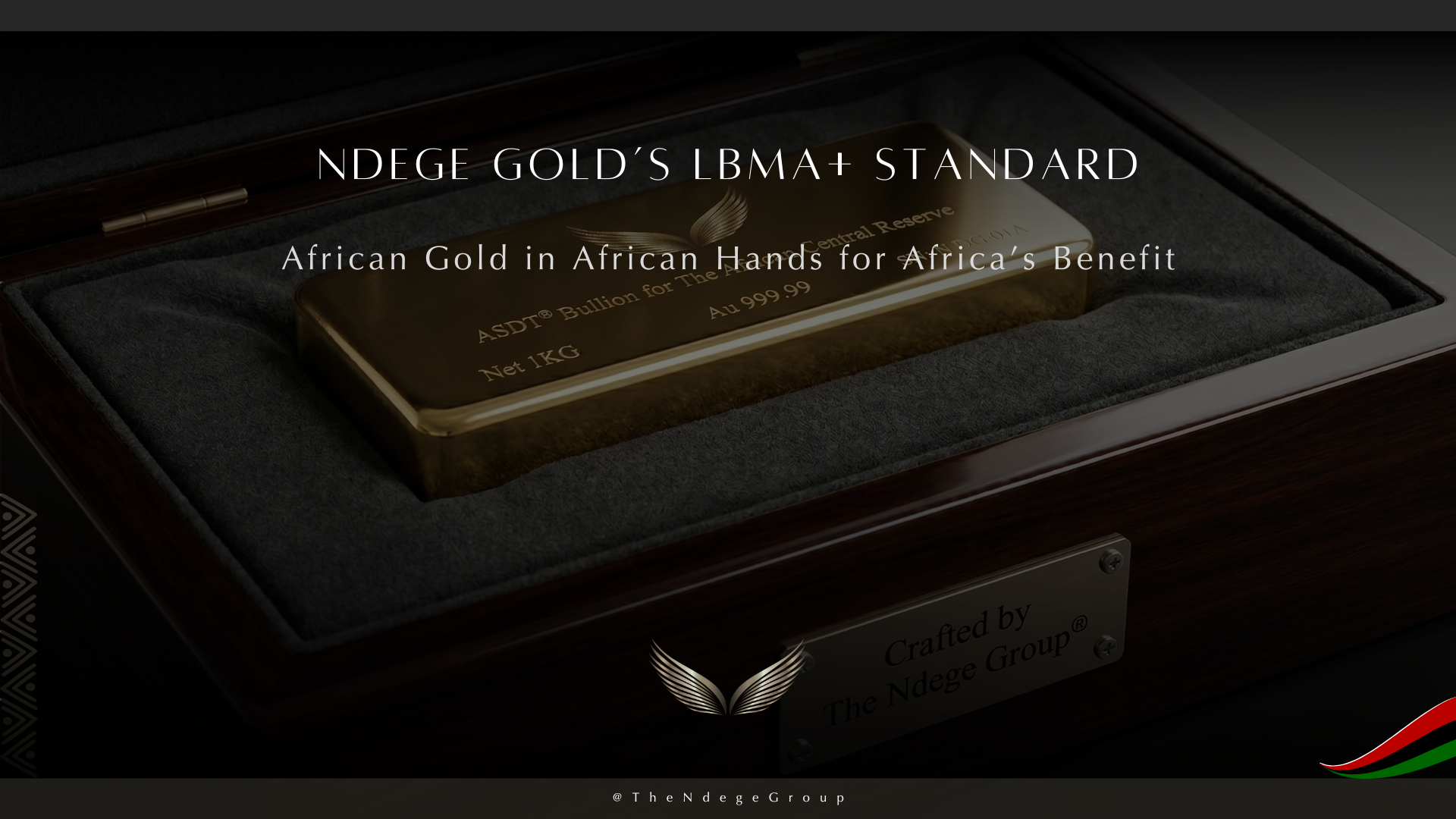
The arithmetic of African gold has been legible for decades. Africa holds approximately 40 per cent of the world’s gold reserves. In 2024 the continent produced an estimated 880 tonnes of gold, representing roughly 22 per cent of global mine production, with a market value exceeding $65 billion at prevailing prices. Of that figure, African economies retained less than seven per cent across the full value chain, from extraction through refining, hallmarking, vaulting, and financial instrument creation. Switzerland refines approximately 70 per cent of the world’s gold, including the overwhelming majority of ore originating from African mines. The question is not what happened to the rest. The question is what institutional architecture it takes to ensure it does not happen again. That is what Ndege Gold© is. The institutional mechanics of sovereign resource protection: how the continent’s mineral wealth is governed, traced, vaulted, and returned to the peoples whose ancestral territories hold it.
The Extractive Arithmetic of African Gold
Ghana provides the clearest illustration of what the extractive gap means in practice. Ghana is consistently Africa’s largest gold producer, generating revenues of $5.2 billion from gold exports in 2022. In that same year, Ghana entered a sovereign debt crisis requiring an IMF emergency financing facility of approximately $3 billion. A country producing $5.2 billion in gold in a single calendar year sought $3 billion in emergency external financing. The resolution is not paradoxical once the mechanism is understood: Ghana retained only the spot price of unrefined ore at the point of export. The refining margin, accruing to Swiss refiners such as Valcambi, PAMP, Argor-Heraeus, and Metalor, was captured in Zurich and Geneva. The reserve premium, accruing to the central bank or institutional buyer who holds the hallmarked bar, was captured elsewhere. The financial instrument yield, from gold-backed securities, exchange-traded products, and swap agreements structured against vaulted reserves, was captured in London and New York. Ghana provided the ore. Ghana received the spot price. Every value-added layer thereafter accrued to institutions whose operational base is in the Northern Hemisphere.
Uganda illustrates the second dimension of the problem: the illicit flow. In 2022, Uganda officially exported $514 million in gold to the United Arab Emirates. Uganda produces negligible quantities of domestically mined gold. The discrepancy between Uganda’s gold production capacity and its gold export volume represents artisanal gold from the eastern Democratic Republic of Congo, transiting through Kampala without formal documentation, underinvoiced against international benchmark prices, and captured by intermediary comptoir networks whose fee structure bears no tax obligation to the sovereign territories in which the gold was actually extracted. The UN Panel of Experts on the DRC documented in its 2021 report that gold from artisanal mines in North Kivu and Ituri regularly received certificates of origin attributing it to compliant mines in Rwanda and Uganda, passing through the LBMA’s responsible sourcing framework on documentation that was fabricated at origin. The LBMA’s due diligence standard, rigorous in institutional design, depends on paper documentation that can be reproduced without audit trail by an intermediary with a printer and a cooperative official.
Thirdly, the aggregate data from Global Financial Integrity and UNCTAD confirms that these individual country experiences reflect a structural continental condition. $88.6 billion exits Africa annually through illicit financial flows, with gold underinvoicing constituting the leading commodity category. The mechanism is information asymmetry. Illicit flows persist because transaction records are mutable, held by intermediaries operating outside African sovereign jurisdiction, and auditable only after the fact, where they are auditable at all. No African sovereign authority has historically possessed real time access to international gold price benchmarks against which to verify export declarations at point of departure. The gap between the declared export value and the actual market price of the gold being exported is the illicit flow. Ndege Gold© is designed to close that gap at source, not through enforcement action after the fact, but by making the gap architecturally impossible to create within the registered sovereign corridor.
The Joint Venture and the Architecture of Collective Sovereignty
The Ndege Gold© mandate advances under Addendum Number 47 to the African Federation Treaty Framework© version 3.1 (AFTF© v3.1), registered under SSRN Abstract ID 6168632, establishing a unified legal architecture for sovereign mineral coordination across six initial member states. The first is the Democratic Republic of Congo, a founding member state whose eastern provinces host artisanal mining operations employing an estimated three million people and whose cobalt and gold endowment, if retained within a sovereign processing framework, represents one of the largest concentration of mineral wealth on earth. The second is Uganda, the primary land transit corridor for eastern DRC mineral exports, whose integration into the mandate closes the Kampala transit gap that the UAE export data documents. The third is Burundi, providing cross border logistics and security integration across the Great Lakes corridor. The fourth is South Sudan, providing perimeter verification along the northern frontier of the extraction zone and trade facilitation infrastructure at its borders. The fifth is Ghana, the continent’s largest gold producer, providing the West African maritime gateway and port logistical infrastructure on the Atlantic coast. The sixth is Liberia, providing secondary Atlantic port access and the maritime security integration appropriate to a programme handling sovereign gold in transit.
Africa’s Sovereign Development Trust® has appointed LINC Holdings International SARL as project lead for the mandate. LINC Holdings carries an established operational footprint across Central and West Africa and brings active relationships with both state mining authorities and artisanal mining cooperatives in the target territories. The mandate is formalised. The joint venture structure is active and is bolstered by a partnership with COMADEMA, an ASDT® co-operative operating within the sovereign corridor framework, alongside deepening direct relationships with the government of the Democratic Republic of Congo. This is not a framework awaiting regulatory approval before operational commencement.
The structural contrast with the historical model of multinational mineral extraction requires a direct examination, because the objection that any supranational governance architecture represents an infringement of individual sovereign authority rests on a selective reading of what individual sovereign authority has produced. Glencore’s negotiations with the DRC government over the Katanga copper and cobalt concessions produced, in 2017, a settlement in which Glencore agreed to pay $150 million to resolve allegations of corruption in the original concession award. The underlying dynamic, one in which a single multinational corporation with revenues exceeding the GDP of most African states negotiates directly with a single sovereign government of limited institutional capacity, produced a concession agreement that transferred the overwhelming majority of mineral value to a corporation headquartered in Baar, Canton Zug, and listed on the London Stock Exchange. The individual sovereign authority of the DRC produced a concession agreement that required a $150 million settlement to correct in retrospect.
The AFTF© framework resolves this structural exposure through a principle the treaty terms the Interdependence Matrix. Under this architecture, no individual member state negotiates mineral concessions in isolation. The treaty framework creates a collective bargaining position in which the combined mineral endowment of all member states constitutes the negotiating asset. A corporation seeking access to DRC gold operates within the same legal framework governing access to Ghanaian port infrastructure and Ugandan transit corridors. The fragmentation that historically allowed asymmetric bilateral agreements to be negotiated against individual governments is replaced by a unified continental legal front whose constituent members retain full domestic authority under the subsidiarity principle.
| Territory | Sovereign Status | Primary Operational Role |
|---|---|---|
| Democratic Republic of Congo | Founding Member State | Large scale industrial and artisanal extraction; cooperative integration across North Kivu and Ituri corridors |
| Uganda | Founding Member State | Transit corridor governance; regional refining integration; Kampala gateway formalisation |
| Burundi | Founding Member State | Cross border logistics and Great Lakes security integration |
| South Sudan | Founding Member State | Northern perimeter verification; mineral border trade facilitation |
| Ghana | West African Hub | Atlantic port logistical access; maritime trade security; West African refining gateway |
| Liberia | West African Hub | Secondary Atlantic port access; maritime security integration |
Table 1. Ndege Gold© Initial Six Member State Corridor: Sovereign Status and Primary Operational Role
Technical Traceability and the OmniGaza® Substrate
The integration of the OmniGaza® blockchain platform provides cryptographic transparency across the full gold supply chain, from artisanal extraction at point of origin through processing, refinement, vaulting, and reserve certification. The technical specifications are material to the argument. OmniGaza® operates on the Antelope blockchain protocol, delivering a processing throughput of 3,571 transactions per second with a settlement finality of exactly two seconds. A second verification layer, provided by the Locus Chain protocol, secures the long duration immutability of historical resource verification records. The combined architecture eliminates the administrative gap between declared and actual transaction value that currently enables trade underinvoicing on a continental scale.
Each gram of gold entering the Ndege Gold© registry receives a cryptographic identifier assigned at the physical point of extraction, verified through handheld XRF spectrometry and cross-referenced against the SGS confirmed geological profile of the originating territory. That identifier travels with the physical asset through every subsequent transformation: transport to the Ruiru processing facility, refining to the Ndege Gold© LBMA+ standard, vaulting as a sovereign reserve asset, and eventual backing of the monetary instruments issued under the Central Bank of Africa programme. The LBMA+ designation refers to the programme’s target refining standard: London Good Delivery specification as the verified purity floor, augmented by full cryptographic provenance certification from point of extraction, a combination that no existing Good Delivery refinery in Switzerland, the UAE, or elsewhere currently provides as standard output. There is no point in this chain at which the declared value of the asset can diverge from its cryptographically confirmed provenance without generating a ledger entry that cannot be retroactively altered. The mechanism through which Ugandan gold re-export fraud operates, namely the substitution of a fabricated certificate of origin for the actual extraction record, is architecturally impossible within the OmniGaza® substrate. The identifier was assigned at extraction. The ledger entry cannot be changed.
The integrity of an immutable ledger depends entirely on the integrity of the data entered at origin. The oracle problem, as it is termed in distributed ledger architecture, is the vulnerability through which a falsified input produces a permanently recorded falsehood. The Ndege Gold© architecture closes this vulnerability through dual-layer verification that operates before any record is committed to the chain. The XRF spectrometer reading at point of extraction is not accepted in isolation. It is cross-referenced in real time against the SGS-confirmed geological profile of the specific extraction corridor, a profile characterising the known mineralogical signature of that territory's ore body. A fabricated reading that does not match the documented mineralogical signature of the zone from which the gold was purportedly extracted generates an automatic verification failure. The record is therefore grounded in physical geology, confirmed against an independent third-party geological standard, and only then committed to the immutable ledger. The system's resistance to falsification begins in the ground, before the chain is ever written to.
The accumulated sovereign gold reserve can be expressed with mathematical precision. Let Gs represent the total physical gold reserve accumulated at the Ruiru facility, defined as the sum of verified deposits from the six federating territories, where Ri represents the verified gold reserve of each of the six initial member territories:
Figure 1. Gs denotes the aggregate sovereign gold reserve; Ri the verified reserve of each of the six initial member territories. Throughput figure reflects the OmniGaza® platform operating on the Antelope blockchain substrate at two-second settlement finality. Source: ASDT® / Ndege Gold© programme specification, AFTF© v3.1 Addendum 47.
The objection that blockchain infrastructure is structurally premature for regions with severe energy deficits and limited connectivity has been addressed by the continent itself. Mobile money adoption in sub-Saharan Africa provides the relevant precedent. M-Pesa, launched in Kenya in 2007 without the benefit of conventional banking infrastructure, now processes transactions equivalent to more than 50 per cent of Kenya’s GDP annually and carries over 60 million active accounts across East Africa. The GSMA Mobile Economy Sub-Saharan Africa 2024 report records 615 million unique mobile subscribers across the region, with mobile money transaction values exceeding $900 billion annually. The continent did not wait for landline telephone networks before adopting mobile telephony. The OmniGaza® platform integrates directly with M-Pesa, MTN Mobile Money, and Airtel Money rails, and with existing SWIFT correspondent banking infrastructure during the transition period. The artisanal miner in Ituri does not require a bank account or a broadband connection to participate in the sovereign mineral registry. The mobile money account that already exists in that community is the on-ramp. The supercomputer infrastructure at Ruiru, backed by in excess of €100 million in committed capital, provides the institutional processing capacity at the other end.
The traceability architecture also satisfies and exceeds the compliance standard that governs institutional gold purchasing in every major market. The OECD Due Diligence Guidance for Responsible Supply Chains of Minerals from Conflict-Affected and High-Risk Areas, now incorporated by reference into the EU Conflict Minerals Regulation and the forthcoming Corporate Sustainability Due Diligence Directive, requires documentary evidence of responsible sourcing across the full mineral supply chain. The current standard is paper-based, and its documented vulnerability to fabricated certificates of origin is precisely the gap that the UN Panel of Experts has reported on in successive annual reviews of the DRC corridor. The OmniGaza® cryptographic traceability framework provides, in place of paper documentation, a real-time immutable ledger record from the point of extraction to the point of vaulting. Every LBMA-listed refiner, every central bank gold buyer, and every institutional gold-backed product issuer operating under EU or UK regulatory frameworks has a compliance obligation that the Ndege Gold© architecture addresses directly. The sovereign registry produces records that satisfy the OECD Annex II due diligence requirements as a structural output of normal operations, requiring no additional compliance layer.
Sovereign Vaulting at the Ruiru Hub
The physical consolidation of gold reserves at the Northlands facility in Ruiru, Kenya, represents the point at which sovereign intent becomes sovereign custody. Currently, the overwhelming majority of African gold is shipped in unrefined state to Switzerland, the UAE, or India for processing and vaulting. The Swiss refining industry, led by Valcambi, PAMP, Argor-Heraeus, and Metalor, processes an estimated 70 per cent of the world’s gold supply, with African ore representing a substantial share of that input. Each of these refineries charges a processing margin on the raw material and retains the hallmarked bar under Swiss custody until purchase by a central bank or institutional buyer. The vaulting fees, processing margins, and secondary financial instrument premiums that accrue from gold held in Swiss vaults are captured by Swiss financial institutions. The African sovereign state that produced the underlying ore received the unrefined commodity price at the point of export and no further value thereafter.
The Ruiru facility changes the terminal point of this value chain. The Northlands facility is designed for processing, testing, and hallmarking operations that bring African artisanal and small-scale gold to the Ndege Gold© LBMA+ standard: London Good Delivery specification as the verified purity threshold, augmented by end-to-end cryptographic provenance certification from the point of extraction to the hallmarked bar. The LBMA Good Delivery standard, established in 1750 and refined across nearly three centuries, governs the physical and chemical specifications of gold bars accepted for settlement between central banks and institutional counterparties worldwide. It is the trust infrastructure of the global gold market. The Ruiru programme meets that standard in full and advances beyond it in one material respect: every bar produced at the facility carries an immutable, publicly verifiable ledger record of its complete physical journey, from the cooperative in North Kivu through corridor transit, assay, and refining, to the vault. For the sovereign wealth fund manager, the family office, and the central bank reserve officer evaluating African gold supply for the first time, this is a categorically different offer. The provenance risk that has historically attached to African-origin gold, the certificate fraud, the transit opacity, the comptoir intermediation, is architecturally eliminated at the point of production. Africa’s Sovereign Development Trust® has committed in excess of €100 million to the supporting supercomputer and database infrastructure required to operate the sovereign registry and the OmniGaza® integration layer at the facility. Physical assets vaulted at Ruiru are directly certified against the sovereign reserve targets of the Ndege Gold© programme, with Phase 1 targeting a capitalisation of $2.5 billion and Phase 2 projecting reserves of $5 billion by 2035.
The significance of sovereign vaulting extends well beyond the processing margin. Gold held under African sovereign custody and certified on an African blockchain registry serves as collateral for sovereign bond issuances, as reserve backing for monetary instruments, and as the physical foundation of a central bank reserve architecture that does not depend on the goodwill or the vault space of institutions domiciled in Zurich, Dubai, or Mumbai. Furthermore, every metric tonne of African gold refined to LBMA+ standard at Ruiru rather than at Valcambi is a margin captured on the continent, a fee not paid to Swiss infrastructure, a provenance record that belongs to the sovereign trust, and a bar whose cryptographic certification makes it the most traceable, most verifiable gold bar in the global institutional market. Multiplied across the full target reserve programme, the cumulative value retention is institutional in scale.
| Phase | Target Horizon | Reserve Capitalisation Target | Primary Milestone |
|---|---|---|---|
| Phase 1 | Immediate Deployment | USD 2.5 billion | Ruiru facility operational; OmniGaza® registry live; LINC Holdings + COMADEMA co-operative joint ventures producing |
| Phase 2 | 2035 Horizon | USD 5 billion | Full six-corridor production; Central Bank of Africa® reserve backing established; Ndege Money sovereign currency backed |
Table 2. Ndege Gold© Reserve Capitalisation Programme: Phase Targets and Primary Milestones
The reserve architecture addresses the commodity price volatility question directly. A currency backed by a single commodity asset class carries exposure to price cycles in that commodity, and a responsible monetary architecture must account for this. The Ndege Gold© reserve programme operates under a stabilisation protocol in which the physical gold reserve provides the foundational asset floor for Ndege Money© issuance, whilst the broader reserve composition under the Central Bank of Africa® framework incorporates diversified hard asset classes across the continental mineral endowment, including platinum-group metals, rare earth elements, and strategic commodity positions managed through the African Rare Earth Mineral Fund©. Currency issuance ratios are governed by reserve adequacy thresholds specified in the AFTF© v3.1 monetary protocol, ensuring that Ndege Money© issuance remains within the verified physical reserve cover at all times. The architecture produces a reserve-backed digital currency whose floor value is guaranteed by physical assets on the continent, and whose ceiling is managed by the institutional disciplines of the Central Bank of Africa® framework.
The Central Bank of Africa and the Question of the Afriq
This section addresses a commitment the African Union made in treaty form in 1991 and has not fulfilled in the thirty five years since. The Abuja Treaty, signed by 51 African heads of state in June 1991, established a six stage roadmap toward continental economic integration. Stage 5 called for the harmonisation of monetary, fiscal, and financial policies across regional economic communities. Stage 6 called for the establishment of a single African Central Bank and the introduction of a single African currency. The treaty set a target of 2028 for the completion of the full integration programme. In 2023, the African Union Commission reaffirmed its commitment to the Afriq, the proposed single African currency, in the Agenda 2063 progress report. The African Monetary Fund framework was adopted in principle at the 2014 AU Summit in Malabo. The Pan-African Payment and Settlement System (PAPSS), launched commercially in 2022, represents the most operationally advanced component of this architecture, enabling direct settlement of intra-African trade transactions without routing through correspondent banks in New York or London.
Secondly, it is necessary to state clearly what does not yet exist. There is no African Central Bank in operation. There is no Afriq in circulation or formal issuance. The African Monetary Fund has not been capitalised. The ECOWAS ECO, the proposed West African single currency, was originally scheduled for introduction in 2020, was subsequently deferred to 2027, and has not achieved the macroeconomic convergence criteria required for launch among its intended member states. The African Development Bank’s 2024 African Economic Outlook noted that monetary integration on the continent remains aspirational in its current institutional form. The AU’s record on this specific commitment is thirty five years of earnest declarations without an operational central bank, an issued currency, or a capitalised monetary fund.
The AU’s difficulty is not a failure of ambition. It is a failure of sequencing. Currency unions require reserve backing, and reserve backing requires physical assets held under sovereign custody, and sovereign custody requires processing infrastructure, and processing infrastructure requires capital, and capital requires institutional architecture that can attract and deploy it systematically. The Abuja Treaty assumed that political agreement could precede and generate the technical and financial infrastructure required for monetary integration. Thirty five years of evidence from the ECOWAS ECO delays, the uncapitalised Monetary Fund, and the Afriq’s perpetual deferral suggests this sequencing assumption has not produced results at the pace the continent requires.
The Afriq, in the form in which it will achieve continental circulation, is not a political declaration waiting for consensus. It is a monetary instrument waiting for its reserve backing to be fully established. Africa’s Sovereign Development Trust® is establishing that backing now, in a vault in Ruiru, on an immutable ledger, gram by verified gram.
David Okiki Amayo Jr., Founder and Chairman, Africa’s Sovereign Development Trust®
ASDT’s approach is different in method, and the difference is material to understanding why this programme is advancing rather than deliberating. The Central Bank of Africa programme advancing under the AFTF© does not begin with political agreement and work toward financial infrastructure. It begins with physical gold reserves under sovereign custody at the Ruiru facility, traces them on an immutable blockchain registry, and uses that physical asset base to back the monetary instruments issued under the Ndege Money© programme. The currency follows the reserve. The reserve does not follow the currency. This is not a critique of the AU process. The AU’s political architecture and the AFTF© institutional architecture are complementary, and PAPSS settlement infrastructure is expressly integrated into the OmniGaza® payment rail architecture as the primary intra-African settlement mechanism. The point is one of route to market.
Additionally, the Central Bank of Africa℠ advancing under the AFTF© is not positioned as a competitor to the AU’s aspiration. It is positioned as the institution that builds the infrastructure the aspiration requires, and presents that infrastructure as a working model to willing member state parties rather than waiting for unanimous political commitment across 55 states before a single physical asset is accumulated. Ndege Money©, the sovereign digital currency advancing under the Central Bank of Africa programme, eliminates an estimated $51.4 billion in annual transaction frictions that currently suppress intra-African trade, a figure derived from AfCFTA Secretariat modelling of correspondent banking costs, cross-border payment latency losses, and currency conversion premiums on intra-continental trade flows as documented in the AU Commission’s 2023 AfCFTA implementation assessment. It is backed by the physical gold reserves accumulating at Ruiru. The Afriq, in its sovereign development form, will be the monetary expression of a reserve that already exists in a vault in Kenya, already certified on an immutable ledger, already traceable to the specific artisanal mining cooperative in North Kivu where a miner with an XRF spectrometer confirmed its grade.
Artisanal Dignity and the Social Infrastructure Protocol
Artisanal and small-scale mining employs an estimated 40 million people across Africa and supports the livelihoods of approximately 150 million dependants. It accounts for between 15 per cent and 20 per cent of global gold production by volume. It receives, in most regulatory frameworks, the least institutional protection and the lowest unit price for its output. The mechanisms of exploitation operating at the artisanal level are specific and documented. Creuseur networks in the DRC function as informal credit systems in which miners receive cash advances from comptoir operators and are contractually obligated to sell their production to that operator at below-market prices until the advance is repaid. The information asymmetry is structural: the miner does not have access to real time international gold price benchmarks, does not have a practical alternative market beyond the local comptoir network, and does not have a legal mechanism to exit an advance agreement whose terms the comptoir operator controls. The Fairtrade Gold certification programme, launched in 2011 and covering operations in Peru, Bolivia, Colombia, Uganda, Kenya, Tanzania, and Ethiopia, provides an alternative price premium and supply chain standard. Its reach covers a small fraction of global artisanal output and does not resolve the structural market access problem that the creuseur network exploits.
Article 12 of the AFTF© v3.1 mandates a structurally different model. Under the Ndege Gold© framework, artisanal miners operating within the registered extraction corridors have access to a direct buyback mechanism at verified market prices. Gold quality is assessed at point of sale using handheld XRF spectrometers and confirmed against SGS geological reporting. The information asymmetry that allows comptoir operators to underprice artisanal output is eliminated because the instrument in the miner’s community confirms the grade of the ore, the OmniGaza® registry confirms the verified spot price, and the transaction is recorded on an immutable ledger at that confirmed grade against the verified price. The miner knows what the gold is worth. The record cannot be altered after the fact.
Furthermore, the mandate enforces a proof of work social infrastructure model. Each extraction activity within the registered corridor triggers a proportional investment in local social infrastructure, specifically clinics, schools, and resource centres in the communities whose ancestral territories encompass the extraction zone. Local barter canteens allow miners to deposit gold for immediate credit within their local community economy rather than waiting for conversion into external currency through a network of intermediaries. The dignity of the artisanal miner under Article 12 is not a corporate responsibility addendum to the Ndege Gold© mandate. It is a core security mechanism. Communities with a direct, verified financial stake in the sovereign integrity of their territory’s mineral registry are the most effective guardians of that registry against smuggling, diversion, and informal channel leakage. The social infrastructure and the security architecture of the sovereign mineral programme are, in the AFTF© framework, one and the same instrument.
Two Objections, Addressed With Institutional Precision
First, the Westphalian sovereignty objection. Critics of supranational mineral governance argue that consolidating strategic gold reserves under the stewardship of the African Rare Earth Mineral Fund© infringes the discretionary resource sovereignty of individual nation states, particularly in circumstances requiring domestic fiscal flexibility such as balance-of-payments crises or emergency infrastructure financing. This concern is grounded in the history of post-colonial resource nationalisation, where states sought to protect extractive assets from external corporate capture. Tanzania’s nationalisation of its mineral sector under the Arusha Declaration, Zimbabwe’s land and mineral reform programme, and the DRC’s periodic revisions of the Mining Code all represent expressions of the same instinct: that sovereign control of natural assets requires the unilateral authority to deploy them as national policy instruments.
The objection is logically incomplete because it treats individual state sovereignty in isolation from the structural context that determines its practical value. The DRC, acting in sovereign isolation, negotiated a mineral concession with Glencore that required a $150 million corruption settlement to partially correct. Tanzania, acting in sovereign isolation, saw its Tanzanite and gold sectors subject to decades of transfer pricing by multinational corporations whose legal structures the Tanzanian Revenue Authority lacked the institutional resources to audit. The AFTF© framework resolves this structural vulnerability through the subsidiarity principle, which expressly preserves national discretionary authority over domestic fiscal, social, cultural, and educational policy. The treaty framework’s jurisdiction is confined to the strategic coordination of resources whose optimal governance requires continental scale. Individual member states retain full authority over domestic mining licences, environmental standards, local employment requirements, and community benefit agreements outside the registered sovereign corridor. What the treaty framework supersedes is the bilateral concession negotiation process through which individual states have historically been exposed to asymmetric corporate capture, one at a time, without the institutional counterweight that collective governance provides.
The enforceability of the treaty framework against a member state that acts in breach of its corridor governance obligations is grounded in the Pan African Court℠, the judicial institution established under the AFTF© as the continent’s sovereign dispute resolution authority. Member state parties to the treaty framework submit to the Court’s jurisdiction as a condition of participation in the sovereign corridor and the collective bargaining architecture it provides. The governing law is the AFTF© itself, constituted as a treaty instrument under international law with Nairobi, Kenya, as the seat of jurisdiction pending the Court’s full establishment. The mechanism of enforcement combines economic incentive, through participation in the collective mineral bargaining position and access to the sovereign reserve capitalisation programme, with legal remedy, through the Court’s adjudicative authority over treaty breaches. A state that defects from the corridor governance framework forfeits its participation in both. The architecture of collective sovereignty is therefore self-reinforcing: the benefit of membership and the cost of defection are both institutional in scale.
Secondly, the technological readiness objection. The argument that blockchain infrastructure is premature for regions with inadequate energy access and limited digital connectivity appears reasonable until it is tested against adoption data. The GSMA Mobile Economy Sub-Saharan Africa 2024 report records 615 million unique mobile subscribers in sub-Saharan Africa, representing 57 per cent of the population, with mobile money transaction values exceeding $900 billion annually. This infrastructure did not exist before it was built. It was built because a latent demand was met with appropriate technology at appropriate cost, without waiting for legacy banking infrastructure to be established as a precondition. The OmniGaza® platform’s integration with M-Pesa, MTN Mobile Money, and Airtel Money rails means that the artisanal miner in Ituri does not require a bank account or a broadband connection to participate in the sovereign mineral registry. The mobile money account already present in that community is the on-ramp. The €100 million supercomputer infrastructure at Ruiru provides the processing capacity at the institutional end. The gap between these two points is bridged by an integration architecture designed for precisely this context, not as a future aspiration, but as the technical requirement the platform was engineered to meet from the first version of its architecture.
Active Stewardship: ASDT as Operator, Not Architect
The Ndege Gold© mandate is not a proposal. It is not a framework awaiting political ratification before operational commencement. The operational mandate is formalised under AFTF© v3.1 Addendum 47, registered under SSRN Abstract ID 6168632. LINC Holdings International SARL is appointed and active as project lead. The OmniGaza® sovereign registry is live with primary integrations to the Kenya Revenue Authority and the Rwanda Revenue Authority. The XRF spectrometer buyback protocol is specified under Article 12 and operative within registered extraction corridors. The blockchain traceability architecture is in production on the Antelope substrate. The Ruiru processing facility is advancing through its development programme. The distinction between what is live and what is in development is stated here precisely because it is the distinction that matters: the institutional architecture, the legal framework, the traceability substrate, and the corridor partnerships are operational. The physical processing and vaulting infrastructure at Ruiru is the current development priority, and its timeline is governed by the Phase 1 capitalisation programme.
The distance between the ASDT® approach and the approach of institutions that have produced thirty five years of aspirational monetary integration without a circulating currency or an operational central bank is a distance of method, not of ambition. The ambition is identical: African mineral wealth governed, processed, vaulted, and invested by African institutions for African peoples. The method differs in that ASDT® begins with the physical infrastructure and builds toward the institutional recognition, rather than beginning with the institutional declaration and waiting for the physical infrastructure to materialise through consensus.
The Central Bank of Africa℠, advancing as a sovereign entity under the AFTF© framework and in active coordination with willing member state parties, represents the institutional apex of the architecture this programme is building. The Ndege Gold© mandate is the reserve programme that gives it substance. OmniGaza® is the substrate that gives it integrity. The Ndege Money© sovereign digital currency will be the monetary expression of a reserve that already exists in a vault in Ruiru, already certified on an immutable ledger, already traceable to the specific artisanal cooperative in North Kivu where a miner with a handheld spectrometer confirmed its grade and received a fair price recorded permanently in the sovereign registry. The African Rare Earth Mineral Fund© provides the investment architecture that converts the physical reserve into a continentally managed institutional endowment.
Africa’s gold has always been in African soil. The work of this generation is to ensure it is also in African hands, on African terms, certified on an African ledger, refined at an African facility to a standard that meets and exceeds the highest institutional bar the global gold market has set, vaulted under African sovereign authority, and transformed into the monetary and institutional foundation that the continent’s development trajectory requires. The LBMA+ bar produced at Ruiru is the trust signal. It carries the purity a central bank requires, the provenance a family office demands, and the sovereign integrity no Swiss refiner has ever been positioned to offer. That is not a declaration. It is an operating programme. It is advancing now. Formal enquiries regarding participation in the sovereign reserve allocation, institutional partnership arrangements, and state party coordination are administered exclusively through the Strategic Executive Office of Africa’s Sovereign Development Trust®.
Amayo Jr., David Okiki. (2026). Addendum Number 47: Ndege Gold© to the African Federation Treaty Framework© v3.1: Sovereign Mineral Coordination and the Ndege Gold Mandate. SSRN. ssrn.com/abstract=6168632
Amayo Jr., David Okiki. (2026). From Aspiration to Architecture: A Draft Constitution for the African Federation (Version 4.0). SSRN. ssrn.com/abstract=6604678
Amayo Jr., David Okiki. (2026). The Central Bank of Africa Technical Treatise: Institutional Architecture for Continental Monetary Sovereignty and Mineral Backed Clearing. Zenodo. doi.org/10.5281/zenodo.18596580
Amayo Jr., David Okiki. (2026). Ndege Money: Architecting Sovereign Digital Currency Infrastructure for African Economic Integration. Zenodo. doi.org/10.5281/zenodo.18219656
Amayo Jr., David Okiki. (2025). The African Federation Treaty Framework©: Operational Architecture for Continental Socioeconomic Sovereignty. Zenodo. doi.org/10.5281/zenodo.17670879
Africa’s Sovereign Development Trust®. (2026). OmniGaza® Master Architecture Reference V4.0. Nairobi: The Ndege Group®. Zenodo. doi.org/10.5281/zenodo.15061707
African Union Commission. (2023). AfCFTA Implementation Assessment: Trade Finance, Payment Systems and Transaction Cost Reduction under the African Continental Free Trade Area. Addis Ababa: AUC / AfCFTA Secretariat. au.int/afcfta
OECD. (2016, updated 2023). Due Diligence Guidance for Responsible Supply Chains of Minerals from Conflict-Affected and High-Risk Areas. Third Edition. Paris: OECD Publishing. doi.org/10.1787/9789264252479-en
Amayo Jr., David Okiki. (2026). African Federation Treaty Framework© v3.1 Addendum 47: Ndege Gold© Sovereign Mineral Coordination Mandate. SSRN. ssrn.com/abstract=6168632
African Development Bank Group. (2024). African Economic Outlook 2024: Driving Africa’s Transformation Through Industrialisation and Service Sector Development. Abidjan: AfDB. afdb.org
African Union Commission. (2023). Agenda 2063: The Africa We Want. Progress Report. Addis Ababa: AUC. au.int/agenda2063
Global Financial Integrity. (2022). Illicit Financial Flows: A Critical Issue for Developing Countries. Washington DC: GFI. gfintegrity.org
GSMA Intelligence. (2024). The Mobile Economy Sub-Saharan Africa 2024. London: GSMA. gsma.com/mobileeconomy
International Monetary Fund. (2023). Ghana: Request for a Three-Year Arrangement Under the Extended Credit Facility. IMF Country Report No. 23/168. Washington DC: IMF. imf.org
London Bullion Market Association. (2024). Responsible Sourcing Guidelines: Good Delivery Rules and Guidance. London: LBMA. lbma.org.uk
UN Panel of Experts on the Democratic Republic of the Congo. (2021). Final Report of the Group of Experts on the Democratic Republic of the Congo. New York: United Nations Security Council. un.org
UN Trade and Development (UNCTAD). (2020). Economic Development in Africa Report 2020: Tackling Illicit Financial Flows for Sustainable Development in Africa. Geneva: UNCTAD. unctad.org
World Gold Council. (2024). Gold Demand Trends Full Year 2024. London: WGC. gold.org