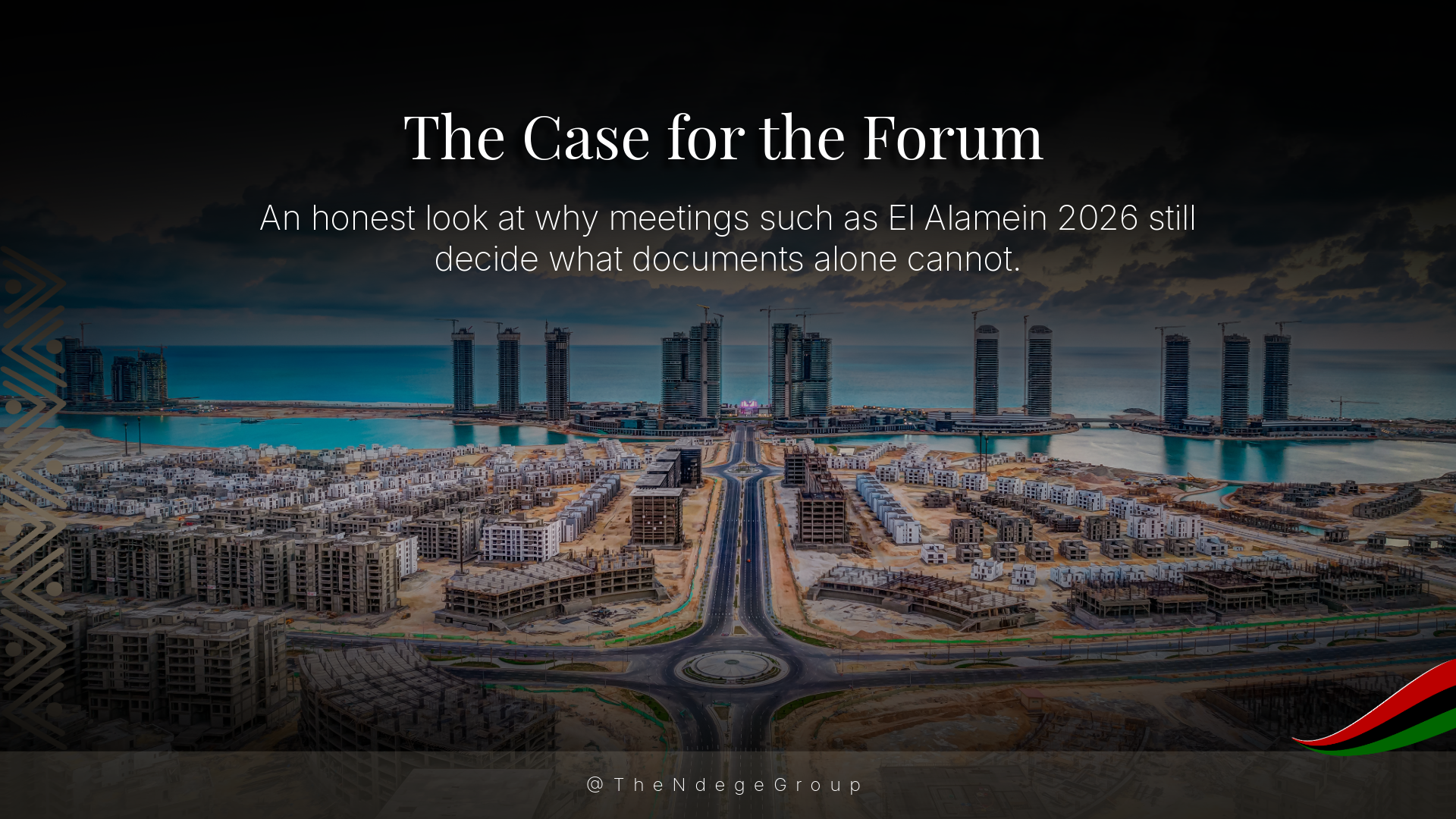
The disillusionment with legacy multilateral institutions that has characterised the past decade of African political discourse is well founded, because the evidence that produced it is correctly read. The AU Assembly’s implementation rate on its own decisions sits below 35 per cent. The African Monetary Co-operation Programme, constituted in 1987, has not produced a continental currency after 37 years. The African Standby Force achieved initial operational capability in 2016 but has never been deployed under a unified continental command. These are failures of design. What this article argues, across five distinct propositions and against three serious counter-arguments, is that the justified scepticism toward these institutions leaves the forum as a structurally distinct instrument standing on its own merits. The forum is where the institution is conceived, where bilateral commitments are made before documents are signed, and where the trust that no communiqué can replicate is built between the specific individuals who will ultimately move things. Alamein 2026, co-convened by the African Union and AUDA-NEPAD with confirmed ministerial attendance and a structured B2B programme, is precisely this kind of forum: a working assembly that has already produced five accepted bilateral meetings for ASDT® before a single flight was booked. Publishing the African Federation Treaty Framework© before seeking the partners it designates was the only viable intellectual property strategy for a continental institution operating in an environment where ideas are appropriated before they are constituted. The mathematics of ratification across 55 AU member states reward compounding over sequence, and a forum strategy achieves in two years what a sequential lobbying programme requires five to attempt. The structural gaps in Africa’s continental architecture are specific design failures, and ASDT® closes each of them by specific architectural design. The world is in session. ASDT® is present.
The Forum Is Where the Institution Is Born.
The structural distinction between a communiqué and a bilateral conversation is, above all, a matter of function. A communiqué is the recorded output of a decision that has already been made, or more frequently, the diplomatic text that papers over the fact that no decision has been made at all. A bilateral conversation is where the specific individuals who have the authority to move things commit to one another, person to person, before any document is signed and before any institution officially records the commitment. Every durable continental outcome Africa has produced in the past thirty years traces its origin not to the final instrument, but to a room where two or three people decided to make it happen. The instrument followed. The decision preceded it.
The AfCFTA ratification process illustrates this with precision. The momentum that produced the Niamey summit in 2019 originated in the sustained bilateral work of specific trade ministers who had committed to one another, in rooms outside the formal sessions, that the area agreement would proceed (African Union, 2019). The AU Assembly’s 2023 adoption of AfCFTA phase II protocols reflects the same pattern: the institutional adoption is the recorded outcome of a negotiation process whose decisive moments occurred in conversations that the formal record does not capture. The instrument documents the trust that was already built. The trust preceded the document.
The SADC Industrialisation Strategy’s activation at the 2015 Harare summit confirms the same structural dynamic at the regional level. The strategy had existed in draft form for several years before its formal adoption. At Harare, specific heads of state and ministers committed to one another, in the corridors and bilateral margins of that summit, that they would move it forward in their respective legislative calendars (SADC, 2015). The forum provided the physical proximity that made those commitments credible, the time pressure that made them urgent, and the social architecture of mutual accountability that made them durable. No video call, no email chain, and no formal written exchange has ever produced the same quality of commitment at that level of institutional authority.
The African Development Bank recognised this distinction formally enough to establish the African Investment Forum in 2018 as a dedicated deal-making forum entirely separate from its annual general meeting. The AfDB’s own internal evaluation of its formal institutional sessions had concluded that they were not producing the bilateral investment commitments that capital deployment requires, because the structure of a formal session is designed to produce statements of institutional position, not bilateral commitments (AfDB, 2018). The African Investment Forum was constituted precisely because the AfDB understood that capital moves in conversations, not in plenary declarations. The forum is the instrument of sovereign trust-building that no digital communication, however sophisticated, has replicated. And that is especially true when the forum is convened under the right institutional auspices.
Alamein 2026 Is Structurally Distinct from the Forums That Preceded It.
The World Economic Forum at Davos, the Africa CEO Forum, the Mo Ibrahim Forum, the AU Assembly, and the assorted Davos-adjacent events that populate the annual African governance calendar are structurally different instruments, and that difference matters for what each produces. The honest evaluation of each is necessary before the specific case for Alamein 2026 can be made with precision. The legitimate critique of the forums that have disappointed applies to each on its specific structural terms, and conflating them forfeits the analytical clarity that the AFTF© ratification strategy requires.
The World Economic Forum produces declarations, thematic statements, and the social capital of having been in the room. It does not produce ratifications. Its membership is primarily private sector, and its convening authority over sovereign governments is persuasive in nature. For African participants, Davos functions as a bilateral networking context, not as a continental governance forum, because it has no African institutional mandate and no mechanism by which the commitments made in Davos translate into legislative action in member state capitals. A useful room, and the wrong room for what the AFTF© requires.
The Mo Ibrahim Forum produces governance indices, advisory conversations, and the Ibrahim Index of African Governance, which informs discourse at a high level of intellectual quality. It does not bind governments. Its convening authority is reputational in nature, and its outputs, however valuable as diagnostic instruments, do not constitute ratification mechanisms. The Africa CEO Forum produces private sector commitments that depend entirely on the policy environment that governments produce and whose implementation is therefore contingent on a variable that the CEO Forum itself cannot control. The AU Assembly produces communiqués at a documented implementation rate below 35 per cent across member states, because the AU Assembly is a formal institutional session rather than a bilateral commitment architecture, and formal institutional sessions produce formal institutional outputs (African Union Commission, 2023). The gap between the communiqué and the implemented decision is the structural argument for the forum.
Alamein 2026 is co-convened by the African Union and AUDA-NEPAD. AUDA-NEPAD carries implementation authority across the AU’s development agenda and a direct mandate relationship with member state governments. The forum has confirmed ministerial attendance, a structured B2B programme, and a format designed around working sessions rather than plenary declarations. Five accepted bilateral meetings for ASDT® were confirmed before departure, including with the African Development Bank and the LAPSSET Corridor Development Authority. Those are operational engagements with institutions that have the authority and the capital to carry forward what the AFTF© requires of them. A working assembly with institutional co-convenors that carry implementation authority: that architecture is decisive.
Publishing the Architecture Before Seeking the Partners Was the Only Viable Intellectual Property Strategy.
I attend Alamein 2026 with twenty-five published treatises and a permanent DOI-archived record of every instrument, addendum, and framework that comprises the AFTF©. The Zenodo archive at doi.org/10.5281/zenodo.18365997 is a timestamp. It records, irrefutably and in public, that the architecture was conceived, constituted, and published by a specific author on a specific date. The rationale for that sequence, publish first, then present, is strategic. And the strategy is informed by a documented pattern in the African institutional space that anyone who has built here knows well: idea theft, misappropriation, and poor implementation when frameworks are co-opted before they are fully constituted and protected.
The appropriation of Kwame Nkrumah’s continental currency concept is the foundational case. Nkrumah articulated the case for a unified African currency with extraordinary analytical precision in 1963, grounding it in the same arguments about sovereign monetary authority and continental economic coherence that the Central Bank of Africa℠ is constituted to operationalise (Nkrumah, 1963). Successive AU monetary integration frameworks adopted the aspiration while discarding the institutional design, producing after more than sixty years an ambition with no architecture and no enforcement mechanism (Asante, 1986). The concept travelled forward. The constitution stayed behind. The result was a diluted and ineffective succession of frameworks that gave the appearance of progress while foreclosing the possibility of the genuine institutional architecture that Nkrumah had conceived.
The documented misappropriation of community land frameworks in East Africa illustrates the same pattern at the policy level. Community land rights architectures developed by civil society organisations and research institutions across Kenya, Tanzania, and Uganda were adopted by government legislative processes during the land reform waves of the 2000s and 2010s. In multiple documented cases, the adoption was selective: the frameworks were incorporated without attribution, without consultation with the originating organisations, and without fidelity to the original design (Alden Wily, 2018). The result in several instances was legislation that carried the name of the framework while reversing its substantive protections, because the implementing government had taken the vocabulary without the architecture and used it to serve purposes that were structurally incompatible with the original intent.
The AfCFTA negotiations demonstrate the same risk at the continental level. Early framework documents that circulated before formal adoption were selectively incorporated by individual member states in ways that weakened the continental preference architecture, substituting bilateral carve-outs for the continental framework in specific sectors where national commercial interests diverged from the continental mandate (Kelsall et al., 2022). The framework was available before it was protected. Individual actors extracted the portions that served their particular interests. The continental architecture absorbed the cost. The AFTF© was published on Zenodo with a permanent DOI on the date it was completed. Its authorship is unambiguous. Its evolution is archived. I arrive at Alamein not with a pitch, but with a portfolio. The confirmed KCAA engagement on record under reference KCAA/OPS/2117/4 VOL. 12 is one of the items in that portfolio. The forum is where the portfolio is presented to the people with the institutional authority to carry it forward.
The Mathematics of Sovereign Ratification Across 55 Member States Requires a Compounding Forum Strategy, Not a Linear Lobbying Programme.
The AFTF© requires ratification across all 55 AU member states. Each ratification requires, at minimum, three distinct stages: a bilateral engagement at ministerial level to introduce the framework and its institutional architecture, a formal parliamentary or executive adoption process that translates that ministerial commitment into legislative action, and an implementation mechanism that activates the ratified framework within the member state’s national legal and administrative structure. These three stages are sequential and non-fungible: each follows from the preceding one, a successful ministerial engagement does not produce a parliamentary adoption without sustained follow-up, and a parliamentary adoption without an implementation mechanism is a ratification on paper only. The minimum effective unit of work per member state is therefore three distinct engagements at three distinct institutional levels.
Sequential bilateral engagement at one member state per month requires 55 months before a single ratification cycle closes, with no network effects, because each engagement is independent and produces no catalytic introductions. At that pace, the first complete ratification cycle across all 55 member states concludes in 2031, assuming no member state requires more than one ministerial engagement before proceeding to parliamentary adoption. The documented pattern of continental governance makes that assumption untenable. The sequential strategy is unworkable, and it is also not how continental ratification has ever been achieved.
Five accepted bilateral meetings at Alamein 2026 represent five months of sequential engagement compressed into two days. Each of those five institutional counterparts carries, by virtue of their own institutional networks, the potential to generate introductions to two or three further institutional counterparts with the relevant mandate. At a compounding rate of three introductions per confirmed engagement, five Alamein meetings generate a pipeline of fifteen potential subsequent engagements within one quarter, each of which enters the forum strategy for the next convening in the forward calendar at thendegegroup.com/operations/intelligence/events. A ten-year ratification roadmap across all 55 member states is mathematically achievable through approximately twelve forum appearances of Alamein’s scale per year, supported by a sustained programme of bilateral engagements between forums, at a compounding rate of three introductions per confirmed engagement.
The Sandton Symposium 2025 is the proof of concept. A virtual convening that produced ministerial engagement and institutional partner confirmation, it demonstrated that the AFTF© architecture can command the attention of the right rooms when presented with the right framing and the right institutional backing. Sandton 2025 was the prototype of the virtual convening format. The physical assembly format, beginning with Alamein 2026, is the scale deployment. The forward calendar of events at ASDT® now encompasses finance minister assemblies, heads of military convening, and heads of state engagements as part of the active AFTF© ratification push that this forum appearance inaugurates at the physical level.
The Structural Gaps in Africa’s Existing Continental Architecture Are Not Failures of Intention. They Are Failures of Design. ASDT® Closes Them by Design.
The four structural gaps in Africa’s continental architecture have been identified, repeatedly, by the very institutions that are supposed to fill them. The African Court on Human and Peoples’ Rights has issued over 200 judgments since 2009. Member state compliance has been documented at below 25 per cent, because the Court carries no enforcement mechanism (African Court on Human and Peoples’ Rights, 2023). A court without enforcement is an advisory body with a judiciary’s docket. The Pan African Court℠ under the AFTF© is constituted with enforcement power by constitutional design. Jurisdiction is binding. Judgments are compulsory. The enforcement mechanism is embedded in the founding instrument rather than delegated to the voluntary compliance of member states.
The African Monetary Co-operation Programme, established in 1987, has produced no continental currency after 37 years of operation. The reason is structural: the Programme lacks a constitutional mandate, an independent board, and a reserve architecture (AMF, 2024). An ambition without a constitutional mandate is a statement of intent. An institution without an independent board is a subsidiary of the political interests of its member governments. A currency without a reserve architecture is a denomination without a value. The Central Bank of Africa℠ under the AFTF© is constituted with all three: a constitutional mandate under the African Federation Treaty Framework©, an independent board with defined expertise requirements and conflict of interest prohibitions that parallel ASDT®’s own board architecture, and a reserve architecture whose parameters are specified in the founding instrument rather than left to subsequent negotiation.
The African Standby Force was mandated by the AU in 2003, achieved initial operational capability only in 2016, and has never been deployed under a unified continental command (Institute for Security Studies, 2022). The reason is a specific structural absence: no binding instrument governs the rules of engagement across all five regional brigades. Each brigade operates under its own regional framework, with its own command structure, its own chain of accountability, and its own set of conditions under which deployment is authorised. A unified continental defence force without unified rules of engagement is five regional forces with a shared name. The United African Defence Force℠ under the AFTF© is constituted with unified rules of engagement across all operational theatres, embedded in the founding instrument and therefore not subject to the inter-regional negotiation that has prevented the ASF from ever deploying as a unified force.
The fourth and most consequential gap: Africa loses an estimated 88.6 billion US dollars annually to illicit financial flows, the majority of which originate in the extractives sector (UNECA, 2023). There is no single institutional vehicle through which sovereign wealth from African natural resources is retained, governed, and deployed by Africans for Africans. The existing development finance architecture is fragmented across regional development banks, bilateral development finance institutions, and multilateral funds, each with its own mandate, its own governance structure, and its own accountability framework, none of which is constituted to retain and deploy African extractive wealth at the continental level under African institutional authority. The African Sovereign Development Finance Fund© under ASDT® is the vehicle that retains, governs, and deploys that wealth under African institutional authority, governed by the ASDFF© Sub-Board reporting to the Leadership Board, with its capital deployment parameters specified in the Master Sovereign Investment Agreement and its outputs published under Sovereign Asset Parity reporting as defined in Addendum 068. Each gap is closed by a specific, DOI-archived instrument. Each instrument is presented at Alamein with its full documentary record intact.
Established 2004. Has issued over 200 judgments since 2009. Member state compliance documented at below 25 per cent. No enforcement mechanism.
Judgments are advisory in practice. Member states self-select compliance. No instrument compels adherence. A court without enforcement is an advisory body.
Constituted under AFTF© with enforcement power by constitutional design. Jurisdiction is binding. Judgment is compulsory. Enforcement is embedded in the founding instrument.
Established 1987. No continental currency after 37 years. Lacks constitutional mandate, independent board, and reserve architecture.
Aspiration without constitutional mandate is a statement of intent. No independent board. No reserve architecture. No currency after nearly four decades.
Constituted under AFTF© with constitutional mandate, independent board with defined expertise requirements, and reserve architecture specified in the founding instrument.
Mandated 2003. Initial operational capability 2016. Never deployed under unified continental command. No binding rules of engagement across the five regional brigades.
Five regional forces with separate command structures and separate deployment authorisation conditions. A unified force in name only. No binding instrument governing the whole.
Constituted under AFTF© with unified rules of engagement across all operational theatres, embedded in the founding instrument and not subject to inter-regional negotiation.
Fragmented across regional development banks, bilateral DFIs, and multilateral funds. $88.6B in annual illicit outflows from extractives. No single continental sovereign wealth vehicle under African authority.
No institution constituted to retain, govern, and deploy African extractive wealth at the continental level under African institutional authority. Wealth generated in Africa does not remain under African governance.
African Sovereign Development Finance Fund© retains, governs, and deploys under African institutional authority. OmniGaza® provides the sovereign blockchain infrastructure for transparent governance and immutable record.
| Institution | Mandate | Enforcement Power | Monetary Authority | Defence Mandate | Sovereign Wealth Vehicle | Judicial Oversight | Ratification Mechanism |
|---|---|---|---|---|---|---|---|
| African Union | Continental political integration, peace and security, development | Advisory; member state compliance voluntary; implementation rate below 35% | None; AMCP aspirational only | ASF mandated 2003; never deployed as unified force | None at continental level | African Court on Human and Peoples’ Rights; compliance below 25% | Assembly communiqué; implementation dependent on member state will |
| AfDB | Development finance; infrastructure; private sector mobilisation | Loan conditionality only; no sovereign enforcement | None | None | None | Internal oversight only; no external judicial jurisdiction | No ratification mandate |
| AUDA-NEPAD | Infrastructure, agriculture, industrialisation programme delivery | Programme conditionality; no sovereign enforcement | None | None | None | None | No ratification mandate |
| AfCFTA | Continental free trade area; tariff reduction; non-tariff barrier elimination | Dispute settlement mechanism; limited to trade disputes under the agreement | None | None | None | AfCFTA Secretariat oversight; no judicial enforcement | Member state ratification of trade protocols; 48 of 55 ratified as of 2026 |
| ECOWAS | West African economic integration; monetary union (WAMZ); peace and security | ECOWAS Court of Justice; limited enforcement capacity | WAMZ; Eco currency not yet launched | ECOWAS Standby Force; regional deployment only | None at continental level | ECOWAS Court of Justice; member state jurisdiction limited | ECOWAS treaty ratification; regional only |
| SADC | Southern African economic integration; industrialisation; peace and security | Limited; SADC Tribunal suspended 2010; reconstituted with reduced jurisdiction | None; monetary cooperation aspirational | SADC Standby Force; regional deployment only | None at continental level | Tribunal jurisdiction limited to inter-state disputes only post-2010 | SADC treaty ratification; regional only |
| EAC | East African economic integration; political federation aspiration; common market | East African Court of Justice; jurisdiction over EAC law only | East African Monetary Union Protocol; target date repeatedly deferred | No unified defence mandate | None | EACJ; jurisdiction limited to EAC treaty interpretation | EAC treaty ratification; regional only |
| ASDT® | Continental sovereign development; AFTF© ratification; institutional architecture for the African Federation | Pan African Court℠ with constitutional enforcement power; judgment not optional | Central Bank of Africa℠ with constitutional mandate, independent board, and reserve architecture | United African Defence Force℠ with unified rules of engagement across all operational theatres | African Sovereign Development Finance Fund©; retains and deploys African extractive wealth under African authority | Pan African Court℠ with binding jurisdiction and enforcement mechanism; DOI-archived instruments | AFTF© ratification programme; compounding forum strategy; 55-state continental mandate |
Table 1. Continental Institution Comparison: Mandate, Enforcement, and Structural Gap Analysis. Sources: African Union Commission, 2023; AfDB, 2024; ISS, 2022; AMF, 2024; UNECA, 2023; AFTF© v3.1 (Amayo Jr., 2026). Gap cells indicate absence of the relevant institutional function. Filled cells indicate ASDT® instrument closing the gap.
A Summary of the Case for the Forum
Five propositions have been advanced. The forum and the institution are structurally distinct instruments, and every durable continental outcome in the past thirty years traces its origin to a bilateral conversation before a communiqué. Alamein 2026 is structurally distinct from the forums that have disappointed, because it is co-convened by institutions with implementation authority and organised around a working B2B architecture. Publishing the AFTF© before presenting it to institutional partners was the only viable intellectual property strategy for a continental architecture operating in an environment where ideas are appropriated before they are constituted. The mathematics of ratification across 55 member states favour the compounding forum strategy over the linear lobbying programme by an order of magnitude, and the Sandton Symposium 2025 is the proof of concept for the physical assembly format that Alamein 2026 inaugurates at scale. The structural gaps in Africa’s continental architecture are specific design failures, and ASDT® closes each of them through specific, DOI-archived instruments that arrive at Alamein as a portfolio. Taken together, these five propositions constitute a case for the forum as the primary instrument of AFTF© ratification strategy across the next decade, with Alamein 2026 as its inaugural physical deployment.
Three Counter-Arguments and Their Honest Resolution
The presence objection. Forum attendance and framework ratification are distinct acts. The bilateral meetings confirmed for Alamein, however significant, fall short of ministerial commitments to carry the AFTF© to parliamentary adoption in their respective member states. The gap between a B2B meeting and a ratified instrument is substantial, and a strategy that counts forum meetings as ratification progress may be substituting diplomatic busyness for the harder work of legislative engagement.
The distinction is correct, and it is the argument this article has advanced throughout. The forum is where the bilateral relationships are built that make ratification possible; ratification is completed elsewhere, through sustained follow-up. The five confirmed meetings at Alamein are the opening moves in five bilateral engagement tracks, each of which requires the sustained follow-up programme that the ASDT® events calendar and Strategic Executive Office are constituted to maintain. The forum compresses the initiation of those tracks into two days. The tracks themselves extend over months and in some cases years. The compounding mathematics described in the fourth proposition depend on the quality of the bilateral follow-up programme, not merely on the number of forum appearances. Alamein is where the track begins. The forum produces the relationship. The relationship produces the ratification. The sequence is accelerated.
The access objection. The Alamein forum, however well-structured, is attended by a finite number of African institutional decision-makers. The specific individuals with legislative authority to carry the AFTF© to parliamentary adoption in all 55 member states are not present in the same room. A forum strategy that relies on the network effects of bilateral introductions will encounter the same structural limitation as any other network: at some point the introductions reach decision-makers who are not networked into the Alamein attendee list, and the compounding effect attenuates.
The structural limits of any single forum are real, and they leave the forum strategy as a whole unaffected. The forward calendar at thendegegroup.com/operations/intelligence/events is a programme of convening that encompasses finance minister assemblies, heads of military convening, and heads of state engagements, each constituted to reach the specific decision-makers whose institutional authority the AFTF© requires at each stage of the ratification process. Alamein is the inaugural physical appearance in a programme that scales from a virtual proof of concept to the full physical assembly architecture over a ten-year ratification roadmap. The compounding forum strategy reaches every decision-maker more efficiently than a linear bilateral programme, because each forum appearance catalyses the bilateral tracks that reach the decision-makers who were not in that particular room.
The disruption objection. The AFTF©’s proposition that Africa needs new continental institutions alongside the existing ones will encounter structural resistance from the officials of the institutions it proposes to supplement. The AU, AfDB, AUDA-NEPAD, and the Regional Economic Communities are attended by officials whose institutional interests are, at least in part, aligned with the perpetuation of the existing architecture. A forum strategy that presents a new continental architecture to the officials of the existing one may be optimising for the wrong room.
The objection assumes a zero-sum relationship between the AFTF© and the existing continental architecture, a relationship the AFTF© does not claim and its design does not require. The Pan African Court℠ supplements the African Court on Human and Peoples’ Rights by providing the enforcement mechanism the existing Court lacks, not by replacing the existing Court’s jurisdiction. The Central Bank of Africa℠ provides the constitutional mandate and reserve architecture that the African Monetary Co-operation Programme has been unable to self-generate, not by dismantling the AMCP. The United African Defence Force℠ provides the unified rules of engagement that the African Standby Force has never achieved, building on the five regional brigades. The AFTF© closes the gaps in the existing architecture. It is, in the most precise architectural sense, the substrate that the existing architecture requires. The officials of the existing institutions who attend Alamein are, in the majority of cases, the people who have spent their professional careers confronting the structural gaps that the AFTF© is constituted to close. The forum is the right room, because the people who understand the gaps most clearly are the people most likely to recognise the architecture that closes them.
The Architecture Is Moving. An Invitation to Engage, Scrutinise, and Partner.
I navigate the world with autism and ADD. Large assemblies of people in complex social environments are among the most demanding professional contexts I inhabit. I attend them anyway, with the same deliberateness that produced twenty-five consecutive treatises, a continental governance architecture on permanent DOI-archived record, and a Sandton Symposium that convened ministers and institutional partners last year. I attend them because the architecture requires it. Because five confirmed meetings with the African Development Bank, the LAPSSET Corridor Development Authority, and three further institutional counterparts do not happen through documents alone, however meticulously archived. Because the trust that produces ratification is built in rooms, and I have learned over four years of building this architecture that the rooms where things move are the rooms where serious people make specific commitments to one another in the presence of a proposal they cannot dismiss. The AFTF© is that proposal. Alamein 2026 is that room.
UNGA has commenced this week. The world is in session. The forum season that runs from September through to the first quarter of 2027 is the inaugural physical cycle of ASDT®’s active ratification programme, which moves from virtual proof of concept at Sandton 2025 to physical assembly format across a forward calendar that now encompasses finance minister convening, heads of military assembly, and heads of state engagement as the AFTF© ratification push enters its physical phase. The complete African Federation Treaty Framework© and the full institutional architecture of Africa’s Sovereign Development Trust® are permanently archived at doi.org/10.5281/zenodo.18365997. The companion Zenodo archives at doi.org/10.5281/zenodo.18206434 and doi.org/10.5281/zenodo.21454017 carry the supporting instruments. Institutional investors, sovereign wealth funds, development finance institutions, heads of state and their advisers, finance ministers, and the architects of the existing continental institutions who recognise in the AFTF© the substrate their work has been waiting for are invited to engage directly through the Strategic Executive Office of Africa’s Sovereign Development Trust®. The forum produces the relationship. The relationship produces the ratification. The ratification builds the Federation. The architecture is moving. Those who wish to be part of what it builds should make themselves known.
A communiqué records what was already decided, or papers over the fact that nothing was. A bilateral conversation is where people with the authority to move things commit to one another before any document is signed. Twenty-five articles in, the case is for the forum as the instrument through which sovereign trust is built, tested, and converted into the ratifications that the African Federation requires. That is why I attend.
David Okiki Amayo Jr., Founder and Chairman, Africa’s Sovereign Development Trust®
African Court on Human and Peoples’ Rights. (2023). Activity Report of the African Court on Human and Peoples’ Rights. Arusha: African Court. african-court.org
African Development Bank Group. (2018). African Investment Forum: Concept and Architecture. Abidjan: AfDB. afdb.org
African Development Bank Group. (2024). African Economic Outlook 2024. Abidjan: AfDB. afdb.org
African Monetary Fund. (2024). Status of the African Monetary Co-operation Programme: Annual Assessment. Accra: AMF.
African Union. (2019). Agreement Establishing the African Continental Free Trade Area: Niamey Summit Proceedings. Addis Ababa: African Union Commission. au.int
African Union. (2023). AfCFTA Phase II Protocols: Assembly Adoption Record. Addis Ababa: African Union Commission. au.int
African Union Commission. (2023). Implementation Report of AU Assembly Decisions: 2023 Assessment. Addis Ababa: AUC. au.int
Alden Wily, L. (2018). Collective Land Ownership in the 21st Century: Overview of Global Trends. Land, 7(2), 68. doi.org/10.3390/land7020068
Amayo Jr., David Okiki. (2026). The African Federation Treaty Framework©: Version 3.1. Operational Architecture for Continental Socioeconomic Sovereignty. Zenodo. doi.org/10.5281/zenodo.18365997
Amayo Jr., David Okiki. (2026b). The African Federation Treaty Framework©: Supporting Instruments. Zenodo. doi.org/10.5281/zenodo.18206434
Amayo Jr., David Okiki. (2026c). The African Federation Treaty Framework©: Addendum Series. Zenodo. doi.org/10.5281/zenodo.21454017
Asante, S. K. B. (1986). The Political Economy of Regionalism in Africa: A Decade of the Economic Community of West African States (ECOWAS). New York: Praeger.
Institute for Security Studies. (2022). The African Standby Force: Two Decades On. Pretoria: ISS. issafrica.org
Kelsall, T., Schulz, N., Ferguson, W. D., vom Hau, M., Hickey, S., & Levy, B. (2022). African Political Settlements and the AfCFTA: Selective Incorporation and Structural Risk. ODI Working Paper. London: Overseas Development Institute.
Nkrumah, K. (1963). Africa Must Unite. London: Heinemann.
Sandton Symposium. (2025, December). Ratification of Key Protocols of the African Federation Treaty Framework© and Institutional Transition to Active Capital Deployment. Sandton: ASDT®.
Southern African Development Community. (2015). SADC Industrialisation Strategy and Roadmap 2015–2063: Harare Summit Adoption Record. Gaborone: SADC Secretariat. sadc.int
United Nations Economic Commission for Africa. (2023). Illicit Financial Flows from Africa: Track It, Stop It, Get It. Addis Ababa: UNECA. uneca.org