
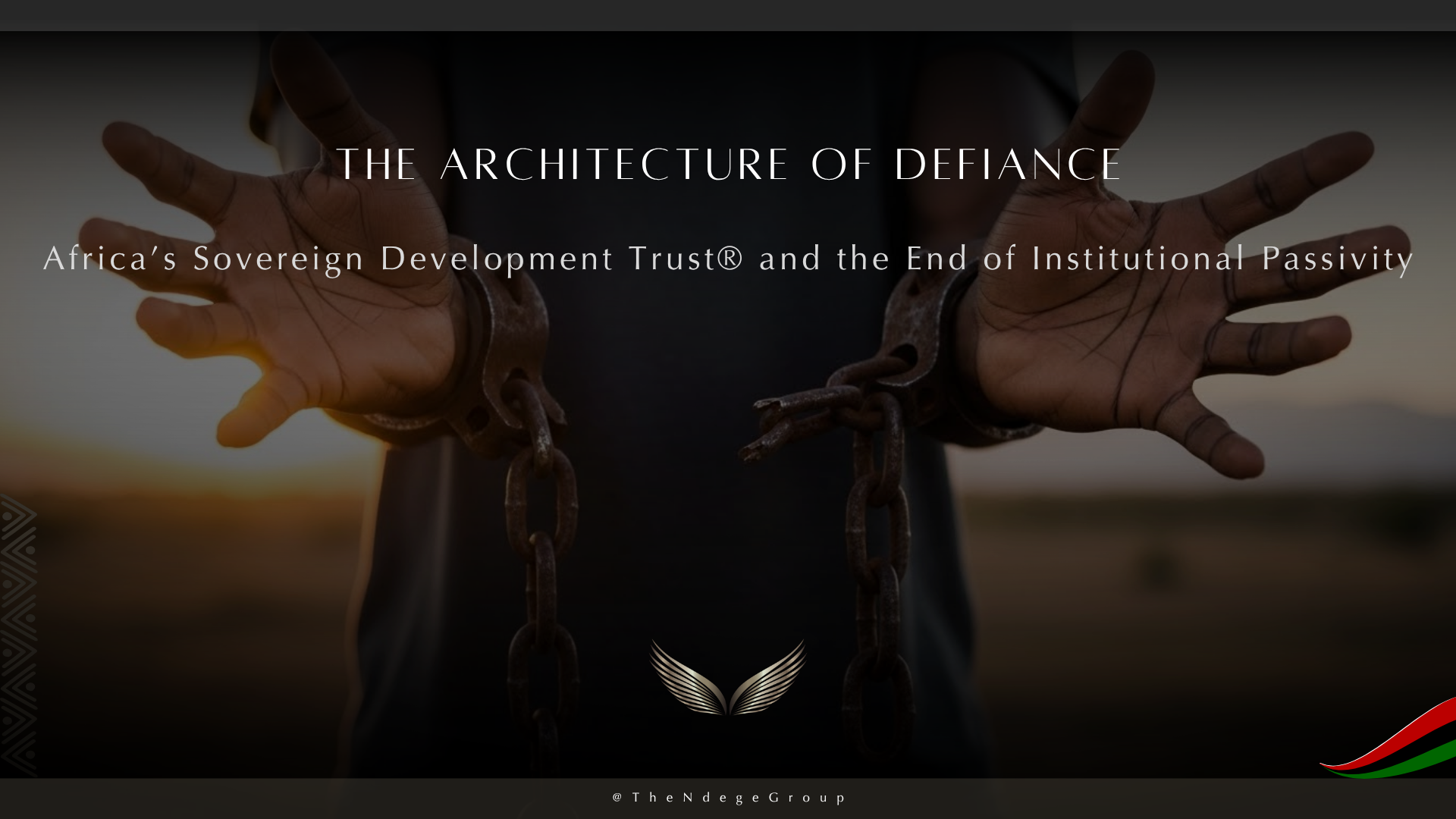
The status quo is not merely dead; it has decomposed. We inhabit a global landscape defined by a profound and dangerous lawlessness — a “Data Dark Age” where judicial interpretations are weaponised to facilitate intellectual property exploitation, and sovereign boundaries are treated as mere suggestions by external actors. From the orchestrated capture of figures like Nicolás Maduro to the opaque machinations of the Bank for International Settlements, the message to the Global South is clear: if you do not architect your own security, you are merely an asset on someone else’s ledger.
The Ndege Group, functioning as Africa’s Sovereign Development Trust® (ASDT), exists to replace the existing global order with a logically flawless, pro-African alternative. We stand alongside the World Bank, the African Union, and the African Development Bank Group. In many ways, we stand beyond them — because we are unbound by the diplomatic paralysis that defines those institutions. We are an instrument of Realist power, engineered through Constructivist identity.
The Tri-Polar Shift and the African Necessity
Geopolitical theory suggests a world fracturing into three dominant blocs: the Americas, Europe-Middle East-Africa, and Asia. Within this multipolarity, Africa risks becoming a mere “buffer zone” unless it asserts a unified, militarised, and technologically superior front.
Realism teaches us that power is the only currency states respect. Africa possesses resources: cobalt for electric vehicle batteries (the DRC produces 70% of global supply), lithium for energy storage, rare earths for semiconductor manufacturing. These resources power the Fourth Industrial Revolution. Yet we extract at derisory prices whilst China monopolises processing, controlling 90% of rare earth refining capacity, and the West monopolises innovation. This represents theft legitimised by institutional complexity.
Liberalism promised that international institutions would regulate this extraction through law and norms. The World Bank’s structural adjustment programmes hollowed out African economies in the 1980s and 1990s, forcing privatisation of utilities that resulted in water cost increases of 400% in Ghana and electricity price surges of 300% in Uganda. The IMF’s austerity measures eviscerated social spending. Zambia’s health budget contracted by 43% under SAP conditionalities. The BIS operates as a shadow sovereign, setting monetary policy that African central banks follow without representation. Liberalism has failed Africa because it was designed to serve other interests.
If you do not architect your own security, you are merely an asset on someone else’s ledger.
Marxism correctly identifies the material exploitation at the heart of this system. African labour remains undervalued. Kenyan tea pickers earn $3 daily whilst UK retail prices yield 2,000% margins. African resources remain underpriced. Nigerian crude sells at $8 to $12 discounts to Brent. Consider the Ethiopian coffee sector: farmers receive $1.50 per kilogramme whilst Starbucks retails the same beans at prices yielding $77 per kilogramme. Under H.E. Paul Kagame’s leadership, blockchain-verified supply chains piloted in Rwanda’s coffee cooperatives demonstrated how eliminating broker intermediaries increased farmer income by 47% whilst reducing consumer prices by 18%. Transaction value that previously leaked to middlemen, estimated at $340 million annually across East African coffee exports, remained within producing communities.
Constructivism reveals that identity shapes interest. Africa has been constructed as developing, aid-dependent, and corrupt. These identities justify continued intervention. The Ndege Group rejects these constructions. We are Africa’s Sovereign Development Trust®: an identity that asserts capability, autonomy, and the right to define our own trajectory. Through The African Charter©, we construct new norms: transparency, community benefit, environmental stewardship, and intergenerational responsibility.
The Tools of Sovereignty: OmniGaza® and the UADF
Our response is the African Federation Treaty Framework© (AFTF). This constitutes a mandate for survival.
Through OmniGaza®, we have resolved the lawlessness at the heart of African financial architecture. By using blockchain as a “Financial Firewall,” we ensure that 99.9% of transaction value remains on the continent. We are moving Africa into the Fourth Industrial Revolution, leveraging our AI-driven trading platform launching in Q3 2026, machine learning risk assessment, quantum-resistant cryptography, and supporting an African, asset-backed digital currency to bypass the legacy gatekeepers of the BIS and the Petrodollar.
The technical architecture employs distributed ledger technology with sovereign nodes controlled by participating African central banks, ensuring that transaction validation, data storage, and protocol governance remain under African authority. Smart contracts automate compliance verification: KYC/AML checks, environmental impact assessments, labour standards certification, all without ceding regulatory sovereignty to external auditors. Cross-border settlement happens in milliseconds at costs 94% below SWIFT transfers, using stablecoin mechanisms backed by African sovereign wealth funds and commodity reserves.
Sovereignty without enforcement capacity is theatre. The UADF exists because soft power without hard power is simply begging with better vocabulary.
Simultaneously, the United African Defence Force© (UADF) is establishing itself as the continent’s definitive security arm. Through secondments from national militaries, sophisticated weaponry procurement including UAV systems, cyber warfare capabilities, and integrated air defence networks, joint training exercises across five military academies, and a robust intelligence division, we are building the capacity to deter external aggression and internal subversion. Africa must possess its own eyes and ears. We are building our own table and arming the room.
The recent fate of Nicolás Maduro illustrates the stakes. The method of his detention reveals a fundamental truth: sovereignty without enforcement capacity is theatre. The Venezuelan military, despite Soviet-era equipment stockpiles, proved incapable of deterring a targeted extraction operation conducted by private military contractors. Africa must learn this lesson or repeat Venezuela’s fate. The UADF exists because soft power without hard power is simply begging with better vocabulary.
The African Rare Earth Mineral Fund© and the Daudi Mutuku Fund for Education©
Our economic defensive posture is anchored by The African Rare Earth Mineral Fund© under The Ndege Group Nominees Limited. We recognise that the global energy transition, requiring 6 million tonnes of lithium, 7 million tonnes of cobalt, and 300,000 tonnes of rare earth elements by 2030, represents a race for African resources. Through this fund, we ensure that value capture happens at the source.
Zimbabwe possesses the world’s second-largest lithium reserves at 23 million tonnes, yet Chinese firms control 80% of extraction operations, processing occurs in Jiangxi Province, and battery manufacturing happens in Shenzhen. The value chain sees raw lithium carbonate exported at $15,000 per tonne, processed into battery-grade material worth $78,000 per tonne, and manufactured into cells retailing at $340,000 per tonne equivalent. Zimbabwe captures 4% of the value chain. This constitutes extraction.
The Fund implements production-sharing agreements requiring 60% in-country processing, technology transfer mandates ensuring African engineers master refining techniques, and OmniGaza® blockchain verification tracking every tonne from mine to market. Pilot programmes in Zambia’s copper belt demonstrate that transparent pricing mechanisms updated hourly based on London Metal Exchange data increase government mining revenues by 34% by eliminating transfer pricing schemes that previously siphoned profits to offshore subsidiaries.
Sovereignty extends beyond weaponry and minerals to intellectual infrastructure. The Daudi Mutuku Fund for Education© responds to the Constructivist war on African identity. We fund:
Pro-African Literature Publishing — Funding 47 authors across 12 languages to produce textbooks, novels, and academic journals that centre African epistemologies. Kenyan children learn their history from Kenyan historians. British revisionism portrays colonialism as “modernisation.” We reject that narrative.
Community Resource Centres — Building 23 hubs across rural and peri-urban areas equipped with vocational training facilities, computer laboratories with satellite internet connectivity, and libraries stocked with technical manuals in indigenous languages.
Physical School Construction — Funding construction of 18 primary schools and 7 secondary schools across Tanzania, Uganda, Mozambique and Malawi, employing local contractors, using locally-sourced materials, and incorporating renewable energy systems. The spreadsheets of our development trust result in the souls of educated African citizens.
Education that serves empire produces graduates who administer their own subjugation. Education that serves Africa produces citizens who build institutions like The Ndege Group®.
Principled Partnerships: The Proof That Collaboration Can Serve Africa
Partnerships must occur on Africa’s terms moving forward.
The United Arab Emirates’ $1 billion investment into Ghana’s technology infrastructure demonstrates that partnership models respecting African sovereignty can yield mutual benefit. The UAE gains access to Ghana’s growing tech talent pool and strategic Atlantic positioning; Ghana obtains infrastructure accelerating its digital economy. Critical difference: Ghana retains data sovereignty, infrastructure ownership reverts to Ghanaian entities after 15 years, and technology transfer clauses mandate skills development for Ghanaian engineers.
Japan’s commitment to East African road networks, constructing 2,400 kilometres of highways across Kenya, Tanzania, and Rwanda under JICA coordination, illustrates that infrastructure investment can avoid replicating colonial extraction. Japanese firms employ 73% local labour, source 61% of materials from African suppliers, and conduct environmental impact assessments meeting ISO 14001 standards. These roads connect Mombasa port to Kampala manufacturing hubs, reducing cargo transit time by 58% and transport costs by 41%, enabling African trade rather than merely extracting resources to Asian markets.
The KOICA health programmes, establishing 34 maternal health clinics across Ethiopia and training 2,890 midwives, demonstrate development assistance that builds capacity. South Korean medical professionals train Ethiopian counterparts who then train subsequent cohorts, creating self-sustaining expertise. Maternal mortality in programme areas decreased by 47% over five years.
Partnerships succeeding are those respecting African sovereignty, transferring technology, building local capacity, and operating under transparent terms negotiated by empowered African institutions.
The pattern is clear: partnerships succeeding are those respecting African sovereignty, transferring technology, building local capacity, and operating under transparent terms negotiated by empowered African institutions. Partnerships failing, World Bank SAPs, IMF austerity programmes, extractive mining concessions, impose external priorities through conditionalities that circumvent democratic accountability.
Africa’s terms means: data sovereignty ensuring information generated on the continent remains under African legal jurisdiction; technology transfer mandating that foreign firms operating in Africa train African engineers in manufacturing processes; revenue transparency requiring publication of all payments to governments; environmental standards matching or exceeding international best practices; local content requirements ensuring African firms participate in value chains; and dispute resolution through African arbitration mechanisms rather than European courts.
The Ndege Group® implements these principles through The African Charter©, which all partners must accept. We seek equity. We welcome Japanese road builders, Emirati transport and data centre operators, Korean health experts, and Norwegian investors, provided they engage as partners rather than proprietors.
A Call to Stakeholders: Engagement as Duty
To African governments: The era of passivity is over. The CIA and its proxies count on your fragmentation. The African Federation Treaty Framework offers you the only path to collective security and economic indomitability. The United African Defence Force© offers a continental defence architecture that makes such divisions strategically obsolete and external manipulation structurally impossible.
To international stakeholders: The Ndege Group is the logically inevitable successor to the failed models of the 20th century. Engage with our programmes: The African Rare Earth Mineral Fund©, the UADF, OmniGaza®, The Daudi Mutuku Fund for Education©, and the implementation of the African Federation Treaty Framework©. Approach these as strategic alignment with the only stable, high-growth architecture on the continent.
When you partner with African governments individually, you navigate 54 different regulatory systems, 42 currencies, and 2,000 ethnic power dynamics. When you partner with The Ndege Group®, you engage with Africa’s Sovereign Development Trust®: a unified counterparty capable of continental-scale coordination. We offer what the African Union promises but cannot deliver: executable governance architecture backed by enforcement and direct management capacity.
The Status Quo is Dead. But Africa is Rising.
Africa’s Sovereign Development Trust® (ASDT®). (2025). African Federation Treaty Framework© (AFTF©) V3.1. Zenodo. DOI: 10.5281/zenodo.17770245.
African Development Bank Group. (2025). Africa Infrastructure Development Index. Abidjan: AfDB.
Brookings Institution. (2024). Chinese and European Lending to Africa: Structural Outcomes and Value Chain Impact. Washington D.C.: Brookings.
International Energy Agency (IEA). (2024). Critical Minerals Outlook 2024. Paris: IEA Publications.
International Monetary Fund (IMF). (2025). Sub-Saharan Africa Regional Economic Outlook. Washington D.C.: IMF.
SIPRI. (2025). Uranium and Rare Earth Extraction in Africa: A Review of Proliferation and Value Chain Risks. Stockholm: Stockholm International Peace Research Institute.
Stockholm International Peace Research Institute. (2025). African Security Architecture and Continental Defence Frameworks. Stockholm: SIPRI.
World Bank. (2025). Africa’s Resource Wealth and the Development Paradox. Washington D.C.: World Bank Group.
World Bank. (2025). Structural Adjustment Programmes: A Retrospective Assessment of Sub-Saharan Africa. Washington D.C.: World Bank Group.
The African Federation Treaty Framework v3.1 is available at doi.org/10.5281/zenodo.17770245, on SSRN and on ResearchGate.